
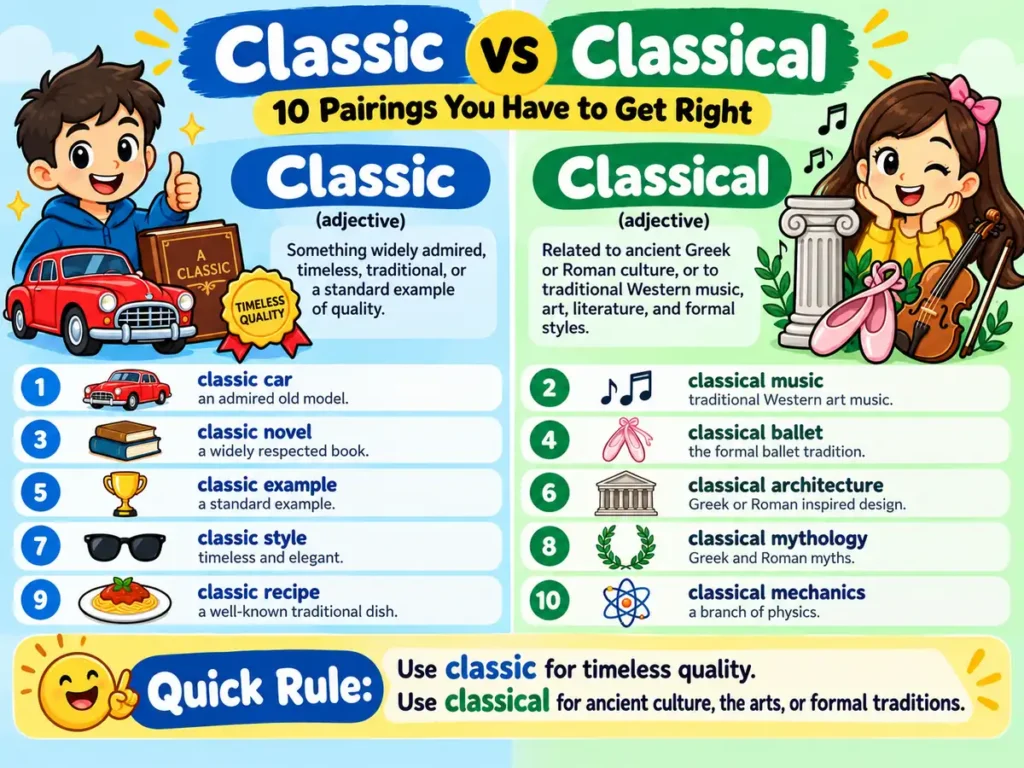
Classic vs Classical: 10 Pairings You Have to Get Right
On classic vs classical, there is no test to apply. Merriam-Webster defines each word as the other at a sense, so the dictionary cannot settle it. What settles it is the noun that follows: classical music, but classic rock.
By Naveed Akhtar, an SEO content writer with 10 years of article-writing experience · Updated 19 September 2026 · About 8 minutes
Classic vs Classical: Why There Is No Rule to Apply
Most guides give you a clean rule. Classic means of lasting quality; the longer form means of ancient Greece and Rome, or of the European art-music tradition.
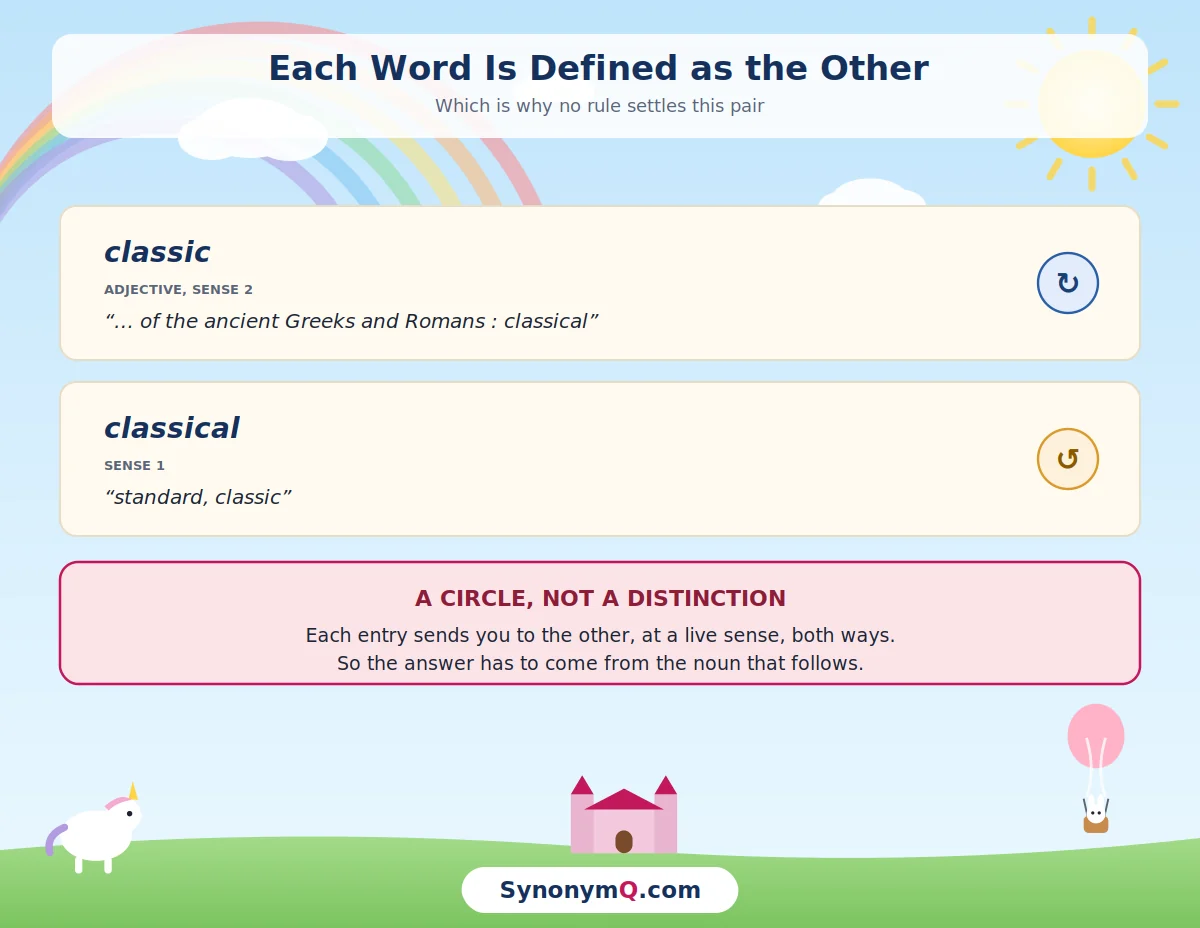
The rule is a fair summary and it is not much use at the moment you need it, because the two dictionary entries cross-reference each other.
classic, adjective sense 2: “of or relating to the ancient Greeks and Romans or their culture : classical“
classical, sense 1: “standard, classic”
Merriam-Webster, both entriesEach word is defined as the other. Not partly, not at an archaic sense: at a live one, in both directions. A dictionary that equates two words cannot then tell you which to pick.
So this page does not give you a test. It gives you the list. For most real sentences the choice is already fixed by the noun, and the honest answer is which pairings are settled and which are genuinely open.That makes this pair different from its neighbours. Systemic and systematic are separated by grammar, and economic and economical by which direction you are swapping. Here, neither works.
The 10 Pairings That Are Already Fixed
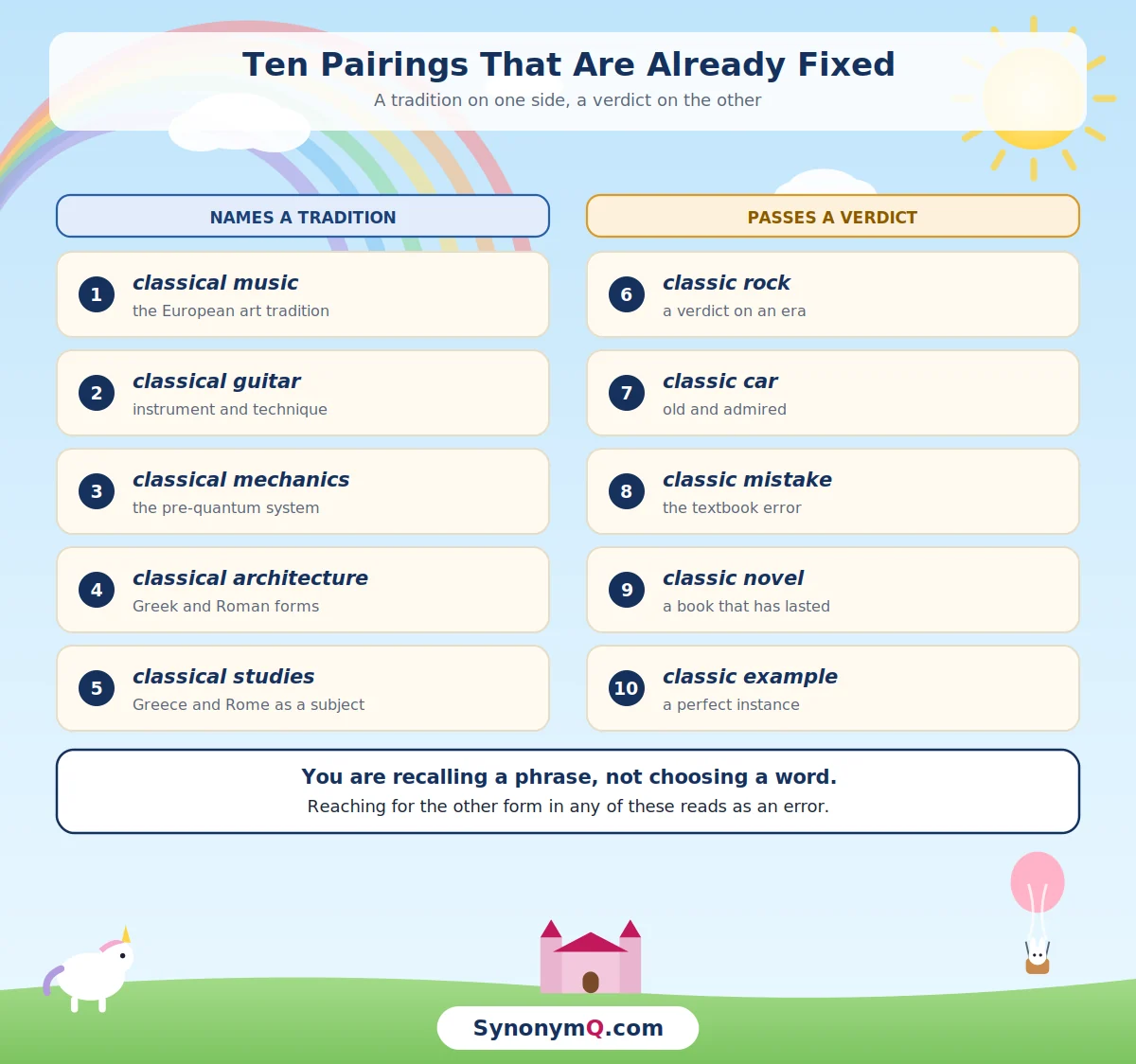
These are settled by usage. Reaching for the other word in any of these slots reads as an error even where the logic would allow it.
| # | The phrase | Why that word |
|---|---|---|
| 1 | classical music | Names the European art tradition. Classic music is not the genre |
| 2 | classic rock | A verdict on an era of recordings, not a tradition |
| 3 | classical guitar | The instrument and its technique, named for the tradition |
| 4 | classic car | Old and admired. Nothing to do with antiquity |
| 5 | classical mechanics | The pre-quantum system. A period in the discipline |
| 6 | classic mistake | The textbook instance of a known error |
| 7 | classical architecture | The Greek and Roman forms, or a revival of them |
| 8 | classic novel | A book that has lasted. Any period |
| 9 | classical studies | The academic subject covering Greece and Rome |
| 10 | classic example | A perfect instance of the thing being described |
That pattern predicts most new cases correctly. It is a description of the list rather than a rule that generated it, which is why the list comes first.
One Word Is Also a Noun. The Other Never Is.
Here is the one hard line through the middle of this pair, and it settles a whole family of sentences.
Classic is also a noun. Merriam-Webster gives it four noun senses: the Greek and Roman literature, an enduring work, a perfect example, and a recurring event such as a sporting fixture.
The longer form is never a noun. Merriam-Webster lists it as an adjective only.
Not available — there is no such nounShe is studying the classicals at university. The noun form, and the usual phrasingShe is studying the classics at university.So “a classic” and “the classics” are both fine, and there is no matching form on the other side. If your sentence needs a thing rather than a description, only one word is available.
What “Classical” Does in Physics, Politics and Universities
Several fields use the longer form as a technical label, and it is the same period-or-tradition sense doing ordinary work in each.
| Field | The term | What the word is marking |
|---|---|---|
| Physics | classical mechanics, and physics with the same modifier | The framework that came before relativity and quantum theory |
| Political theory | classical liberalism, and republicanism likewise | The earlier, foundational form of a tradition |
| Universities | classical studies, or civilisation with the same modifier | Greece and Rome as a subject |
| Economics | the same modifier on economics | The Smith and Ricardo period, before the marginalists |
None of these is a word-choice question. They are fixed names, and the shorter form never substitutes into any of them.
Where those fields use the shorter form, it is doing the verdict job as usual: a classic paper in physics is one everybody still cites.
When You Genuinely Have a Choice
A smaller set of sentences is open, and the two words say different things in them.
| Sentence | What it claims |
|---|---|
| “a classic education” | An excellent one, or the standard sort |
| “a classical education” | One built on Greek, Latin and the ancient authors |
| “classic design” | Design that has lasted and still looks right |
| “classical design” | Design drawing on Greek and Roman forms |
These are the sentences worth slowing down for. The reader cannot recover your meaning from context, because both readings make sense.
If both readings are live, name the thing instead. “An education built on Latin and Greek” cannot be misread, and it is shorter than the sentence you would write defending your adjective afterwards.Getting It Right Without a Rule
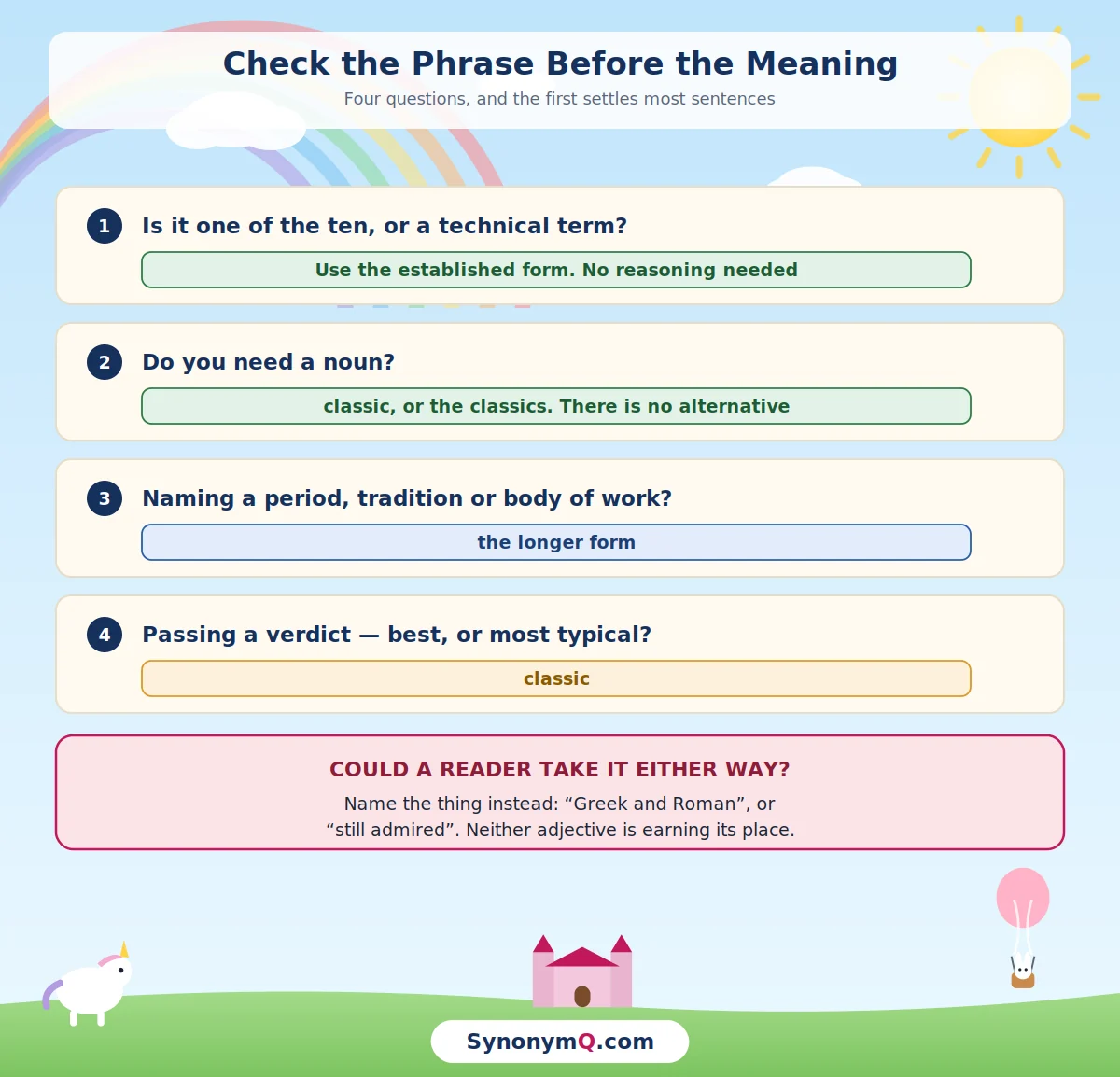
Four questions, in this order.
| Ask | If yes | Label |
|---|---|---|
| Is the phrase one of the ten above, or a technical term? | Use the established form. No reasoning required | Direct Swap |
| Do you need a noun? | Classic, or the classics. There is no other option | Direct Swap |
| Are you naming a period, tradition or body of work? | The longer form | Direct Swap |
| Are you passing a verdict — best of its kind, or most typical? | Classic | Swap With Adjustment |
| Could a reader take it either way? | Name the thing. “Greek and Roman”, or “still admired” | Requires Rewrite |
Question one settles most sentences, which is the honest shape of this pair. You are recalling a phrase far more often than you are choosing a word.
Pairs settled by convention rather than by logic turn up across the language, and the commonly confused words index groups the ones worked through here.
Frequently Asked Questions
Why is it classical music and not classic music?
Because the phrase names a tradition rather than passing a verdict. Classic music is not wrong as English; it just is not the name of the genre. Anyone who says it will be understood and heard as an outsider to the subject.
Is it classic literature or classical literature?
Both, and they differ. The longer form means Greek and Roman writing. Classic literature means books that have lasted, of any period. A classic novel can be from 1925.
Is it classic guitar or classical guitar?
The longer form names the instrument, the repertoire and the technique. Classic guitar would be a verdict on a particular instrument, which is occasionally what people mean about a vintage model.
Can the two words ever be swapped?
In the open cases in the table above, yes, and the sentence then claims something different. In the ten fixed pairings and the technical terms, no. Swapping there reads as an error.
What does “the classics” mean?
Usually Greek and Roman literature, or the university subject that studies it. It can also mean the enduring works of any tradition. There is no matching noun form of the longer word.
How This Page Was Checked
Read from the sources attributed, on 19 September 2026:
- The adjective senses of classic including the sense-2 cross-reference, and all four noun senses — Merriam-Webster.
- The senses of the longer form including the sense-1 cross-reference back, and that it is listed as an adjective only — Merriam-Webster.
- The incumbent treatment of the pair, for what it covers and what it leaves out — Grammarly.
What could not be checked. Cambridge’s grammar page on this pair returned a 403 on the day of writing, so the British side is unverified here and nothing above rests on it.
What is reasoning rather than a retrieved fact. The ten pairings are observed usage rather than a dictionary list, and the tradition-versus-verdict pattern is this page’s description of them, not a rule any authority publishes. The senses and noun forms are retrieved.
Written by Naveed Akhtar, an SEO content writer with 10 years of article-writing experience.
Related: continual versus continuous is another pair where the usual rule turns out to be softer than the guides suggest.

Naveed Akhtar writes every guide on SynonymQ. He is an SEO content writer with ten years of article-writing experience, working on the question a thesaurus never answers: which of these words belongs in this sentence, for this reader. Every page cites the dictionary entries it draws on and the date they were read.