
Continual vs Continuous: Which One Your Document Requires
On continual vs continuous, what you are writing decides. In ordinary prose both are defensible, and Merriam-Webster’s first sense of continual is the unbroken one. In an ISO document the choice is fixed: the standards say continual improvement, Lean says continuous.
By Naveed Akhtar, an SEO content writer with 10 years of article-writing experience · Updated 18 September 2026 · About 8 minutes
Continual vs Continuous: The Rule Binds in Only One Place
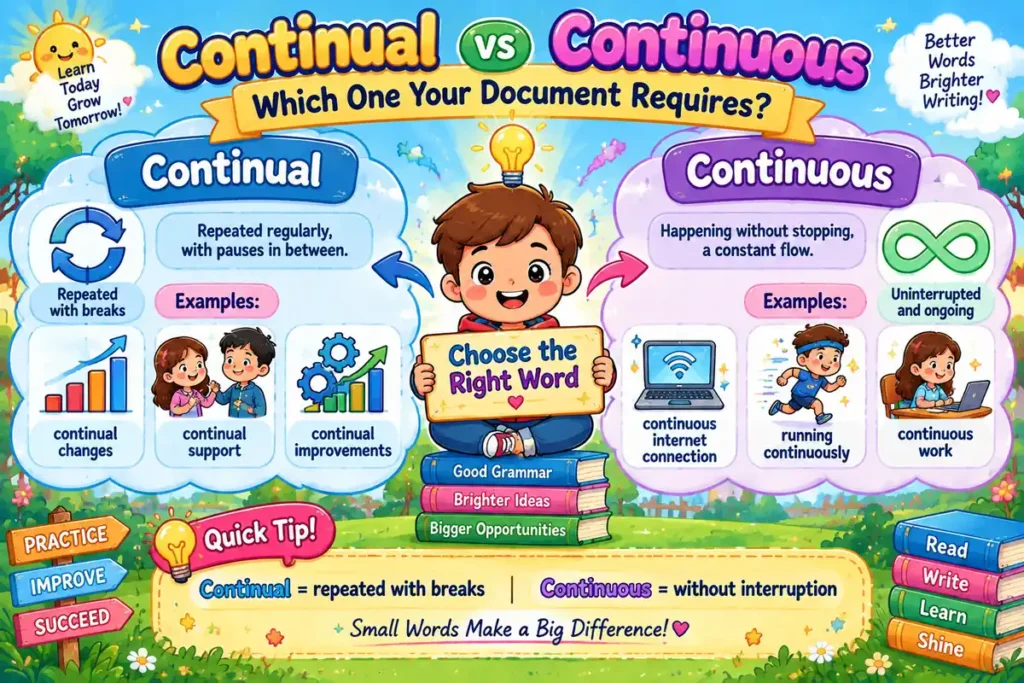
Every guide teaches the same rule. Continual means repeated with gaps between; continuous means unbroken. Rain that stops and starts is continual, and a continuous line has no break in it.
The rule is useful and worth knowing. What almost no page tells you is how much weight it actually carries, and the honest answer is that it depends entirely on what you are writing.
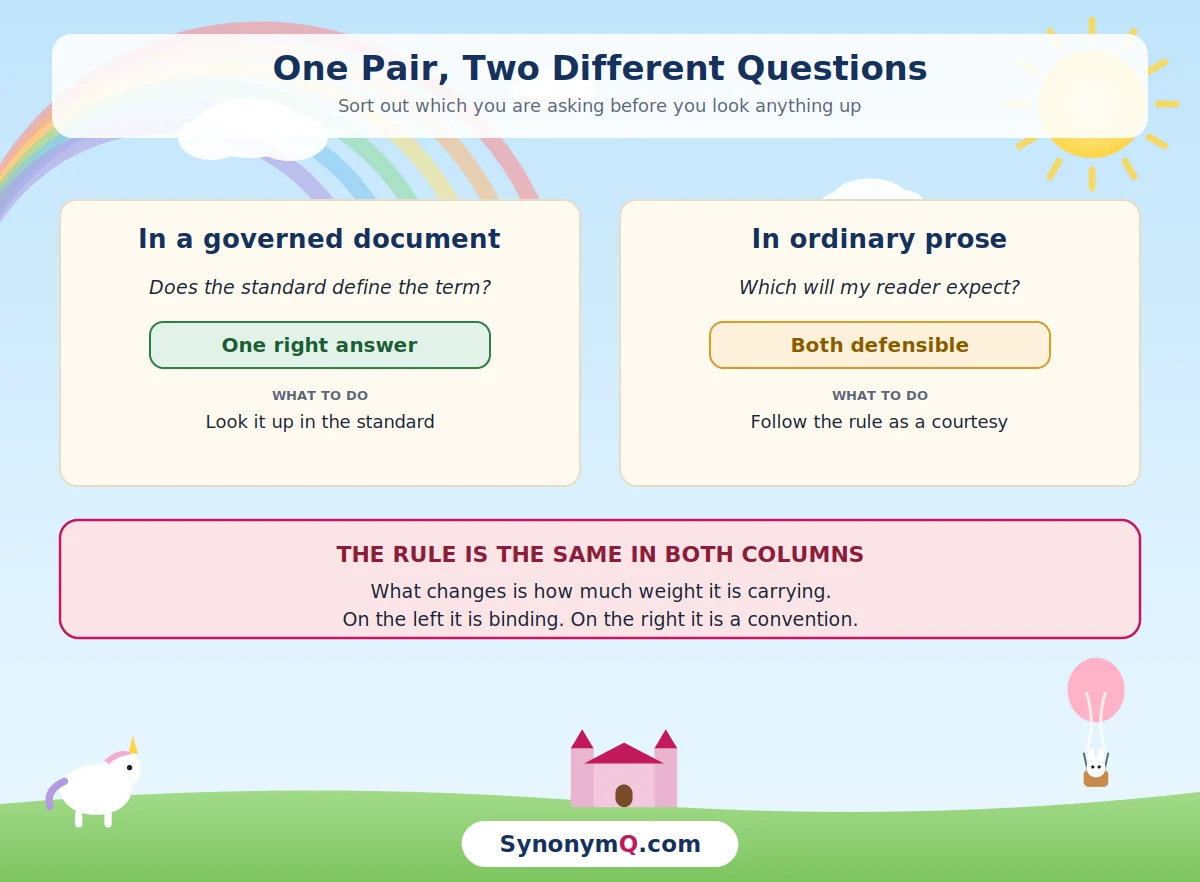
Two questions wear the same costume. “Which word is correct here?” has one answer in a quality manual governed by a standard, and a much softer answer in an email, a report or an essay. Sort out which one you are asking before you look anything up.In a governed document the word is a defined term and you follow the standard. In ordinary prose the dictionaries permit both, the usage authorities disagree, and the real question becomes what your reader will assume.
This page takes the governed case first, because it is the one with a definite answer.
What ISO Decided, and Why It Was Not a Dictionary Decision
If you are writing a quality manual, an audit report or a management-system procedure, this is the section you came for.
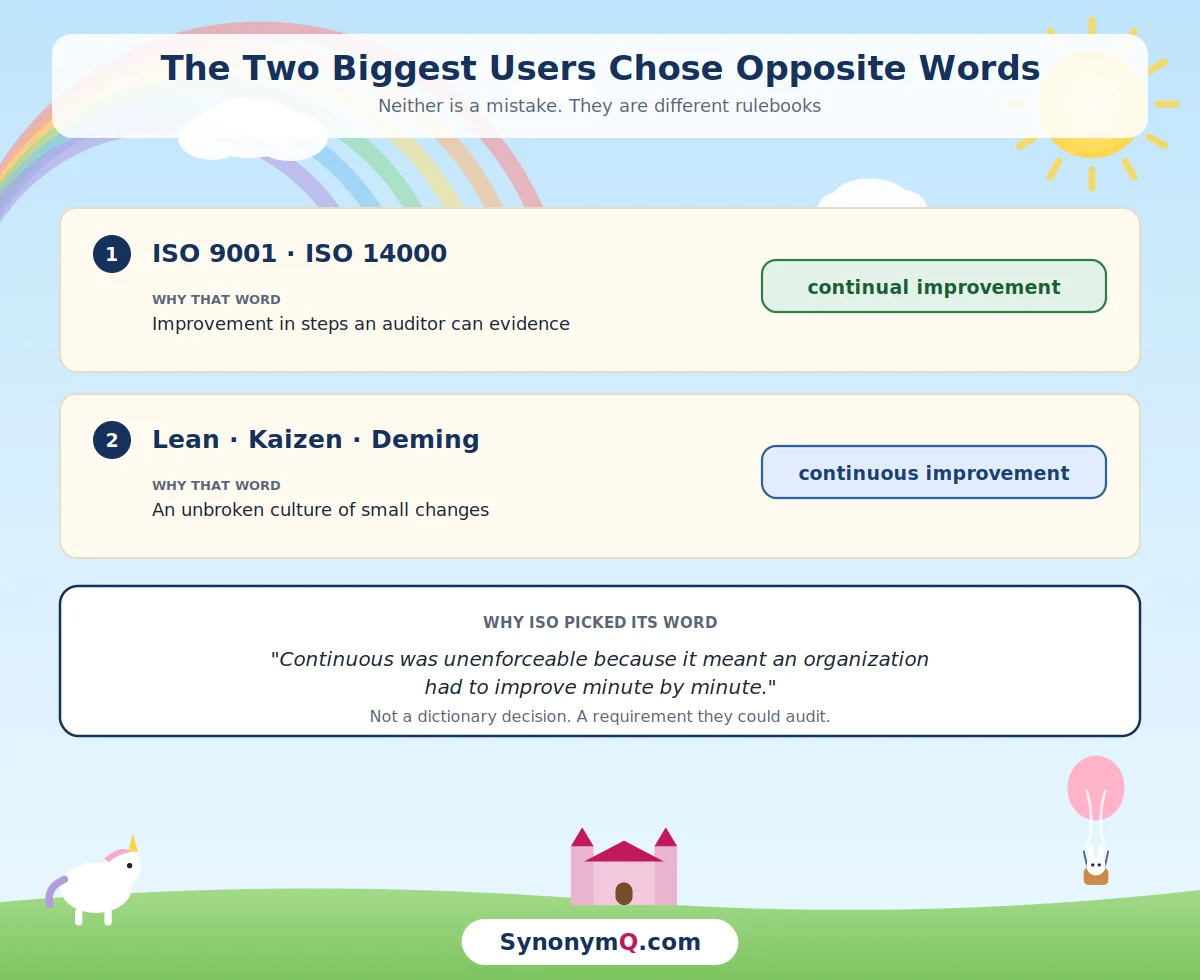
ISO standards say continual improvement. Not continuous. ISO 9001 uses it, and ISO 14000 uses it for environmental management systems.
The interesting part is the reasoning. When ISO 9001:2000 was being drafted, the committee debated the two words and picked continual on grounds that had nothing to do with the dictionary.
“Continuous was unenforceable because it meant an organization had to improve minute by minute, whereas continual improvement meant step-wise improvement.”
On the ISO 9001:2000 drafting decision. The same account notes the committee “reportedly did not base the change on dictionary definitions or the standard’s vocabulary.”Read that again, because it matters more than it first appears. The committee was not resolving a usage question. It was writing a requirement it could audit.
“Improve continuously” would oblige an organisation to be improving at every instant, which no auditor could ever confirm or deny. “Improve continually” asks for improvement in steps, and a step is a thing you can evidence.
So the word is doing a legal job, not a descriptive one. If your document sits under ISO 9001 or ISO 14000, write continual improvement because the standard says so, not because the recurring-versus-unbroken rule told you to. The two happen to agree here, which is a coincidence worth not relying on.Choosing a term by what it commits you to, rather than by what it describes, is the same discipline that separates best practice from its alternatives.
Lean and Deming Went the Other Way
Here is where people get caught. The other great improvement tradition uses the opposite word, and it is just as settled.
| Where you are writing | The established term | Why that one |
|---|---|---|
| ISO 9001, ISO 14000 and audit documentation | continual improvement | Improvement in auditable steps, chosen so the requirement could be enforced |
| Lean, Kaizen and the Deming tradition | continuous improvement | An unbroken culture of small changes, not a series of discrete projects |
| General business writing | Either, consistently | No governing body. Pick one and do not alternate inside a document |
Both are correct in their own house. Neither is a mistake, and someone who “corrects” you across the boundary is applying the wrong rulebook.
The practical test. Ask who will audit or assess the document. If the answer names a standard, use that standard’s term. If nobody will, pick the term your readers already use and stay consistent.This is also why searching for “which is better” returns arguments rather than an answer. The two words belong to two different systems, so the comparison has no neutral ground to stand on.
Where Merriam-Webster Puts “Uninterrupted”
Now the ungoverned case, and one fact that reframes it.
The popular rule assigns the unbroken sense to continuous. Merriam-Webster’s entry for continual does not agree.
| Sense | Definition | What the rule says this sense belongs to |
|---|---|---|
| 1 | “continuing indefinitely in time without interruption” | continuous |
| 2 | “recurring in steady usually rapid succession” | continual |
The dictionary’s first sense of continual is the one the rule hands to the other word. That is not an oversight, and the entry explains itself.
Merriam-Webster notes that continual is the older word, that it carried both meanings for centuries before continuous existed, and that it “continues to be used — as it has been since the 14th century, to mean continuing without interruption.”
What this does and does not mean. It does not make the rule wrong. Continual does more often mean recurring, and writing to the rule will not get you into trouble. It means the rule is a convention about typical use, not a boundary the definitions enforce.A dictionary that partly equates two words is the same situation that makes systemic and systematic hard to separate on meaning alone.
The Rule Has a Birthday
The distinction is not ancient. It was proposed, by a named person, in a datable book.
Elizabeth Jane Whately set it out in 1851. Before that, both words descend from the same Latin root, continuus, and had been overlapping for centuries.
The usage authorities have never fully closed ranks behind it since. Merriam-Webster’s Dictionary of English Usage records that continual is “the more likely of the two to mean ‘recurring,'” while noting it also keeps the uninterrupted sense.
Burchfield’s Fowler’s endorses the distinction and then concedes that good writers use the adverbs more or less interchangeably. Endorsing a rule while admitting it is not observed is a fair summary of where the pair sits.
Why the date is useful. A 175-year-old style preference is worth honouring in careful writing and not worth arguing about. It tells you to follow the rule without treating a departure from it as an error.Which Word Your Document Is Governed By
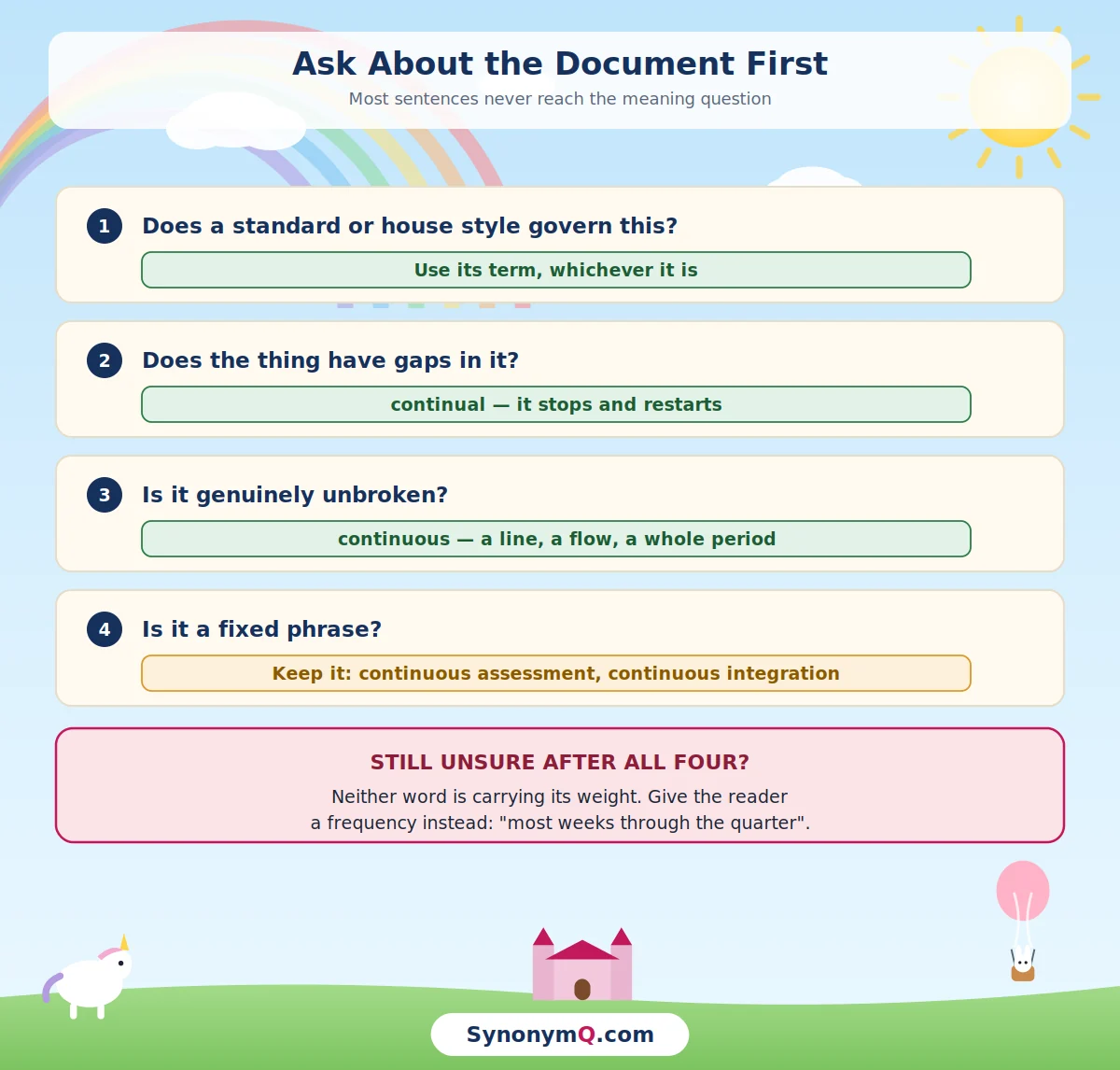
Three questions, in this order. The first settles more real sentences than the rule does.
| Ask | If yes | Label |
|---|---|---|
| Does a standard or house style govern this document? | Use its term. ISO says continual improvement; a Lean programme says continuous | Direct Swap |
| Are you describing something with gaps in it? | Continual. Interruptions, complaints, delays: things that stop and restart | Direct Swap |
| Are you describing something genuinely unbroken? | Continuous. A line, a surface, a flow, a period with no break | Direct Swap |
| Is it a fixed phrase? | Keep the phrase. Continuous assessment, continuous integration, continuous tense | Swap With Adjustment |
| None of these, and you are still unsure? | Neither word is carrying its weight. Say how often it happens instead | Requires Rewrite |
That last row is the honest one. When you cannot tell which you mean, the reader will not be able to either, and a frequency is clearer than either adjective.
Vague — the adjective is doing no workWe received continual complaints about the checkout. Specific — the reader learns somethingWe received complaints about the checkout most weeks through the quarter.Replacing an imprecise word with a countable fact is usually a bigger improvement than choosing correctly between two near neighbours.
When Nothing Governs, Write for the Reader
In ordinary prose you have permission from the dictionaries to use either. That is not the same as the choice being free, because your reader may well believe the rule.
Plenty of careful readers were taught the recurring-versus-unbroken split and will read continual rain as rain with breaks in it. Writing against their expectation costs you a moment of friction for no gain.
The workable position. Follow the rule in your own writing, because it is free to follow and some readers expect it. Do not correct other people’s prose by it, and do not assume a writer who departs from it has made an error.Where the two are genuinely interchangeable, consistency matters more than the choice. Alternating between them in one document reads as carelessness even when both instances are defensible.
Judging a word by what the reader will infer rather than by what the dictionary permits is the same judgement call behind actually versus really.
Frequently Asked Questions
Is it continual improvement or continuous improvement?
Both, depending on the framework. ISO 9001 and ISO 14000 say continual improvement. Lean, Kaizen and the Deming tradition say continuous improvement. Use whichever governs your document, and do not mix them.
Does the difference between continual and continuous actually matter?
In a governed document, yes: it is a defined term. In ordinary prose it matters less than most guides suggest, because Merriam-Webster’s first sense of continual is the uninterrupted one. Following the rule is still the safer habit.
What is the difference between continual, continuous and constant?
Constant is the loosest of the three and the most often used for emphasis rather than precision. It can mean unbroken or merely frequent, so it settles nothing that the other two leave open.
Is “continous” a word?
No. It is a common misspelling of continuous, missing the second u. The word has two: con-tin-u-ous.
Continually or continuously: is it the same rule?
The adverbs follow the adjectives, in theory. In practice Burchfield’s Fowler’s notes that good writers use them more or less interchangeably, so the adverb pair is the softest part of this distinction.
How This Page Was Checked
Read from the sources attributed, on 18 September 2026:
- Both numbered senses of continual in the dictionary’s own order, and the usage note on the 14th-century uninterrupted sense — Merriam-Webster.
- The ISO 9001:2000 drafting decision, the quoted reasoning, and the ISO 14000 usage — Wikipedia, Continual improvement process. This is the weakest source on the page and is flagged as such; the claim is reported, not endorsed.
- Whately 1851, the shared Latin root, and the quotations from Merriam-Webster’s Dictionary of English Usage and Burchfield’s Fowler’s — Stan Carey, Sentence first.
What could not be checked. Collins’ English Usage entry on constant, continual and continuous returned a 403 on the day of writing, so the three-way answer in the FAQ rests on the other sources rather than on Collins.
What is reasoning rather than a retrieved fact. The ISO decision and the dictionary senses are retrieved. Treating them as answers to two separate questions is this page’s own framing, and it is the page’s main argument.
Written by Naveed Akhtar, an SEO content writer with 10 years of article-writing experience.
Related: the full commonly confused words index groups this pair with others that share a root, and impressive versus impressed is the same kind of one-root problem settled by grammar.

Naveed Akhtar writes every guide on SynonymQ. He is an SEO content writer with ten years of article-writing experience, working on the question a thesaurus never answers: which of these words belongs in this sentence, for this reader. Every page cites the dictionary entries it draws on and the date they were read.