
Economic vs Economical: The Swap Works One Way Only
On economic vs economical, the swap works one way only. Merriam-Webster lists economical as sense 2 of economic, so economic can mean thrifty. Economical has no current sense meaning “relating to the economy”, so the reverse is not available.
By Naveed Akhtar, an SEO content writer with 10 years of article-writing experience · Updated 19 September 2026 · About 8 minutes
Economic vs Economical: The Swap Works One Way Only
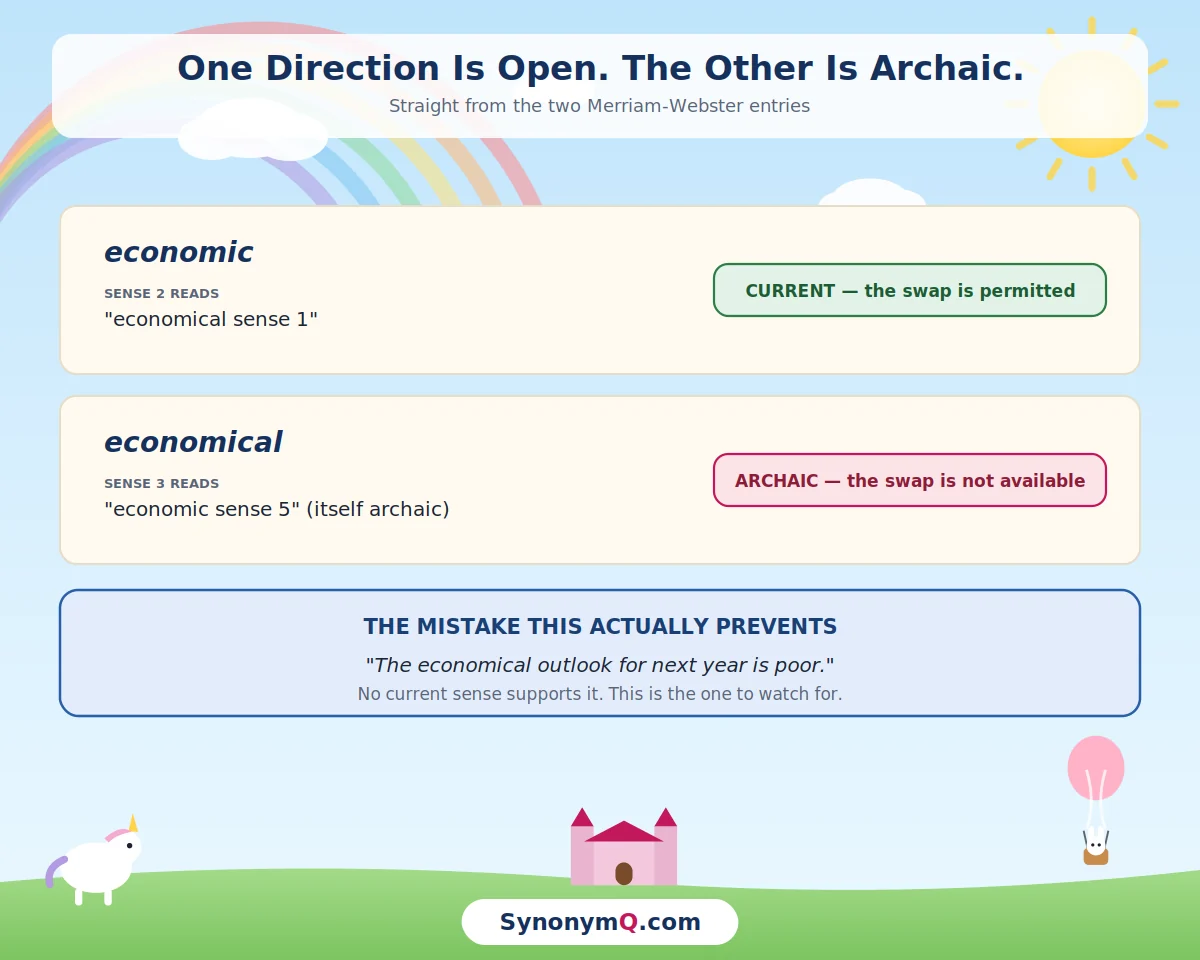
Every guide gives you the same clean split. Economic is about the economy; economical means thrifty. An economic policy, an economical car.
The split is a good working rule and most sentences never trouble it. It also describes the words as a matched pair, two equal options, and that is the part that is not quite true.
The words are not symmetrical. One of them can legally do the other’s job. The other one cannot. Knowing which direction is open is more useful than knowing the rule, because it tells you where a swap is safe.Everything below comes from two dictionary entries that take about a minute to check yourself, and one of them says something its own publisher’s usage article does not.
Merriam-Webster Lists One Word as a Sense of the Other
Here is the entry for economic, in the order the dictionary gives it.
| # | Sense | Note |
|---|---|---|
| 1 | “of, relating to, or based on the production, distribution, and consumption of goods and services” | The sense everyone teaches |
| 2 | “economical sense 1” | Current, not archaic |
| 3 | “having practical or industrial significance or uses” | |
| 4 | “profitable” | See below |
| 5 | “of or relating to a household or its management” | Archaic |
Read sense 2 again. The dictionary does not paraphrase economical there; it points at it. An economic car is not an error by Merriam-Webster’s own entry.
Worth knowing where that leaves the guides. Merriam-Webster also publishes a usage article on this pair, and it ranks near the top for the question. It teaches the clean split and does not mention sense 2 of its own dictionary entry.That is not a scandal. A usage article is meant to give you a usable rule, and “the dictionary permits the overlap but almost nobody uses it that way” is a worse rule than the clean split.
It does mean the clean split is editorial advice rather than a fact about the words, which is the same situation behind systemic and systematic.
The Direction That Is Blocked
Now the other entry, which is where the asymmetry shows up.
| # | Sense | Note |
|---|---|---|
| 1 | “marked by careful, efficient, and prudent use of resources : thrifty” | |
| 2 | “operating with little waste or at a saving” | |
| 3 | “economic sense 5” | Archaic, and sense 5 is the archaic household one |
There is no current sense of economical meaning “relating to the economy.” The only cross-reference back to economic is archaic, and it points at the archaic household sense rather than the modern one.
So the two entries do not mirror each other. Economic reaches into economical‘s territory at a live sense. Economical reaches back only through a dead one.
Blocked — no current sense supports thisThe economical outlook for next year is poor. Permitted by the dictionary, though unusualA more economic use of the budget.The first sentence is the mistake people actually make, and it is the one the rule is really protecting you from. The second is the one the rule over-corrects.
“Economic” Also Means Profitable
Sense 4 is the one that catches people in business and engineering writing, and it is not the thrifty sense.
Economic on its own can mean profitable, or worth doing at the price. “It is not economic to repair it” says the repair costs more than it returns.
Why this matters for the choice. Someone reading “not economic to repair” might think you meant economical and mistyped. You did not. That is sense 4, and it is the standard phrasing in costing and engineering writing.The two readings are close enough to be worth separating. Economical describes something that uses little. Economic in this sense describes something that returns more than it costs.
A repair can be economical and still not economic: cheap to do, and still not worth doing on an asset about to be scrapped.
Where Economy and Economics Fit
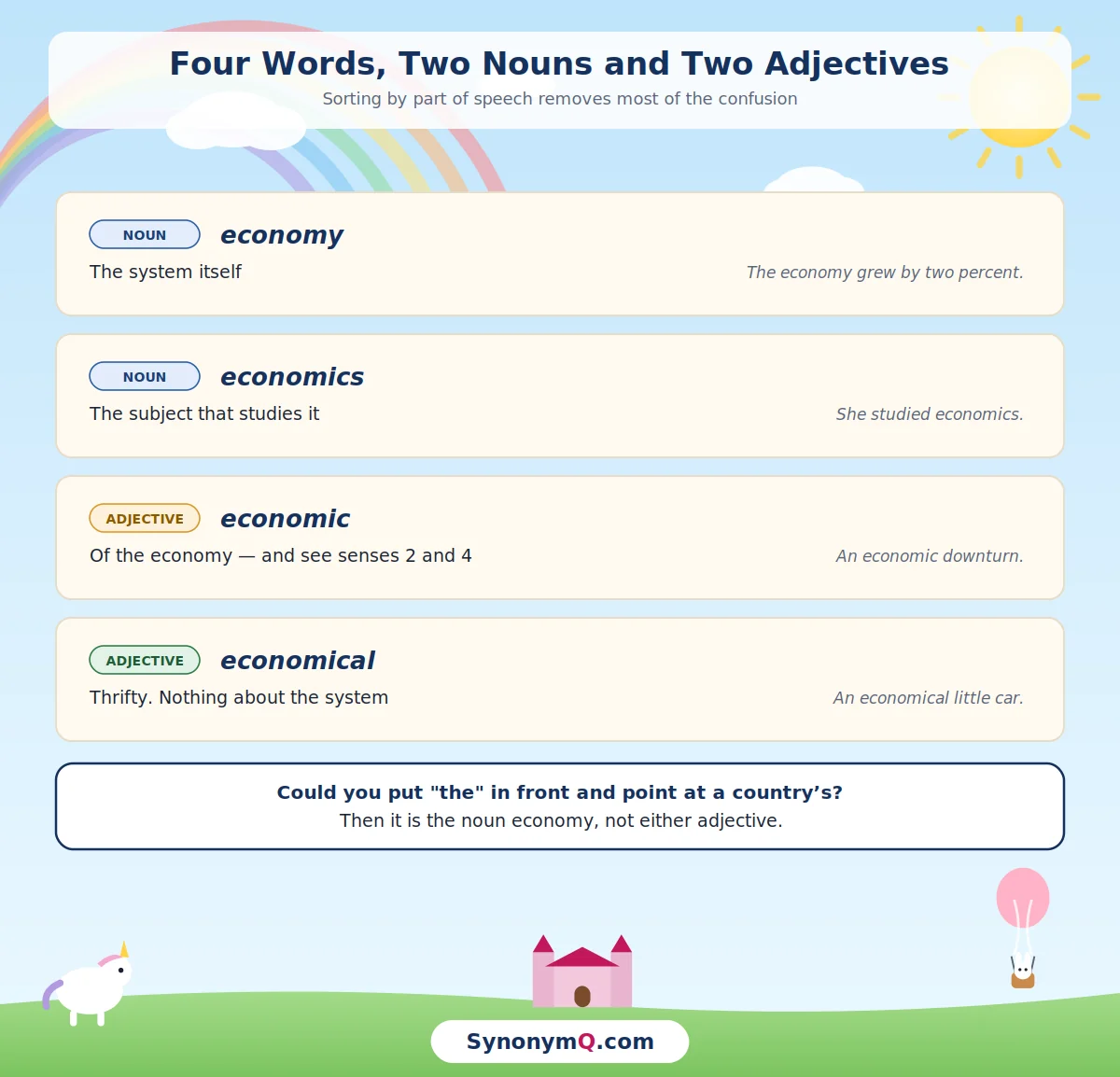
Most of the confusion in this family disappears once the four words are laid out by what kind of word each one is.
| Word | Part of speech | What it names | Test sentence |
|---|---|---|---|
| economy | Noun | The system itself, or thrift | “The economy grew by two percent.” |
| economics | Noun | The subject that studies it | “She studied economics.” |
| economic | Adjective | Relating to either of those, and see senses 2 and 4 | “An economic downturn.” |
| economical | Adjective | Thrifty. Nothing about the system | “An economical little car.” |
The quick test for the nouns. If you could put “the” in front and point at a country’s, you want economy. If it is a thing you could take a degree in, you want economics.
Socio-economic belongs with economic, not with this pair. It is a fixed compound and socio-economical is not a word.
Which One Your Sentence Needs
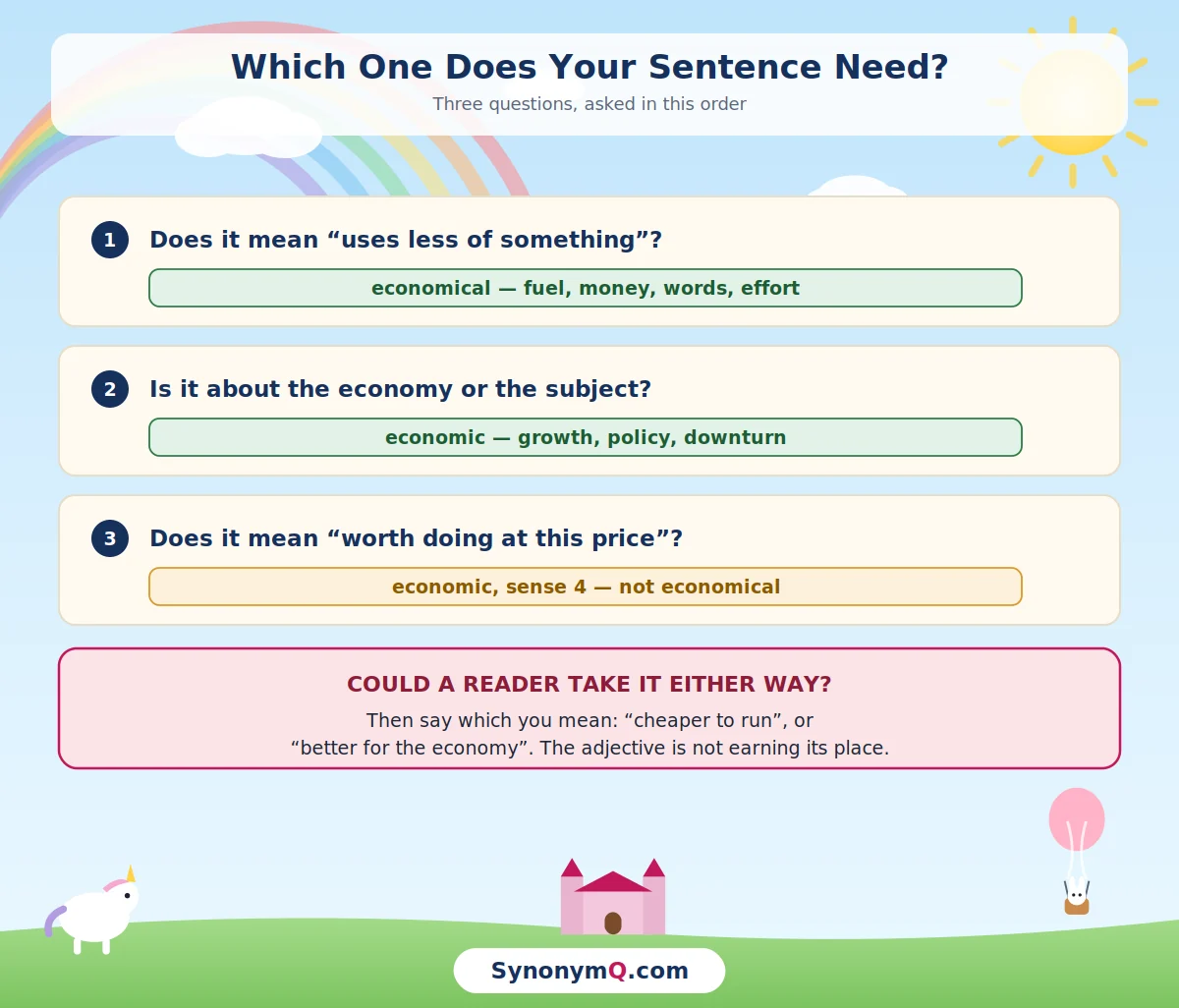
Three questions, asked in order.
| Ask | If yes | Label |
|---|---|---|
| Does the sentence mean “uses less of something”? | Economical. Fuel, money, words, effort | Direct Swap |
| Is it about the economy, or the subject of economics? | Economic. Growth, policy, downturn, sanctions | Direct Swap |
| Does it mean “worth doing at this price”? | Economic, sense 4. Not economical | Swap With Adjustment |
| Is it a fixed phrase? | Keep it. Economic growth, socio-economic, economies of scale | Swap With Adjustment |
| Could a reader take it either way? | Say which. “Cheaper to run” or “better for the economy” | Requires Rewrite |
A few worked sentences, since this pair is a standard exercise in English classes and the exercises rarely explain themselves.
| Sentence | Which, and why |
|---|---|
| “An ___ crisis has hit the region.” | Economic. The crisis is in the economy, not in anyone’s spending habits |
| “This hatchback is very ___ on fuel.” | Economical. It uses less |
| “Solar became ___ at that scale around 2015.” | Economic, sense 4. It began to return more than it cost |
| “She was ___ with her praise.” | Economical. Sparing, and the idiom takes this form |
| “The government published its ___ forecast.” | Economic. A forecast about the economy |
Why Readers Will Still Correct You
Sense 2 gives you permission that most readers will not honour. Write “an economic car” and a fair number of people will read it as a slip, whatever the dictionary says.
That is worth taking seriously rather than arguing with. The purpose of choosing a word is being understood, and a technically defensible choice that stops the reader has cost you something.
The workable position. Follow the clean split in your own writing. Use sense 2 only where the dictionary is your defence, and do not correct other people’s prose by a rule that their dictionary does not enforce.Being permitted by the dictionary and being read as correct are two different things, which is the same gap examined at “most favorite”.
Sense 4 is the exception worth defending. “Not economic to repair” is standard in costing writing and should not be edited to economical, because that changes what the sentence claims.
Frequently Asked Questions
Can economic mean economical?
By the dictionary, yes. Merriam-Webster gives “economical sense 1” as sense 2 of economic, and it is not marked archaic. In practice most readers will expect economical, so use the overlap knowingly rather than by accident.
Can economical mean economic?
No, not in current English. Economical‘s only cross-reference to economic is an archaic sense pointing at an archaic meaning. “The economical outlook” is the error this pair actually produces.
What is the difference between economy and economics?
Economy is the system: a country has one. Economics is the subject that studies it: you can take a degree in it. Both are nouns, which is what separates them from the two adjectives.
Is it economic crisis or economical crisis?
Economic crisis. The crisis is in the economy. Economical crisis would have to mean a thrifty crisis, which is not a thing anyone means.
Does economical mean cheap?
Close, but it describes efficient use rather than a low price. A durable tool can be economical and expensive; a cheap one that fails twice is not economical at all.
How This Page Was Checked
Read from the sources attributed, on 19 September 2026:
- All five senses of economic in the dictionary’s own order, including sense 2 and sense 4 — Merriam-Webster.
- All three senses of economical, and the absence of a current sense relating to the economy — Merriam-Webster.
- That the same publisher’s usage article teaches the clean split without mentioning sense 2 — Merriam-Webster, “Economic or Economical?”.
Why all three sources are the same publisher. That is the argument, not an oversight. The point only holds if the dictionary entry and the usage article come from the same house, so both are cited and both can be checked in a minute.
What could not be checked. Cambridge’s grammar page on this pair returned a 403 on the day of writing, so the British side is unverified here and nothing on this page rests on it.
What is reasoning rather than a retrieved fact. That the asymmetry is the useful thing to know is this page’s own framing. The senses and their ordering are retrieved.
Written by Naveed Akhtar, an SEO content writer with 10 years of article-writing experience.
Related: continual versus continuous is another pair where the rule is softer than the guides suggest, and the commonly confused words index groups both with the others that share a root.

Naveed Akhtar writes every guide on SynonymQ. He is an SEO content writer with ten years of article-writing experience, working on the question a thesaurus never answers: which of these words belongs in this sentence, for this reader. Every page cites the dictionary entries it draws on and the date they were read.