
“Most Favorite” Is Not Wrong: 3 Things the Dictionary Says
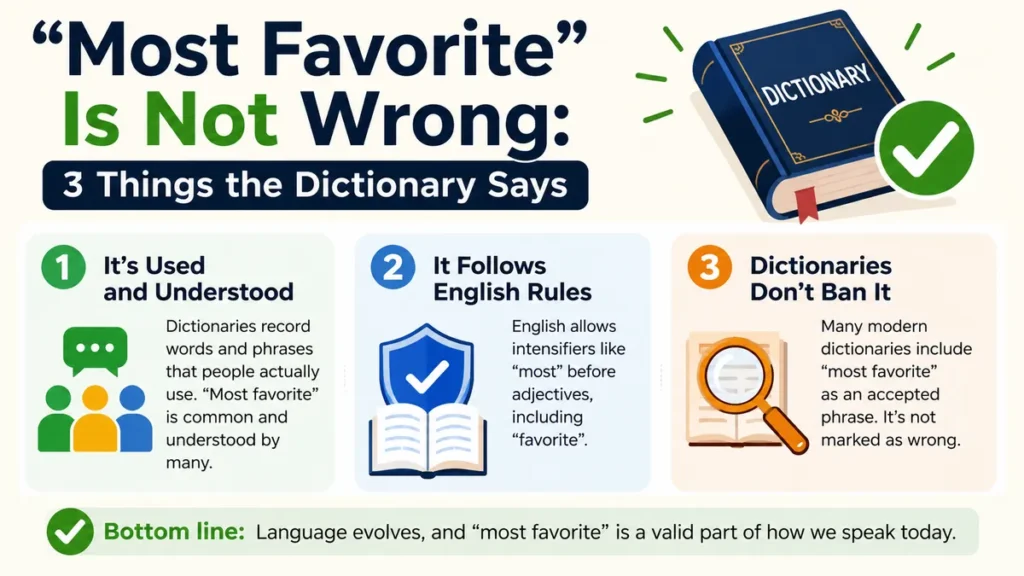
Is “most favorite” correct? Nobody has been able to point at a dictionary rule against it, because there is not one. Oxford Learner’s and Merriam-Webster both carry full entries for favorite and neither prints a usage note forbidding more or most favorite. The phrase is informal and often redundant. It is not ungrammatical, except in the noun senses, where it fails completely.
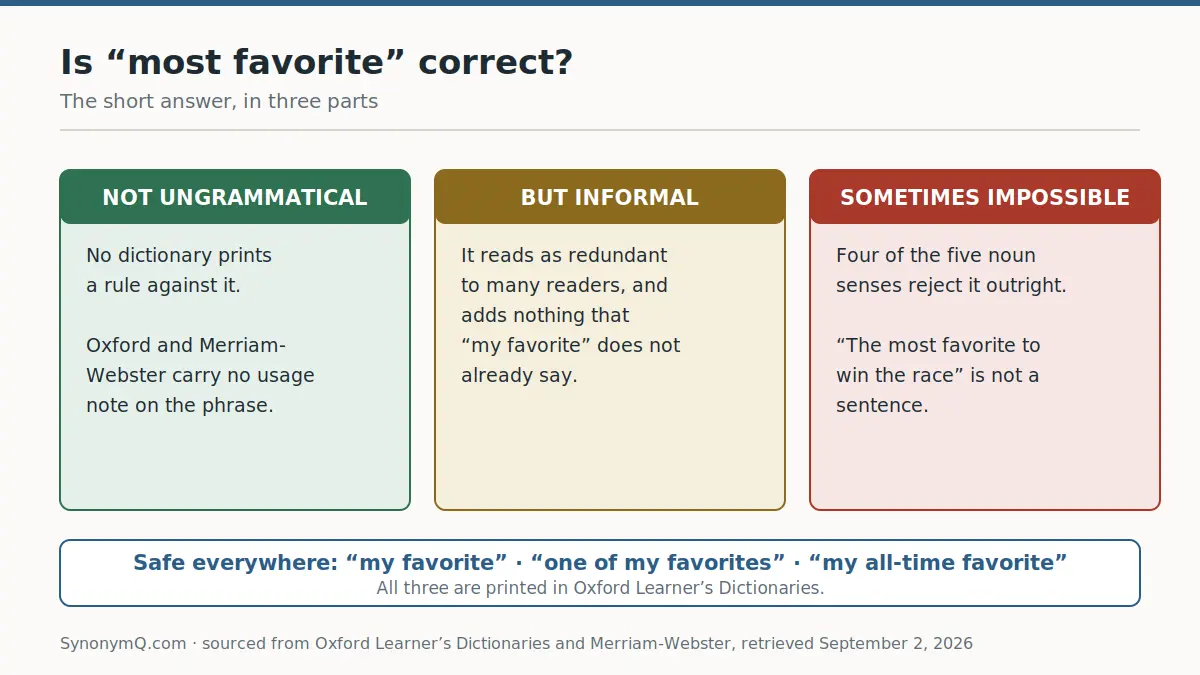
Is “most favorite” correct? The short answer
Search this question and you will find three Quora threads, a parenting site and a cooking blog telling you it is wrong. Two of those Quora titles state it as settled fact. None of them cites a dictionary.
So I opened both dictionaries. Here is what is actually in them.
What the dictionaries say, and what they do not
Oxford Learner’s Dictionaries defines the adjective favourite in one sense: “liked more than others of the same kind.” Merriam-Webster gives two adjective senses, “constituting a favorite” and “markedly popular.”
Between them that is three adjective senses, four noun senses at Merriam-Webster, five at Oxford, a first recorded use in 1583 for the noun and 1692 for the adjective — and not one usage note about gradability. No “sometimes objected to.” No “avoid most favorite.” Nothing.
Neither dictionary prints a usage note
That absence matters. Dictionaries are not shy about flagging disputed usage; they print notes on literally, on hopefully, on irregardless. When the rule is real, the note is there. Here it is not.

You can have more than one favorite
Oxford prints “It’s one of my favourite movies” as an example sentence, and the noun entry gives “The band played all my old favourites” and “One of my personal favourites…”
This kills the most popular version of the argument, which runs: favorite already means the single most-liked thing, so most favorite is like saying most best. But favorite does not mean that. Oxford’s own definition is comparative, not superlative: liked more than others, not liked most of all. You are allowed several favorites, and the dictionary says so in its examples.
The dictionary already accepts a degree word in front of it
This is the part worth remembering. Oxford’s collocations for favourite include least favourite, illustrated with “January is my least favourite month.”
Least is the superlative of little. Most is the superlative of much. They are the two ends of one grammatical operation, and the dictionary prints one of them without comment.

You can still dislike most favorite on style grounds. What you cannot do is call it a grammatical error while accepting least favorite in the same breath, because they are the same move.
The one place it genuinely fails
Here is what the Quora threads and the cooking blog all missed, and it is the answer that would actually help a writer: the problem is not the phrase, it is the part of speech.
Favorite is also a noun, and Oxford lists five noun senses. In every one of them, most is not merely clumsy. It produces something that is not English.

| Noun sense | Oxford’s example | With “most” |
|---|---|---|
| A thing you like more than others | The band played all my old favourites | Fails |
| A person given better treatment | Ann was her favourite | Fails |
| A saved website or app section | Add the website as a favourite | Fails |
| The horse or team expected to win | Her horse is the hot favourite for the race | Fails |
| The person expected to get a job | She’s the favourite for the job | Fails |
Notice the fourth row. Hot favourite and firm favourites are both printed in Oxford, so this sense does take modifiers. It just will not take most, because a race has one favorite by definition. That is a genuine absolute, and it is the only place in the entry where the “already superlative” argument actually holds.
So the useful rule is not “never write most favorite.” It is: check whether favorite is doing the work of an adjective or a noun in your sentence. My most favorite movie is informal. Add it to my most favorites is broken.
Why so many people are sure it is wrong
Two things are going on, and neither is a rule.
The first is a real pattern in English. Some adjectives resist degree modification because they name an absolute: unique, dead, perfect, identical. School grammar teaches this list, and favorite looks like it belongs on it. It half does, in the noun senses, and in Merriam-Webster’s “constituting a favorite” reading, where the word marks a category rather than a degree. In Merriam-Webster’s other reading, “markedly popular,” it is plainly gradable.
The second is redundancy, which is a style objection wearing a grammar costume. Most favorite usually adds nothing to favorite, and readers notice words that do no work. That is a fair criticism. It is not the same as an error, and collapsing the two is how a preference gets repeated until it sounds like a law.
What to write instead
If you want the emphasis without the objection, the dictionary hands you three options and prints an example for each.

| Write this | Substitution | When | Attested by |
|---|---|---|---|
| my favorite | Direct Swap | The default. It already says what most favorite is reaching for | Who is your favourite writer? |
| one of my favorites | Swap With Adjustment | When there are several and you are naming one. This is usually the sentence people actually meant | It’s one of my favourite movies. |
| my all-time favorite | Direct Swap | When you want real emphasis and a formal register | What is your all-time favourite song? |
| my least favorite | Requires Rewrite | The opposite end, fully standard — it reverses the meaning, so the sentence changes with it | January is my least favourite month. |
For a school essay, a cover letter or anything a marker or hiring manager will read, use my all-time favorite or one of my favorites. Avoid most favorite there — not because it is wrong, but because some readers believe it is, and you do not get to argue with them in the margin.
In speech, in a message to a friend, in dialogue you are writing for a character: most favorite is fine, and it carries a warmth that my favorite does not. Children say it constantly. That is not a mistake to correct out of them.
When “most favorite” is the better choice
There is one case where it earns its place. If you have already said favorite in a list and you now need to single out the top of that list, most favorite does a job no single word does: “They are all favorites, but this one is my most favorite.”
You could rewrite it as my absolute favorite of them or the favorite among my favorites, and in formal prose you probably should. But the sentence is doing something specific, and the objection to it is aesthetic rather than grammatical.
Frequently Asked Questions
Is “more favorite” correct too?
The same reasoning applies, and the same absence of a dictionary rule. More favorite is rarer and sounds odder to most ears, so it draws the objection faster. One of my favorites is almost always the sentence you wanted.
Is “most favourite” different in British English?
Only in spelling. Oxford Learner’s prints favourite as the British form and favorite as the American one, with identical pronunciation and identical senses. Nothing about the degree question changes.
Should I correct someone who says “most favorite”?
You can point out that it is redundant. Calling it a grammatical error goes further than either dictionary will support.
How This Page Was Checked
Senses, grammar labels, collocations and every example sentence quoted above were read from the live entries for favourite (adjective) and favourite (noun) at Oxford Learner’s Dictionaries, and from Merriam-Webster, retrieved September 2, 2026.
The central claim of this page is a negative one, that neither dictionary prints a usage note on gradability, and a negative claim deserves a plain statement of its limits. It is based on reading both entries in full on that date. It does not mean no usage authority anywhere has ever ruled on the phrase; it means the two dictionaries people cite when they make this correction do not. No frequency or corpus figure appears on this page, because none was measured.
Related reading on SynonymQ: whether “I’m humbled” is the right response to praise, and alternatives to “fancy” and when the register fits.

Naveed Akhtar writes every guide on SynonymQ. He is an SEO content writer with ten years of article-writing experience, working on the question a thesaurus never answers: which of these words belongs in this sentence, for this reader. Every page cites the dictionary entries it draws on and the date they were read.