
Disinterested vs Uninterested: 3 Rules to Choose the Right Word
In the pair disinterested vs uninterested, “disinterested” means impartial or unbiased, while “uninterested” means bored or indifferent. Use “disinterested” when someone has no personal stake in an outcome, and “uninterested” when someone simply does not care.
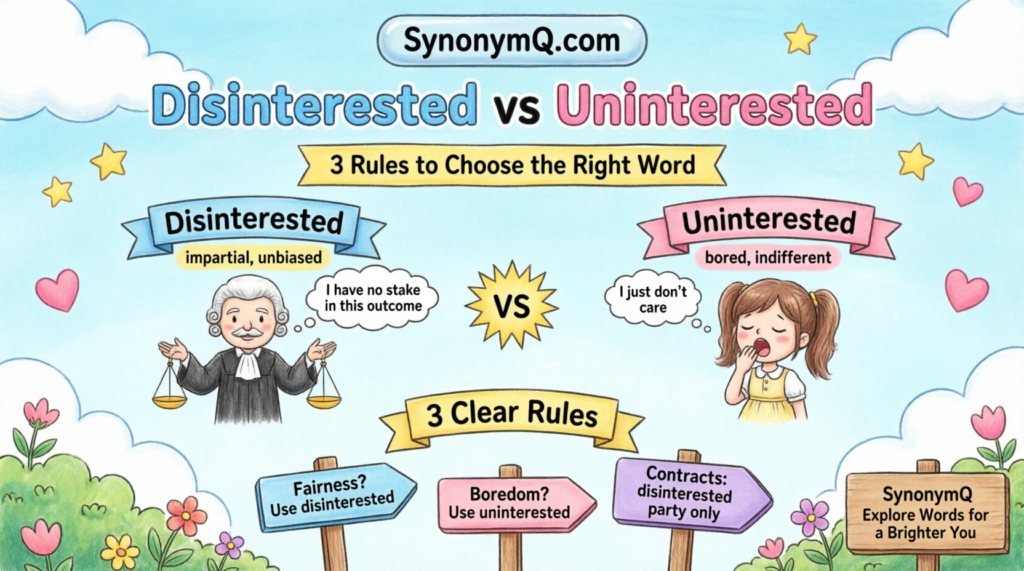
Disinterested
Impartial & Unbiased
(No personal stake)
Uninterested
Bored & Indifferent
(Lacking curiosity)
The Core Difference: How Prefixes Change the Meaning
The confusion between these two words stems from their shared root: “interest.” However, their prefixes change the meaning entirely.
The prefix “dis-” indicates a removal or absence of a specific condition. In this context, it removes personal bias, financial stake, or emotional involvement.
The prefix “un-” simply acts as a negation. It means “not.” Therefore, an uninterested person is simply not interested in what is happening around them.
Understanding this morphological split is the fastest way to remember which word belongs in your sentence.
When to Use Disinterested (Impartial and Unbiased)
Use this word when fairness, neutrality, and objective judgment are required. It describes someone who cannot benefit or lose from the outcome of a decision.
You will frequently see it in legal, athletic, and corporate environments. A referee, a judge, or a mediator must always remain disinterested to ensure a fair process.
For example, you want a disinterested third party to review a contract dispute. They have no emotional or financial ties to either side, allowing them to evaluate the facts objectively.
In scientific research, a disinterested peer reviewer has no financial stake in the study’s success. They can critique the methodology without worrying about their own investments.
Being disinterested does not mean you are not paying attention. In fact, a disinterested judge must pay incredibly close attention to the evidence to deliver a fair verdict.
When to Use Uninterested (Bored and Indifferent)
Use this word to describe a lack of curiosity, engagement, or enthusiasm. It applies to someone who finds a topic dull, irrelevant, or exhausting.
If a student is staring out the window during a lecture, they are uninterested. They do not lack bias; they simply lack attention or care for the subject matter.
Similarly, a cat might be entirely uninterested in a new toy. The animal simply does not find the object stimulating enough to warrant a reaction.
Marketing teams constantly measure uninterested audiences. If a demographic is uninterested in an ad campaign, they will scroll past it without a second thought.
Unlike a disinterested person, an uninterested person is actively disengaged. They are not weighing the facts; they are waiting for the event to end.
Head-to-Head Comparison Matrix
Use this matrix when you are mid-sentence and need a fast decision.
| Dimension | Disinterested | Uninterested |
|---|---|---|
| Core Meaning | Impartial, unbiased, free from self-interest | Bored, indifferent, lacking curiosity |
| Nuance | Can be highly engaged and attentive, but neutral | Disengaged, inattentive, or distracted |
| Register | Formal, professional, legal | Neutral, conversational, everyday |
| Preferred Context | Judging, refereeing, mediating, auditing | Entertainment, hobbies, casual conversation |
| Emotional State | Objective, analytical, fair | Apathetic, tired, distracted |
3 Rules to Choose the Right Word
Rule 1: Fairness
Use Disinterested for judges, referees, and mediators.
Rule 2: Boredom
Use Uninterested for dull lectures, bad movies, and apathy.
Rule 3: Contracts
Use Disinterested Party (locked legal expression).
Object-Sensitive Choices: How the Noun Changes the Rule
The suitability of these words often depends entirely on the noun they modify. Swapping them changes the factual reality of your sentence.
| Target Phrase | Intended Meaning | Best Choice | Avoid | Why |
|---|---|---|---|---|
| A [?] judge | A fair arbiter | Disinterested | Uninterested | An uninterested judge is bored and might miss crucial evidence. |
| An [?] audience | A bored crowd | Uninterested | Disinterested | A disinterested audience implies the crowd has no financial stake in the play. |
| A [?] trustee | A neutral fiduciary | Disinterested | Uninterested | Legal documents require a trustee with no conflicting financial interests. |
| An [?] voter | Someone who doesn’t care | Uninterested | Disinterested | A disinterested voter implies someone eligible but without a biased preference. |
Substitution Guide: Direct Swaps and Rewrites
Every alternative below carries a substitution label, so you know exactly how much work a swap requires.
| Alternative | Relationship | Substitutability | Best Context |
|---|---|---|---|
| Impartial | Exact Synonym | Direct Swap | Legal rulings, refereeing, mediation |
| Objective | Near-Synonym | Direct Swap | Journalism, scientific analysis |
| Indifferent | Exact Synonym | Direct Swap | Describing lack of care or preference |
| Bored | Exact Synonym | Direct Swap | Casual conversation, entertainment reviews |
| Apathetic | Near-Synonym | Swap With Adjustment | Deep psychological or societal disengagement |
| Detached | Contextual Alt. | Requires Rewrite | Emotional distance (can mean fair OR bored) |
| Neutral | Near-Synonym | Direct Swap | Geopolitics, arbitration, debates |
Do Not Substitute: The “Disinterested Party” Rule
Certain legal and business phrases rely on the exact meaning of this word. The phrase “disinterested party” is a locked expression.
In contract law, a disinterested party is someone with no financial or proprietary stake in a transaction. They act as an independent observer or witness.
If you write “uninterested party,” you accidentally describe someone who is bored by the contract. This substitution destroys the legal validity of the phrase.
Corporate bylaws often require a “disinterested director” to vote on conflicts of interest. This means a board member who does not stand to profit from the specific deal being discussed.
Locked Legal Expression
✅ Disinterested Party
An independent witness with no financial stake in the deal.
❌ Uninterested Party
Someone who is bored by the contract. (Destroys legal validity!)
AP Style and the Descriptive Shift
In casual conversation, many speakers use these words interchangeably. Dictionaries now record this descriptive shift, noting that “disinterested” is sometimes used to mean “bored.”
However, formal writing guides and the AP Stylebook strictly reject this overlap. In professional, academic, or journalistic writing, treating them as synonyms is considered an error.
Merriam-Webster notes that the “bored” usage of disinterested has been common since the 19th century, but it remains heavily stigmatized by editors and language authorities.
To protect your credibility, maintain the traditional boundary. This pair tops most lists of commonly confused words, so reserve “dis-” for impartiality and “un-” for boredom.
Example Sentences: Before and After
Each row shows the confused original, the intended meaning, and the corrected sentence.
| Original (Confused) | Meaning Intended | Corrected Sentence |
|---|---|---|
| The judge was completely uninterested in the case. | Impartial / Fair | The judge was completely disinterested in the case. |
| I tried to explain the rules, but the dog was disinterested. | Bored / Not paying attention | I tried to explain the rules, but the dog was uninterested. |
| We need a uninterested third party to audit the finances. | Unbiased / No financial stake | We need a disinterested third party to audit the finances. |
| The crowd grew disinterested during the rain delay. | Bored / Losing patience | The crowd grew uninterested during the rain delay. |
| A uninterested mediator helped settle the strike. | Neutral / Fair | A disinterested mediator helped settle the strike. |
Common Mistakes and How to Self-Edit
The most common mistake occurs when writers try to sound more formal by choosing “disinterested” when they actually mean “bored.”
Using a formal word incorrectly does not elevate your prose; it confuses your reader. If you mean someone is ignoring a movie, just say they are uninterested.
Another trap is assuming that “uninterested” sounds too casual for a business report. In reality, precision always outranks formality.
When editing your own work, ask a simple question: Is this person making a fair judgment, or are they just looking at their phone?
If they are making a judgment, use disinterested. If they are looking at their phone, use uninterested.
Frequently Asked Questions
What does it mean when a person is disinterested?
It means the person is impartial, unbiased, and free from personal stake in the outcome. They can still be highly engaged and attentive to the task at hand.
Is “uninterested” a right word?
Yes, it is the correct and standard word to describe someone who is bored, indifferent, or lacking curiosity about a specific subject.
Can a person be both disinterested and uninterested?
Yes. A judge might be entirely disinterested (impartial) regarding the verdict, yet completely uninterested (bored) by the repetitive testimony of a specific witness.
Is it okay to use disinterested to mean bored in casual speech?
While common in spoken English, language authorities and editors still consider it an error. It is best to maintain the distinction in all written communication.
What is a synonym for an uninterested audience?
You can use “apathetic,” “indifferent,” “inattentive,” or “bored.” Avoid “disinterested,” as that would imply the audience has no financial stake in the performance.
Final Word-Choice Guide
For fairness, judgement and contracts, use disinterested. For boredom, indifference and lack of curiosity, use uninterested. When a sentence needs neither neutrality nor apathy, rewrite around the pair entirely.
Once this pair feels automatic, test yourself on comprised vs compromised and systemic vs systematic, two more pairs that trip up careful editors.
How This Page Was Checked
Definitions and usage constraints were verified against Merriam-Webster and the AP Stylebook. Legal collocations were cross-referenced with Black’s Law Dictionary. All substitution recommendations were tested for grammatical compatibility and register accuracy.

Naveed Akhtar writes every guide on SynonymQ. He is an SEO content writer with ten years of article-writing experience, working on the question a thesaurus never answers: which of these words belongs in this sentence, for this reader. Every page cites the dictionary entries it draws on and the date they were read.