
Efficient vs Effective: 5 Checks Beyond Speed
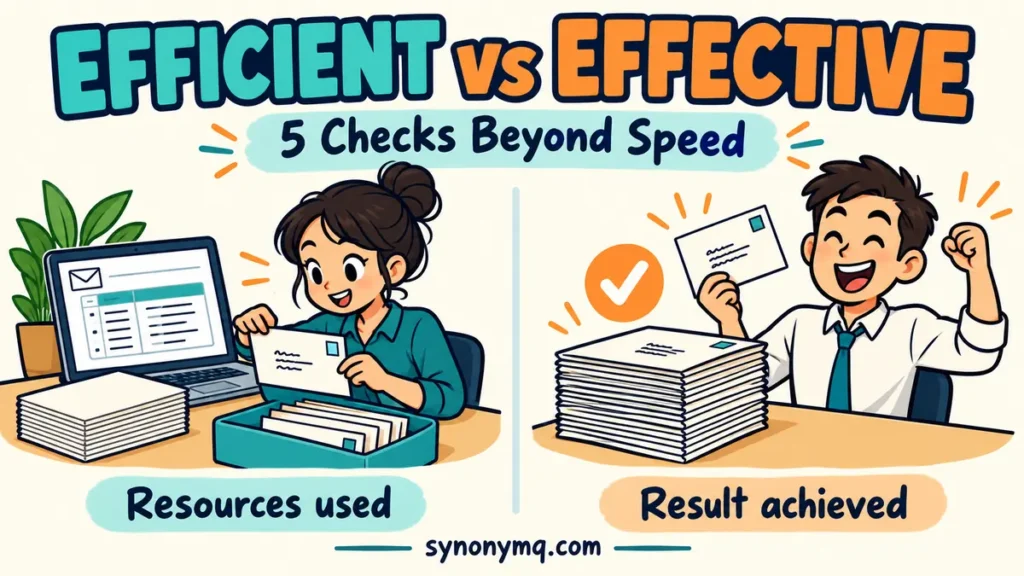
Efficient vs effective is a distinction between resource use and results. Effective means achieving the intended result. Efficient describes doing the work well with little waste of time, effort, money or materials. Use effective to say that something worked; use efficient when how it used resources matters. A process can be both.
1. Did it achieve the intended result?
Two volunteers are preparing invitations. Each finishes a correctly addressed set before the posting deadline. Both methods worked for that task, so both can be called effective.
One volunteer repeatedly rewrote addresses and discarded envelopes. The other used a checked address template and avoided most of that rework. The finished result alone does not tell you which method used resources well.
Oxford defines effective around producing the intended result. Before using the word, name that result. An effective reminder prompts a reply; an effective explanation helps someone understand. Simply being busy does not establish either claim.
The same question helps with people. Calling a teacher effective praises the results of their teaching. Calling the teacher efficient directs attention to how they organise and carry out their work. Neither description automatically tells you everything about the other.
2. Which resource did it save?
For the invitation task, the template reduced wasted envelopes and repeated work while preserving correct addresses. That supports calling it an efficient method. Efficiency concerns the relationship between useful work and the resources it requires.

Oxford’s efficient entry includes doing work properly without wasting resources. It does not reduce the meaning to speed. If you mean only that someone finished quickly, say quickly; our guide to alternatives for quickly separates speed from related claims.
Also name the resource when it matters. A delivery route may save fuel but take longer. “More fuel-efficient” is clearer than an unexplained “more efficient,” especially if the reader is deciding between travel time and fuel use.
An efficient part can miss the wider goal
Suppose an office processes event registrations with little staff time or duplicated effort. Registration is efficient. But if the event fails to attract its intended audience, the overall campaign may be ineffective.
Those judgements concern different scopes: processing registrations and attracting the audience. Keep that distinction visible. Do not call a pile of incorrectly addressed invitations efficient just because someone produced it quickly; the errors may create wasted work.
3. Did the message arrive or get understood?
An email template can save the sender effort. That is an efficiency benefit in preparing and delivering a message. It does not establish that the recipient understood the request.
Imagine an organiser sends “Bring it tomorrow.” The email takes seconds to write, but a new colleague does not know what to bring. A slightly longer message naming the blue folder, meeting time and room may communicate more effectively.
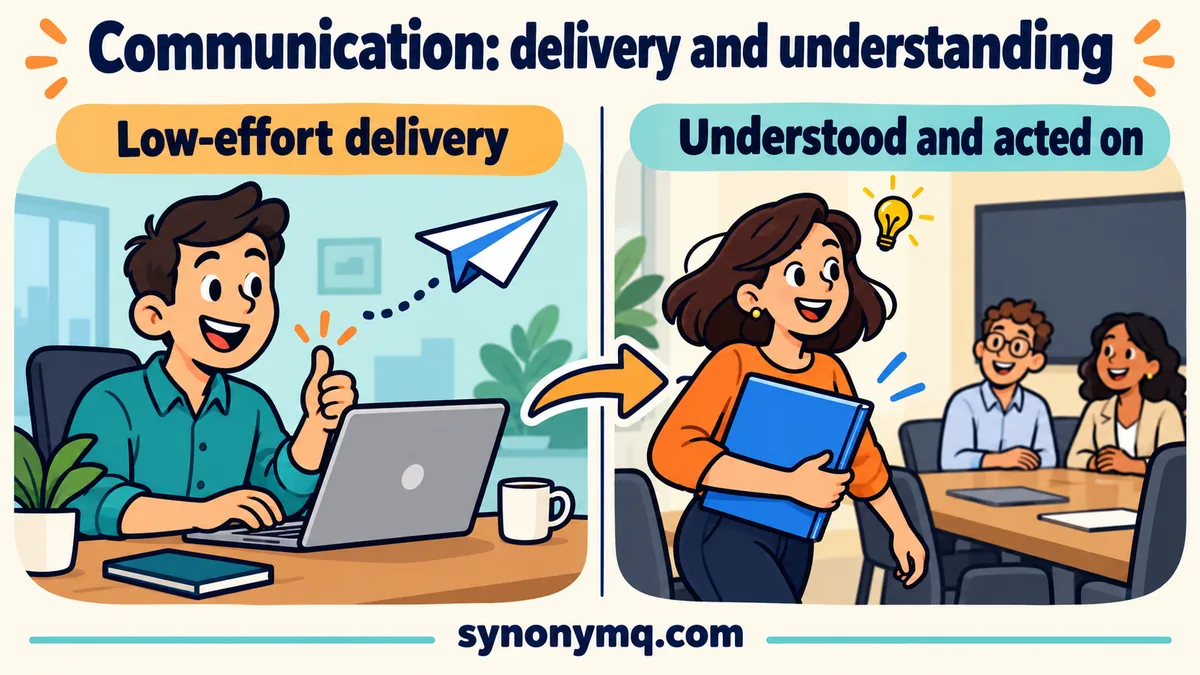
For a message that gets the intended point across, use effective communication. Use efficient when discussing the resources needed for successful communication, such as avoiding repeated explanations. A short email can be unclear, while a clear email can prevent several follow-up messages.
“The team communicates effectively and efficiently” makes both claims. Keep both words only if the context supports understanding or action as well as sensible resource use.
4. Do you need an adjective, adverb or noun?
Efficient and effective are adjectives. Their adverbs are efficiently and effectively; the corresponding nouns are efficiency and effectiveness. The Cambridge comparison explains the adjective distinction.
- Describe the process: “The registration process is efficient and effective.”
- Describe how people work: “The volunteers work efficiently and effectively.”
- Name the qualities: “We reviewed the process’s efficiency and effectiveness.”
In “She handles requests effective and efficiently,” change effective to effectively. Both words describe how she handles requests, so the parallel adverb forms fit.
In management writing, effectiveness asks whether an objective was achieved; efficiency asks how resources were used in doing the work. Avoid switching between the noun and adjective in a comparison such as “efficiency versus effective.” Write “efficiency versus effectiveness.”
5. Does effective mean in use from a date?
On a notice, “The new opening hours are effective from Monday” means the hours start applying on Monday. It does not praise their results or their use of resources. Oxford lists this in-use sense separately from successful performance.

Replacing effective with efficient would change the meaning rather than improve the sentence. For a plain alternative, write “The new opening hours start on Monday.” This is a vocabulary example, not a statement about any particular organisation’s hours.
Efficient vs Effective in Sentence Replacements
These words overlap, but they are not blanket substitutes. A Direct Swap preserves the intended claim in the stated context. Swap With Adjustment changes nearby wording; Requires Rewrite changes the construction.
| Original | Replacement | Decision |
|---|---|---|
| The reminder was effective. | The reminder worked. | Requires Rewrite: suitable when it prompted the intended response. |
| The process is efficient. | The process works with little wasted effort. | Requires Rewrite: makes the resource claim explicit. |
| She works efficient and effective. | She works efficiently and effectively. | Swap With Adjustment: repair both adjective forms. |
| This is a cost-effective option. | This is a cost-efficient option. | Direct Swap in the ordinary value-for-money sense; check any specialist definition. |
The last row is an exception to a neat two-word contrast. Oxford lists cost-efficient alongside cost-effective. Do not insist that the compounds always differ. Value for money also involves benefits, so neither expression means merely the cheapest option.
Efficacy is another nearby word. In ordinary formal English it concerns the ability to produce a wanted result, as Oxford’s efficacy entry explains. It is not another name for saving time or materials. Specialist research uses need their own context.
For other comparisons where a grammatical substitution can still change the claim, browse the commonly confused words guide.
How This Page Was Checked
The linked Oxford and Cambridge entries support the meanings and word forms. Invitation, email and office examples are original teaching scenarios. Recommendations concern the stated task and intended meaning, not every possible use of either word.
Frequently Asked Questions
What is the difference between efficient and effective?
Effective describes achieving the intended result. Efficient describes doing the work well with little wasted time, effort, money or materials. Something can be both.
What is the difference between effectiveness and efficiency?
Effectiveness concerns whether the intended result is achieved. Efficiency concerns how well resources are used to perform the work. They are nouns naming different qualities.
What is the difference between effective and efficient communication?
Effective communication achieves its purpose, such as understanding or action. Efficient communication does so with little wasted time or effort. Brevity alone guarantees neither.
Can something be efficient but not effective?
A subtask can use resources efficiently while failing to advance a wider goal. State both scopes clearly; doing incorrect work quickly is not automatically efficient.

Naveed Akhtar writes every guide on SynonymQ. He is an SEO content writer with ten years of article-writing experience, working on the question a thesaurus never answers: which of these words belongs in this sentence, for this reader. Every page cites the dictionary entries it draws on and the date they were read.