
Envy vs Jealousy: Which 1 Word Fits Your Sentence?
Envy vs Jealousy: Which Word Fits Your Sentence?
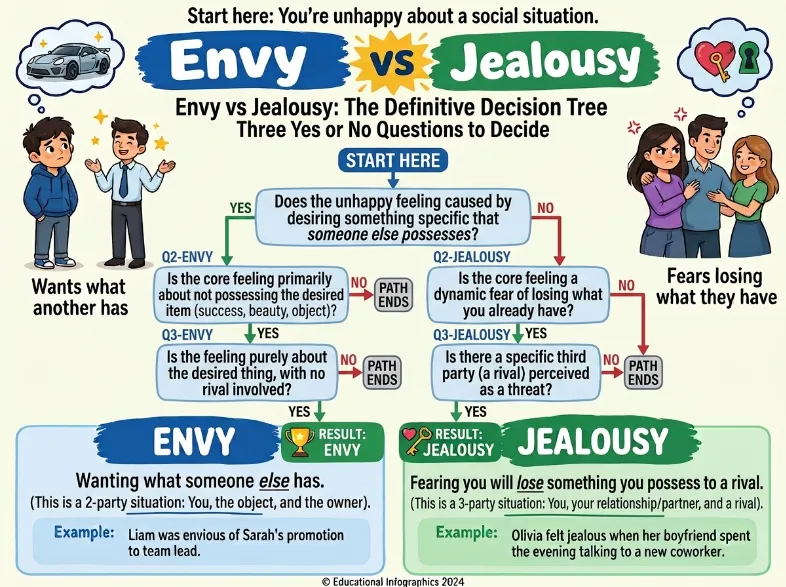
Envy vs jealousy comes down to want versus worry. Use envy for wanting what someone else has, and jealousy for fearing a rival will take what you have. Dictionaries also let jealous stand in for envious, so it’s a convention, not a law.
Written by Naveed Akhtar, an SEO content writer with 10 years of article-writing experience. About 8 minutes to read.
Envy vs Jealousy at a Glance
The table compares the strict convention with what dictionaries actually record.
| Feature | Envy | Jealousy |
|---|---|---|
| Strict convention | Wanting something someone else has | Fearing a rival will take something or someone you have |
| What dictionaries record | Wishing you had what another person has, as Cambridge Learner’s Dictionary defines it | That fear, plus wanting what another person has, plus guarding your own, as Oxford Learner’s Dictionaries lists three senses |
| Word class | Noun and verb; adjectives envious and enviable | Noun; related adjective jealous and adverb jealously |
| In romance | Less common | The usual word, according to Merriam-Webster |
| Fixed expressions | the envy of, green with envy | green-eyed monster, jealously guarded |
| Typical pattern | envy of/at something; envy someone something | jealous of someone or something |
Three Sentence Tests
Definitions overlap, so test the sentence you are writing. Test 1 gives the convention. Tests 2 and 3 set hard limits that override it.
Test 1: Is it lack or loss?
Ask what the feeling is about. If you lack something another person has, the strict convention calls it envy. If you might lose something you already have, it calls it jealousy.
- Envy: Maya felt envy when her cousin announced the scholarship she had applied for herself.
- Jealousy: Maya felt jealousy when her closest friend began spending every weekend with a new group.
Vocabulary.com frames the same rule as two parties against three. Envy needs you and the person with the thing. Jealousy adds a third party who might take what you have.
Merriam-Webster’s usage note, quoted in full by the Grammarphobia blog, calls this a tendency, not a rule. Jealousy leans toward protecting what is yours.
Test 2: Is a rival competing for someone’s affection?
If a partner, friend or parent is giving attention to someone else, use jealous. Envious does not fit that situation.
Take this sentence: Tom gets jealous whenever his partner laughs at a coworker’s joke. Swap in envious and the meaning shifts. It now suggests Tom wants the coworker’s wit, not that he fears losing his partner.
Merriam-Webster’s entry for jealous says the word alone describes someone who tends to suspect unfaithfulness. Its usage note makes the same point with a flirtatious comment aimed at your partner: you would call the reaction jealousy, not envy.
Test 3: Do you need a verb?
Dictionary.com notes that jealousy is always a noun, while envy can be a noun or a verb. If your sentence needs an action, envy is the only choice.
The verb has a double-object pattern: envy someone something, as in I envy you your patience. Cambridge Learner’s Dictionary lists that pattern, and Longman does too.

Where the Rule Bends
Many guides teach lack versus loss as if it were law. Dictionaries record something looser.
Merriam-Webster’s usage note says usage evidence supports neither view: that the words are exact synonyms, or that they are wholly different. Both can mean covetous. Jealousy adds a sense of guarding what is yours.
The jealous entry is blunter. Some people insist only envious can describe strong desire for another’s belongings, but the entry says both words commonly carry that meaning.
Grammarphobia, citing the Oxford English Dictionary, dates the envious sense of jealous to the late 14th century. This is not a recent slip.
Dictionary.com splits the words differently. It treats hostility, not lack versus loss, as the main dividing line, and it lets jealousy include wanting. So the sources disagree, and no single rule satisfies all of them.
Merriam-Webster’s grammar page on jealous vs. envious also offers Homer Simpson’s version of the popular rule.
The one-way swap matrix
The AMA Style Insider blog notes that substitution runs mostly one way. People use jealous where they could say envious, but not the reverse.
| Original sentence | Swap | Label | What happens |
|---|---|---|---|
| I’m so jealous of your new job. | I’m so envious of your new job. | Direct Swap | Same meaning. Oxford Learner’s lists envious as a synonym for this sense of jealous. |
| Her friend’s promotion filled her with envy. | …filled her with jealousy. | Direct Swap | Readers take it as wanting. Merriam-Webster gives a similar salt-shaker example. |
| I envy your calm. | I’m jealous of your calm. | Swap With Adjustment | The verb becomes an adjective plus of. The meaning holds. |
| Her jealous husband checked her phone every night. | Her envious husband… | Requires Rewrite | Meaning shifts to a husband who wants what she has. |
| The recipe is a jealously guarded family secret. | An enviously guarded secret | Requires Rewrite | The protect sense is lost. Try closely guarded. |
| The city’s parks are the envy of nearby towns. | …the jealousy of nearby towns | Requires Rewrite | The idiom is locked. Try make nearby towns jealous. |
Do not swap the two words just to avoid repeating one. That can change your meaning, so repeat the word instead.
Which Word for Which Situation
For formal or academic writing, use envy for wanting what someone else has and jealousy for guarding what you have. Avoid jealous for the wanting sense there.
Prescriptive guides such as Bryan Garner’s, quoted by the Christian Science Monitor, restrict jealousy to emotional rivalry. A strict editor may mark the looser use.
For casual speech, use jealous freely for wanting. Oxford Learner’s lists I’m so jealous! as an ordinary example. Avoid envious in chat when it makes the line sound stiff.
For romance and rivalry, use jealous. Avoid envious, which shifts the meaning to wanting what the other person has.
In a relationship
A partner’s attention going elsewhere is jealousy. Wanting what your partner has, such as their calm or their salary, is envy.
The two can arrive together. You may envy a newcomer’s confidence and then feel jealous of the attention she gets, a pattern Mental Floss describes with a maid-of-honour example.
At work
Wanting a colleague’s promotion is envy in careful prose, though jealous is common in speech. Worrying that a colleague will win over your client is jealousy in Merriam-Webster’s sense of guarding your own advantages.
Do not substitute: locked expressions
- the envy of: Oxford Learner’s lists be the envy of as an idiom. Jealousy does not fit it.
- green with envy: the standard phrase for strong envy. The green-eyed monster names jealousy, and Dictionary.com traces it to Shakespeare’s Othello.
- jealously guarded: this belongs to the protect sense, as in Oxford Learner’s a jealously guarded secret.
- I don’t envy you: Oxford Learner’s gives this a separate sense. It means you are glad you are not in the other person’s position. It does not mean you lack envy.
- a jealous God: Dictionary.com lists a biblical sense of jealous meaning intolerant of unfaithfulness or rivalry. Envy is not used that way.
Envy, Jealousy and Their Neighbours
Three related words get pulled into this comparison. Only one comes close to a replacement.
| Word | Dictionary meaning | Relationship | Swap for envy? |
|---|---|---|---|
| covet | Cambridge Learner’s: to want something very much, especially something someone else has. It labels the verb formal. | Near-Synonym | Swap With Adjustment. It suits formal writing with a thing as the object. It fails in the envy of and I don’t envy you. |
| greed | Cambridge Learner’s: wanting a lot more food, money and similar things than you need. The definition does not mention another person’s possessions. | Related Word | Not a replacement. |
| zealous | Shares its Latin source with jealous, according to Merriam-Webster. | Related Word | Not a synonym today. Merriam-Webster says the meanings were closer in the past. |
Common Questions
Why is envy a sin but not jealousy?
The premise is only partly right. The Catechism of the Catholic Church calls envy a capital sin. It defines envy as sadness at another’s goods plus an immoderate desire to acquire them.
Scripture is less tidy. GotQuestions lists both envy and jealousy among things to avoid. It adds that jealousy in the sense of protective zeal can be positive, while envy never is.
This page covers vocabulary, not theology. For religious teaching, consult a religious source.
Is envy more intense than jealousy?
Most usage guides rate jealousy as the hotter word. Reader’s Digest calls it envy on steroids, and EasyBib says it is much more intense. The AMA Style Insider agrees that envy carries less emotional charge.
Not every source agrees. Visalia Recovery Center calls jealousy the milder emotion. No corpus measurement in the sources checked settles it. Choose by what the feeling is about, not by intensity.
Can you be envious and not jealous?
Yes. Under the strict convention, envy needs only a lack. You can envy a neighbour’s garden without fearing you will lose anything.
The reverse also holds in some cases. A jealous person may be guarding something and want nothing that belongs to anyone else.

Naveed Akhtar writes every guide on SynonymQ. He is an SEO content writer with ten years of article-writing experience, working on the question a thesaurus never answers: which of these words belongs in this sentence, for this reader. Every page cites the dictionary entries it draws on and the date they were read.