
Fast vs Quick vs Rapid: 3 Ways to Describe Speed
Fast vs quick vs rapid depends on what you describe. Fast often concerns movement or operating speed; quick often means taking little time or acting without delay; rapid often describes fast change. These uses overlap, so check the noun and context.

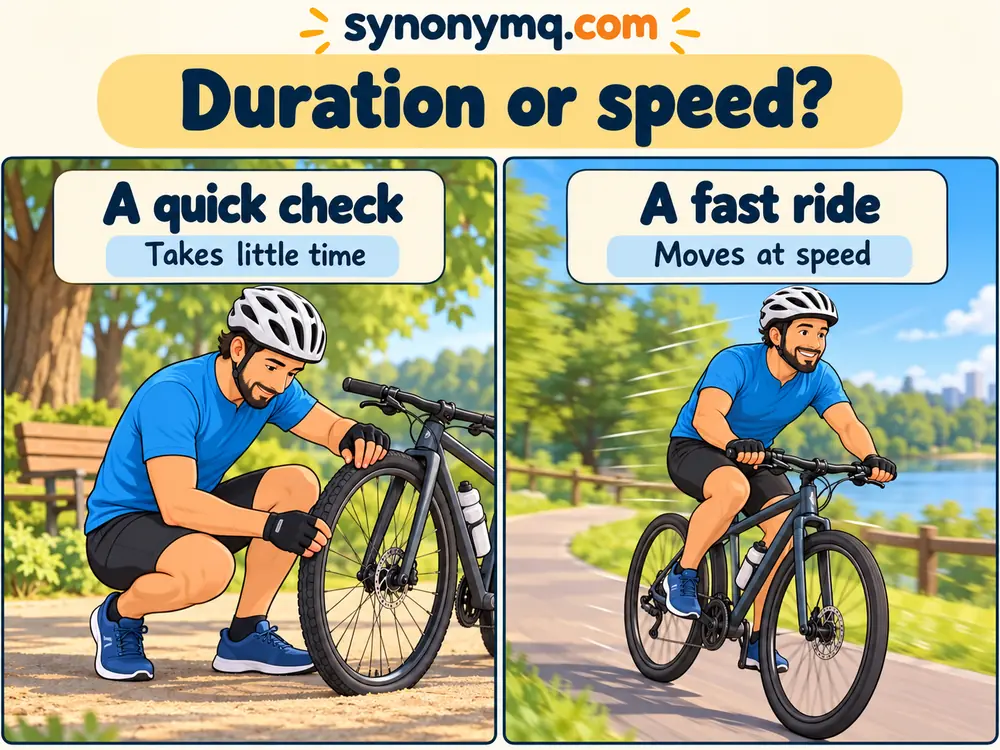
A cyclist makes a quick tire check before a fast ride. Back in the garden, she notices rapid growth in the seedlings. All three adjectives concern speed, but each draws attention to something different.
The useful distinction is not which word sounds strongest. It is whether you mean speed of movement, time spent on an action, or the rate at which something changes.
Three uses: movement, duration, and change
1. Fast: how something moves or operates
A fast cyclist can travel at a high speed. A fast printer produces pages at a high rate. Fast is a straightforward choice when the thing you are describing moves or operates quickly.
It is not limited to physical movement. “The business achieved fast growth” is also natural. The distinction is a useful starting point, not a ban on using fast with change.
Merriam-Webster’s entry for fast covers both adjective and adverb uses. You can describe a fast cyclist and say that the cyclist rides fast.
2. Quick: how little time an action takes
A quick check takes little time. It does not necessarily mean that your hands move at great speed. You may simply check one thing instead of inspecting the whole bicycle.
Quick can also describe a short delay before action: “Thanks for the quick reply.” Here, you are usually thanking someone for responding soon, not for typing at an impressive speed.
Quick does not mean careless. A quick inspection may be enough for a simple task. If you mean that someone rushed and missed details, state that separately instead of expecting quick to carry the criticism.
3. Rapid: how quickly change happens
Rapid growth, a rapid increase, and rapid development are natural combinations. They describe a process happening over a short time or at a high rate.
“The seedlings showed rapid growth” focuses on their development. It does not mean that the pots moved quickly across the bench.
Oxford’s rapid entry highlights change and also records uses such as a rapid response. Rapid is therefore not restricted to processes or scientific writing.
In a report, rapid may fit the tone of a change in sales, demand, or population. In a casual request, “Can we have a quick chat?” is a more natural choice than “a rapid chat.”
The noun matters more than a speed ranking
Fast, quick, and rapid are not three official levels of speed. You cannot infer that a quick runner is faster than a fast runner. To compare actual performance, give a time, distance, or rate.
| Phrase | Usual emphasis | Substitution advice |
|---|---|---|
| A fast train | Traveling at speed | Keep fast for an ordinary description of the train’s speed. |
| A quick lunch | Little time spent eating | Rapid lunch sounds unusual in everyday conversation. |
| Rapid growth | A high rate of change | Fast growth is a direct swap in many contexts, with a plainer tone. |
| A quick response | Little delay before answering | Rapid response also works, often with a more official tone. |
| A quick learner | Learning in little time | Fast learner also works. Neither describes running speed. |
These are tendencies, not rules that make every other combination incorrect. A writer can describe a fast lunch informally, for example, but quick lunch is the clearer starting point for a learner.
Does a quick car mean a fast car?
The meanings overlap. Fast car is the broad everyday phrase for a car capable of high speed. Quick car is also used, especially when the speaker is thinking about how readily it accelerates or responds.
Do not turn that tendency into a universal rule that fast always means top speed and quick always means acceleration. For an exact comparison, name the measurement rather than relying on the adjective.
Quick also works in the pattern quick to + verb: “Mina was quick to notice the loose cable.” Oxford records this pattern for reacting or doing something without much delay.
Use fast, quickly, or rapidly after an action verb
Fast can be an adjective or an adverb. Quick and rapid are adjectives in “a quick check” and “rapid growth”; their usual adverbs are quickly and rapidly.
| Adjective phrase | Adverb sentence |
|---|---|
| A fast runner | The runner moves fast. |
| A quick check | She checks the label quickly. |
| Rapid growth | The seedlings grow rapidly. |
For ordinary modern English, use “The train travels fast,” not “The train travels fastly.” Fast already supplies the adverb form. “Travels quickly” can also work; fast is not missing an ending.

What about “Come quick”?
Quick is also used as an informal adverb. “Come quick!” is familiar speech, so it is inaccurate to say that quick can never follow a verb. Oxford explicitly labels this adverb use as informal.
In neutral edited writing, quickly is usually the safer choice: “Please respond quickly.” Use rapidly when describing the rate of a process: “The queue grew rapidly.”
For a broader selection of adverbs, see our guide to synonyms for quickly. This comparison focuses on choosing among the three main words and their forms.
Faster and quicker compare different things in context
Fast becomes faster and fastest. Quick becomes quicker and quickest. With rapid, use more rapid and most rapid.
- “This scanner is faster” compares operating speed.
- “This route is quicker” compares the time needed for the journey.
- “The second batch showed more rapid growth” compares rates of development.
A quicker route might save time because it avoids a long wait, even if you travel at the same speed. That is why quicker and faster can both fit a journey while drawing attention to different details.
Both “She finished faster” and “She finished more quickly” can be natural. Do not write “more faster” or “most quickest”: each already contains the comparative or superlative ending.
When swift or prompt says more
Two useful alternatives are swift and prompt. Their value depends on the sentence, not on sounding more impressive than fast or quick.
| Alternative | Example | Relationship and substitution |
|---|---|---|
| Swift | a quick response → a swift response | Near-synonym; Direct Swap. Emphasizes speed or readiness of action; can sound more deliberate or formal here. |
| Prompt | a quick reply → a prompt reply | Contextual near-synonym; Direct Swap when you mean little delay in replying. |
| Short | a quick meeting → a short meeting | Contextual alternative; Direct Swap when duration is the intended meaning. It says nothing about how soon the meeting starts. |
Swift can describe fast movement or readiness of action. It does not guarantee graceful movement: “a swift refusal” is about how soon the refusal comes.
Prompt emphasizes responding without delay. It is useful in a thank-you message, but “a prompt train” would not clearly describe how fast the train moves.
Keep other meanings separate. In “hold fast,” fast concerns staying firmly in place. In “river rapids,” rapids names a feature of flowing water. Neither is simply another version of a quick action.
Frequently asked questions
When should you use fast or quick?
Use fast for movement or operating speed, and quick for a brief action or short delay. These uses overlap: fast learner and quick learner can both describe someone who learns readily.
Is rapid the same as fast?
They overlap, especially for change or movement. Rapid often suits growth, increases, and development. Fast is a broader everyday choice and also works as an adverb; rapid normally becomes rapidly.
Is quick faster than fast?
No. Quick and fast are not fixed speed levels. A quick task takes little time, while a fast-moving object travels at speed. Use measurements if you need an exact comparison.
Does rapid mean quick?
Often, yes: both can describe something happening in little time. Their usual word combinations differ, though. Rapid growth and a quick break are natural; swapping the adjectives may sound awkward.

Naveed Akhtar writes every guide on SynonymQ. He is an SEO content writer with ten years of article-writing experience, working on the question a thesaurus never answers: which of these words belongs in this sentence, for this reader. Every page cites the dictionary entries it draws on and the date they were read.