
Judicial vs Judicious: 3 Simple Tests for Better Word Choice
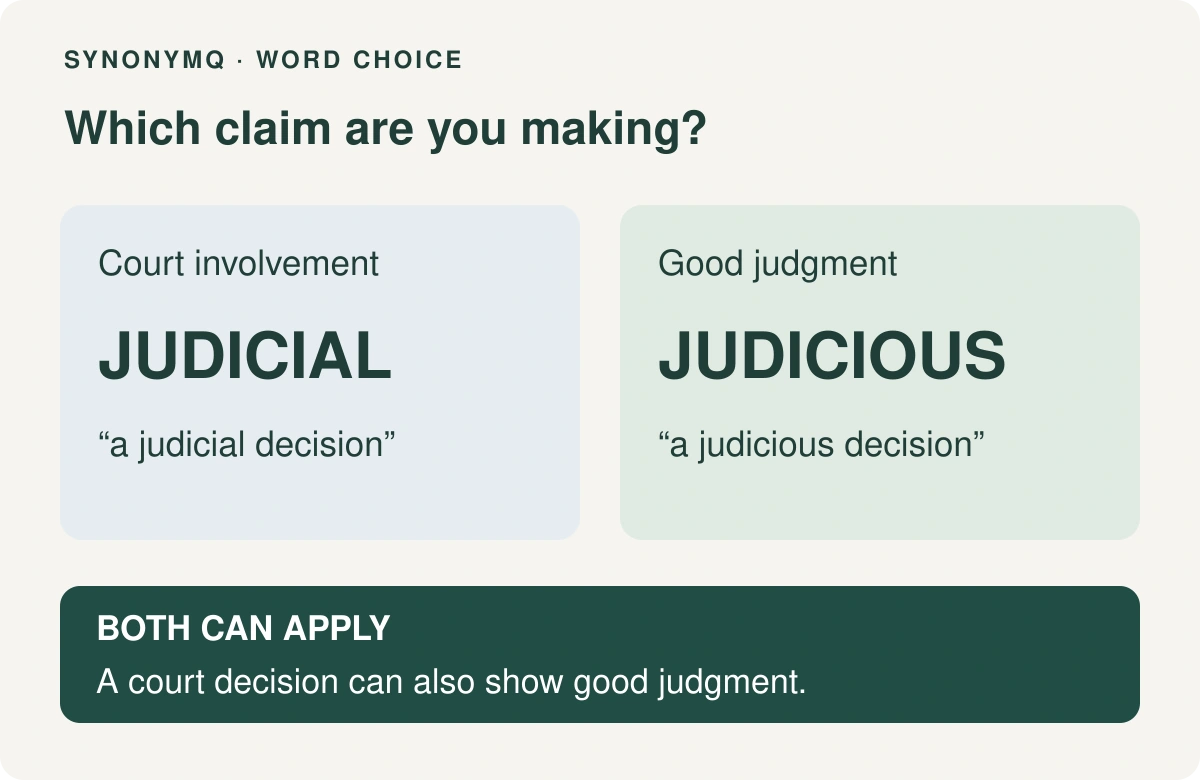
Judicial vs judicious is a choice between court involvement and good judgment. Judicial usually relates to courts or judges; judicious means wise or sensible. A court’s decision can be both, but one word does not guarantee the other.


Judicial vs judicious: what changes in your sentence?
The difference is the claim you are making. Judicial normally identifies a connection with courts or judges. Judicious evaluates someone’s judgment positively.
| Word | Question it answers | What the phrase says |
|---|---|---|
| Judicial | Does this involve a court or judge? | A judicial decision is a court-related decision. |
| Judicious | Does this show good judgment? | A judicious decision is a wise or sensible decision. |
For a court connection, use judicial. For a compliment about good judgment, use judicious. Avoid exchanging them casually: the swap changes what you are claiming.
What does judicial mean?
Merriam-Webster’s entry for judicial connects the adjective with judging, courts and the administration of justice. It also covers things ordered or enforced by a court.
In ordinary modern use, the word identifies the legal setting or authority. It does not, by itself, praise the quality of the judgment being exercised.
- “The report examined delays in the judicial system.” The subject is the court system.
- “The order requires judicial approval.” The approval is connected with a judge or court.
- “The discussion concerned judicial independence.” The expression concerns the independence of judges or courts.
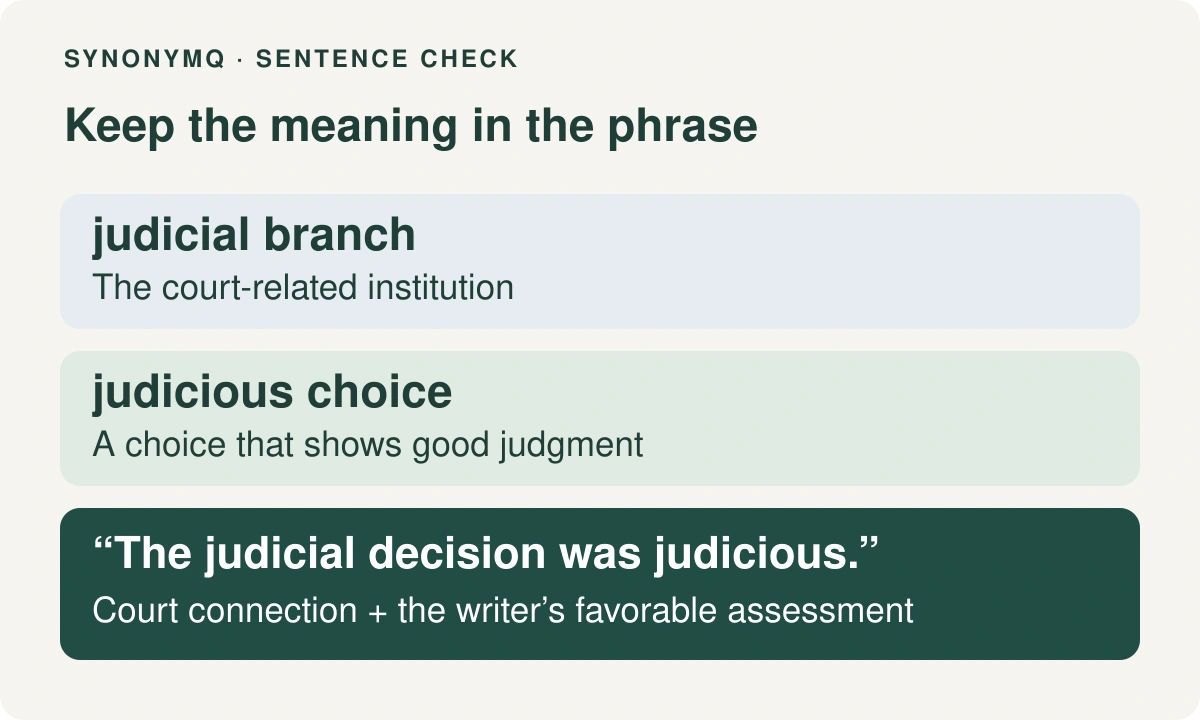
Keep judicial in established expressions such as judicial review and judicial branch. Replacing it with judicious removes the expression’s court-related meaning.
What does judicious mean?
Merriam-Webster’s entry for judicious defines the word through sound judgment. Use it when a person’s choice, approach or use of resources deserves that assessment.
A student, manager, parent or judge can be judicious. The word describes the judgment they exercise, rather than the position they hold.
- “A judicious use of examples made the lesson easier to follow.” The examples were chosen and used well.
- “The manager made a judicious choice about the project schedule.” The choice showed good judgment.
- “The editor was judicious in cutting repeated material.” The cuts were sensible.
Use this adjective to assess a decision, not merely to make it sound important. If you only mean that someone considered the options, describe that process directly.
3 simple tests for choosing the right word
These are sentence checks, not rules about who is allowed to use either adjective. A judge can make a judicious personal choice; a business can be involved in a judicial process.
1. Check the court connection
Ask whether your sentence identifies a court, a judge’s official role or something proceeding from a court. If it does, judicial is usually the word you need.
“The committee requested a judicial review” identifies a court-related process. “The committee requested a judicious review” asks for a review carried out with good judgment. Those requests are different.
2. Check whether you are praising judgment
If you mean a wise choice or sensible use of something, choose judicious. No court needs to be involved.
“A judicious allocation of time” praises the allocation. “A judicial allocation of time” suggests a connection with a court or judge that the sentence may never have intended.
3. Check whether the sentence needs both claims
If a court made a decision and you also consider it wise, both adjectives can apply. State each claim separately instead of expecting one word to carry both.
“The judicial decision was judicious because it addressed the practical problem.” The first adjective identifies the court connection; the second supplies the writer’s favorable assessment.
A judicial decision can also be judicious
These words are not opposites. One normally classifies an action by its connection to courts; the other evaluates the judgment behind it. That leaves room for four situations.
| Situation | Judicial? | Judicious? |
|---|---|---|
| A court decision you consider sensible | Yes | Yes, in your assessment |
| A court decision you consider unwise | Yes | No, in your assessment |
| A sensible personal spending choice | No court connection | Yes |
| An unwise personal spending choice | No court connection | No |
Do not assume that calling an action judicial also calls it fair, wise or effective. Those are additional assessments, and your sentence needs to express them if they matter.
Judicial and judicious in a sentence
The best correction depends on the intended meaning. A phrase can be grammatically possible yet make the wrong claim for the situation.
| If you wrote | And meant | Use this wording | Reason |
|---|---|---|---|
| “She made a judicial choice about her study schedule.” | A sensible personal choice | “She made a judicious choice about her study schedule.” | You are praising judgment, not identifying a court connection. |
| “The committee discussed the judicious branch.” | The branch connected with courts | “The committee discussed the judicial branch.” | Judicial branch is the institutional expression. |
| “The judge made a judicious decision.” | The decision showed good judgment | Keep judicious. | A judge can be judicious. The adjective evaluates the decision. |
| “The judicial decision was controversial.” | A court-related decision prompted disagreement | Keep judicial. | Controversy does not remove the court connection. |
For a sentence using both words naturally: “The judge took a judicious approach to a difficult judicial matter.” The approach is being praised; the matter is identified as court-related.
Why a dictionary may show some overlap
The neat court-versus-wisdom distinction describes the principal modern uses. It is not a claim that every recorded use of judicial is restricted to a courtroom.
Merriam-Webster also records a broader judgment-related sense. Its usage article on this pair documents examples of judicial where readers might expect judicious.
The same article describes that overlapping use as uncommon and recommends judicious for clarity. For a wise personal or professional choice, follow that recommendation.
A recorded meaning and a writing recommendation answer different questions. SynonymQ’s guide to prescriptive vs descriptive usage explains the distinction.
Judicious synonyms and useful alternatives
For “a judicious decision,” sensible, prudent and wise can fit the grammar without changing the sentence structure. Their emphasis differs, so these are near-synonyms rather than universal replacements.
| Alternative | Relationship | Substitution | Best use and limitation |
|---|---|---|---|
| Sensible | Near-Synonym | Direct Swap: “a sensible decision” | Use when practical good sense is the point. |
| Prudent | Near-Synonym | Direct Swap: “a prudent decision” | Use when restraint or practical caution matters. It adds that emphasis. |
| Wise | Near-Synonym | Direct Swap: “a wise decision” | Use when broader understanding or discernment is the point. |
| By the court | Contextual Alternative to judicial | Requires Rewrite: “a decision made by the court” | Use for a decision actually made by a court. It does not replace every sense of judicial. |
The distinctions among judicious, prudent, sensible and wise follow Merriam-Webster’s synonym discussion. The sentence recommendations here are SynonymQ’s editorial guidance.
If judicious already expresses the judgment you mean, keep it. If you mean the institutional term judicial review, preserve that expression rather than searching for a more impressive adjective.
Judicially, judiciously, judiciary and juridical
The similar spellings do not make these words interchangeable. Check both the grammatical role and the meaning before substituting one.
| Word | Role | Meaning in the example |
|---|---|---|
| Judicially | Adverb | “The issue was resolved judicially”: through a court-related process. |
| Judiciously | Adverb | “The editor cut the text judiciously”: with good judgment. |
| Judiciary | Noun, in this use | “The judiciary”: the courts, their judges or the judicial branch. |
| Juridical | Adjective | Relating to law or the administration of justice. It does not mean sensible. |
Judiciary names the institution or its judges in the noun use above. It is a related word, not a synonym for the adjective judicious.
Juridical can overlap with judicial in justice-related writing. Its legal sense also extends beyond courts. For the familiar expression judicial branch, keep judicial.
Judicially and judiciously are the adverbs listed under the corresponding adjective entries. Choose judiciously for wise action; choose judicially when the intended meaning concerns courts or judging.
Judicious antonyms and the opposite of judicial
The direct negative of judicious is injudicious: lacking good judgment. Unwise is a useful alternative when you want to criticize the choice plainly.
Judicial does not have one opposite for every context. If you mean an absence of involvement by a judge, nonjudicial can supply that contrast.
“A nonjudicial settlement” describes the route involved; “an injudicious settlement” criticizes the judgment behind it. Neither adjective tells you what the other does.
How This Page Was Checked
The dictionary entries and usage article linked above were consulted on . This is a source-check date, not a publication or update date.
Definitions and word forms were checked against Merriam-Webster. The examples, three sentence tests and comparison tables are original editorial illustrations, not quotations from real cases.
The broader sense of judicial was checked against both its dictionary entry and the dictionary’s usage discussion. No regional restrictions, corpus counts or pronunciation claims are made.
Continue with SynonymQ’s commonly confused words or compare credible vs creditable for another spelling-based mix-up.

Naveed Akhtar writes every guide on SynonymQ. He is an SEO content writer with ten years of article-writing experience, working on the question a thesaurus never answers: which of these words belongs in this sentence, for this reader. Every page cites the dictionary entries it draws on and the date they were read.