
Prescriptive vs Descriptive: 2 Questions, Not 1 Argument
Prescriptive vs descriptive is not two camps arguing about English but two different questions. Descriptive asks what people actually do; prescriptive asks what will get you corrected. Both answers can be true of the same sentence.
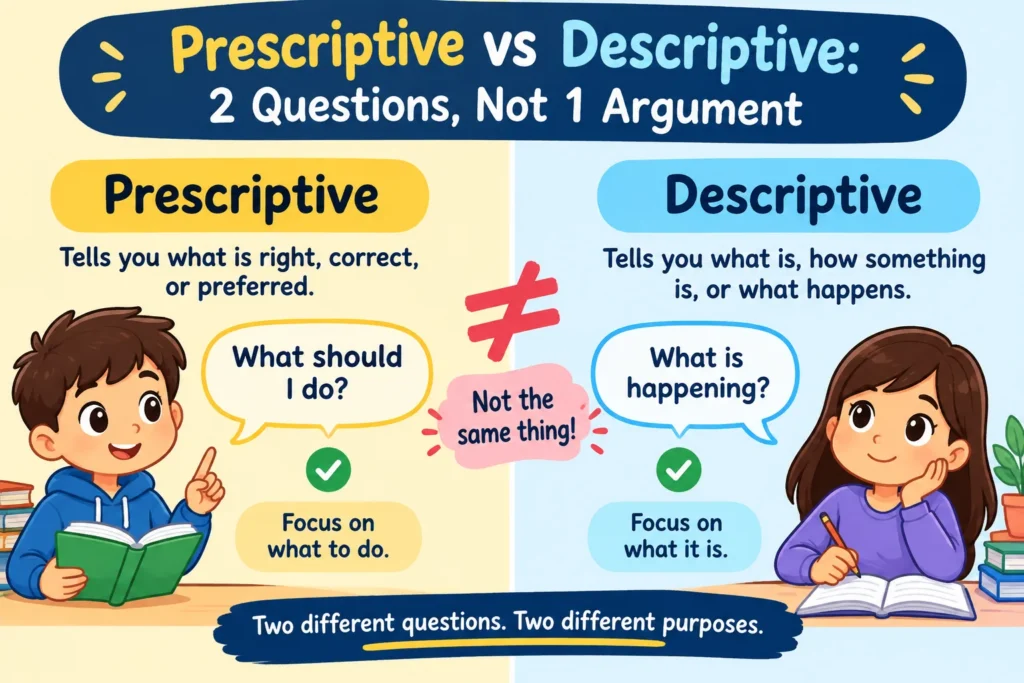
That is why these arguments never end, and why quoting one source at the other settles nothing at all.
Written by Naveed Akhtar, an SEO content writer with 10 years of article-writing experience. About 8 minutes to read.
Prescriptive vs Descriptive: Two Questions, Not Two Camps
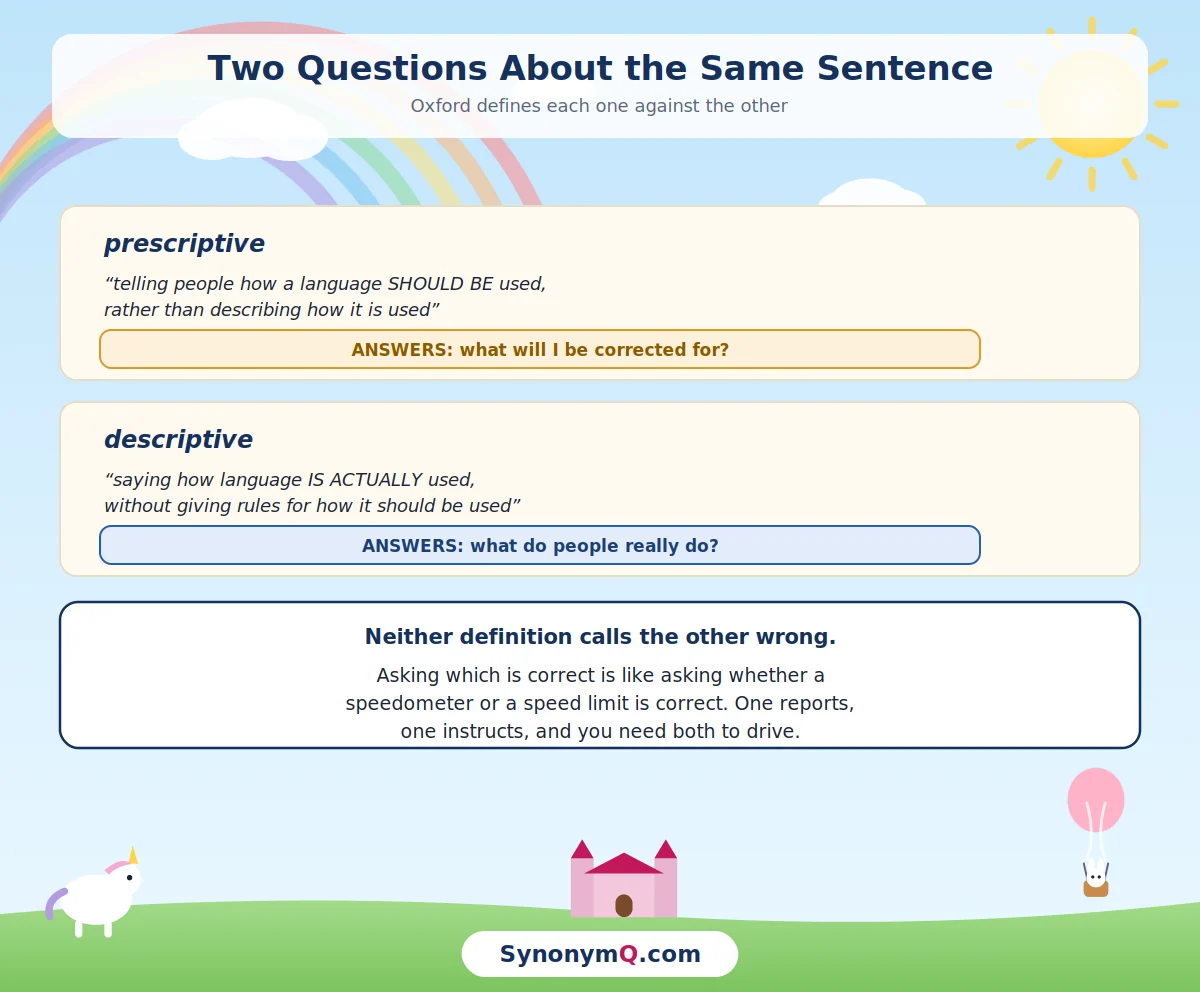
Start with the dictionary definitions, because they define each other and that tells you most of what you need.
| Word | Definition | The question it answers |
|---|---|---|
| prescriptive | “telling people how a language should be used, rather than describing how it is used” | What will I be corrected for? |
| descriptive | “saying how language is actually used, without giving rules for how it should be used” | What do people really do? |
Neither definition claims the other is wrong. They describe two jobs. A prescriptive source is a guide to consequences; a descriptive source is a record of behaviour.
What a Dictionary Is Actually Doing
Most people assume a dictionary is the referee. It is not, and the dictionaries say so themselves.
Merriam-Webster sets out three tests a word must pass to be entered, and none of them is about whether the word is any good.
| Test | What it means |
|---|---|
| Frequent use | Used that way over time, rather than as a passing trend |
| Widespread use | Used across industries and regions, so an average adult is likely to meet it |
| Meaningful use | It communicates something people agree on |
Their summary of the whole process is short: “A word gets into a dictionary when it is used by many people who all agree that it means the same thing.”
And on what a dictionary is for: “A dictionary isn’t an idea museum, it’s a user’s manual for communication.”
So when somebody wins an argument with “it’s in the dictionary,” what they have proved is that enough people use it. That is a real fact, and it is not the same as a licence.
The Same Source Answers Both, If You Ask Differently
Here is the part that most explanations of this topic miss. The divide is not between sources at all.
A single descriptive dictionary will give you a prescriptive answer the moment you ask it directly.
Merriam-Webster records flaunt in the sense of flout as a numbered definition. That is the descriptive answer: people write it, so it is listed.
Then, in its own article about the pair, the same dictionary turns around and warns you off it.
Including the sense “does not mean that we are suggesting you use it in such a fashion, and most copy editors, usage guides, and grammatically inclined pickers of nits would judge you for doing so.”
You can watch the whole thing happen on one page at flaunt vs flout, where the two mix-ups sit at different levels of recognition and the dictionary is explicit about what that does and does not mean.
So Which One Should You Follow?
The practical answer is not a compromise, and it is not “it depends.” It is a division of labour.
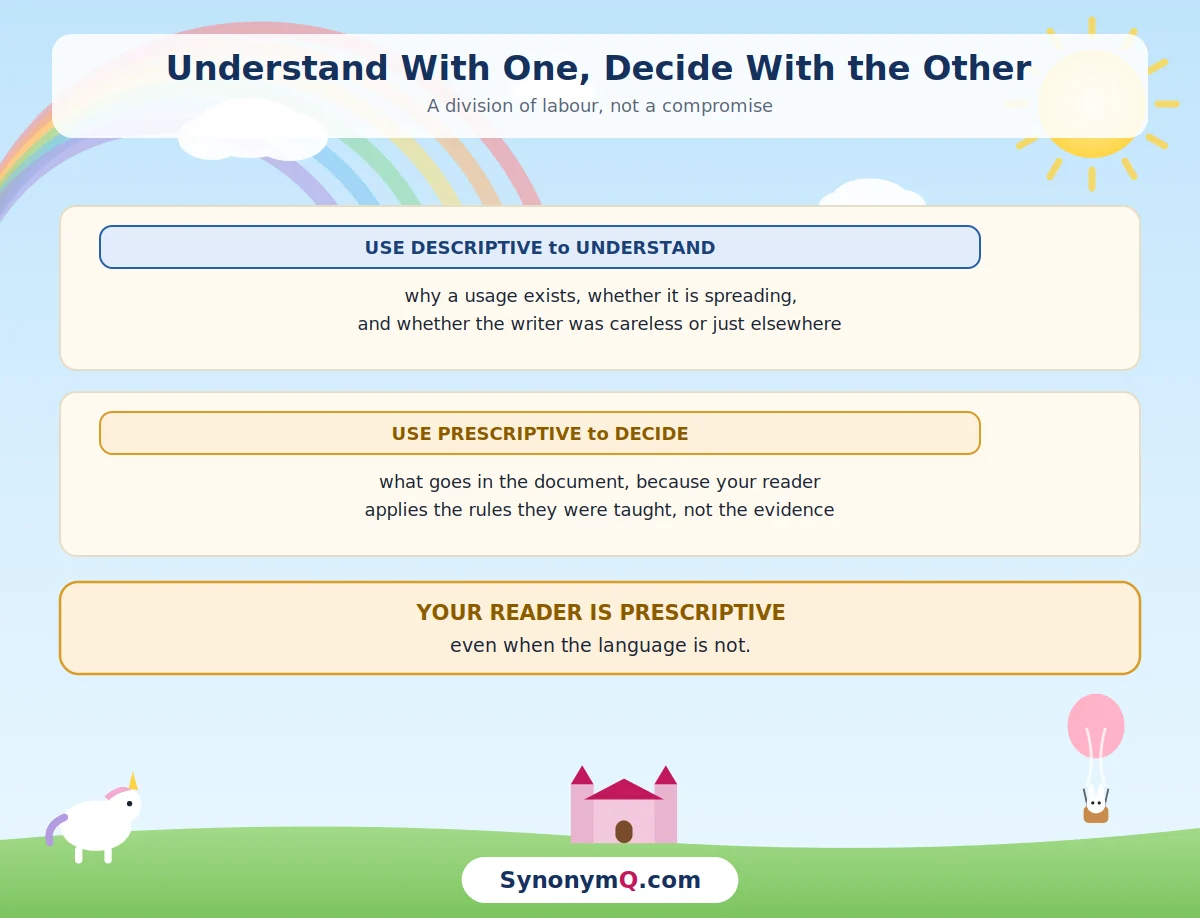
Use the descriptive answer to understand. Use the prescriptive answer to decide.
The descriptive answer tells you why a usage exists, whether it is spreading, and whether the person who wrote it was careless or simply somewhere you are not. That is worth knowing and it stops you correcting people who are not wrong.
The prescriptive answer tells you what happens to your document. Your reader is prescriptive even when the language is not. An editor, a hiring manager or a client is not running a corpus study; they are applying the rules they were taught.
Where the Arguments Come From
Almost every long argument about English is a prescriptive vs descriptive collision wearing a disguise, and they all have the same shape: one person quoting a dictionary at somebody holding a style guide.
The dictionary says the usage is recorded. The style guide says it is not acceptable here. Both are reporting accurately about their own domain, and neither is answering the other.
| Source | Mostly | Good for |
|---|---|---|
| Dictionaries | Descriptive | What a word means and whether a use is established |
| Style guides and house rules | Prescriptive | What this publication or employer will accept |
| Usage articles, including dictionaries’ own | Both at once | What is recorded, and what it will still cost you |
That third row is where most useful writing advice lives, and it is why a dictionary’s usage note is often more practical than its entry.
Labels Are the Dictionary Doing Both Jobs
There is a quiet mechanism that resolves most of this, and it sits in the entries themselves rather than in the argument about them.
When a dictionary marks a sense formal, informal, old-fashioned or North American, it is recording the usage and simultaneously telling you where it belongs. That is a descriptive fact doing prescriptive work.
A label does not say a usage is wrong. It says it is correct somewhere specific, which is far more useful than a verdict, because it tells you exactly when you can use it and when you cannot.
Applying It to Any “Is This Wrong” Question
Work down this list the next time you hit one.
- Is it recorded in a major dictionary? If yes, the people using it are not ignorant. That settles the descriptive question and nothing else.
- Does the entry carry a label? Formal, informal, North American, old-fashioned. A label is the dictionary telling you where the usage lives.
- Is there a usage note? That is the descriptive source answering the prescriptive question, and it is the most useful paragraph on the page.
- Who reads this document? If it will be edited, marked or judged, follow the conservative form regardless of what is recorded.
- Is it your own writing, for readers you know? Then the recorded usage is genuinely available to you.
| Where | Verdict | Why |
|---|---|---|
| A recorded usage, in casual or personal writing | Direct Swap | Nobody is marking it, and the dictionary is behind you |
| A recorded but regionally labelled usage, for a mixed audience | Swap With Adjustment | Correct where you are, unfamiliar elsewhere. Use the unlabelled form instead |
| A recorded usage carrying a warning note, in an edited document | Requires Rewrite | The dictionary has told you in advance that editors will change it |
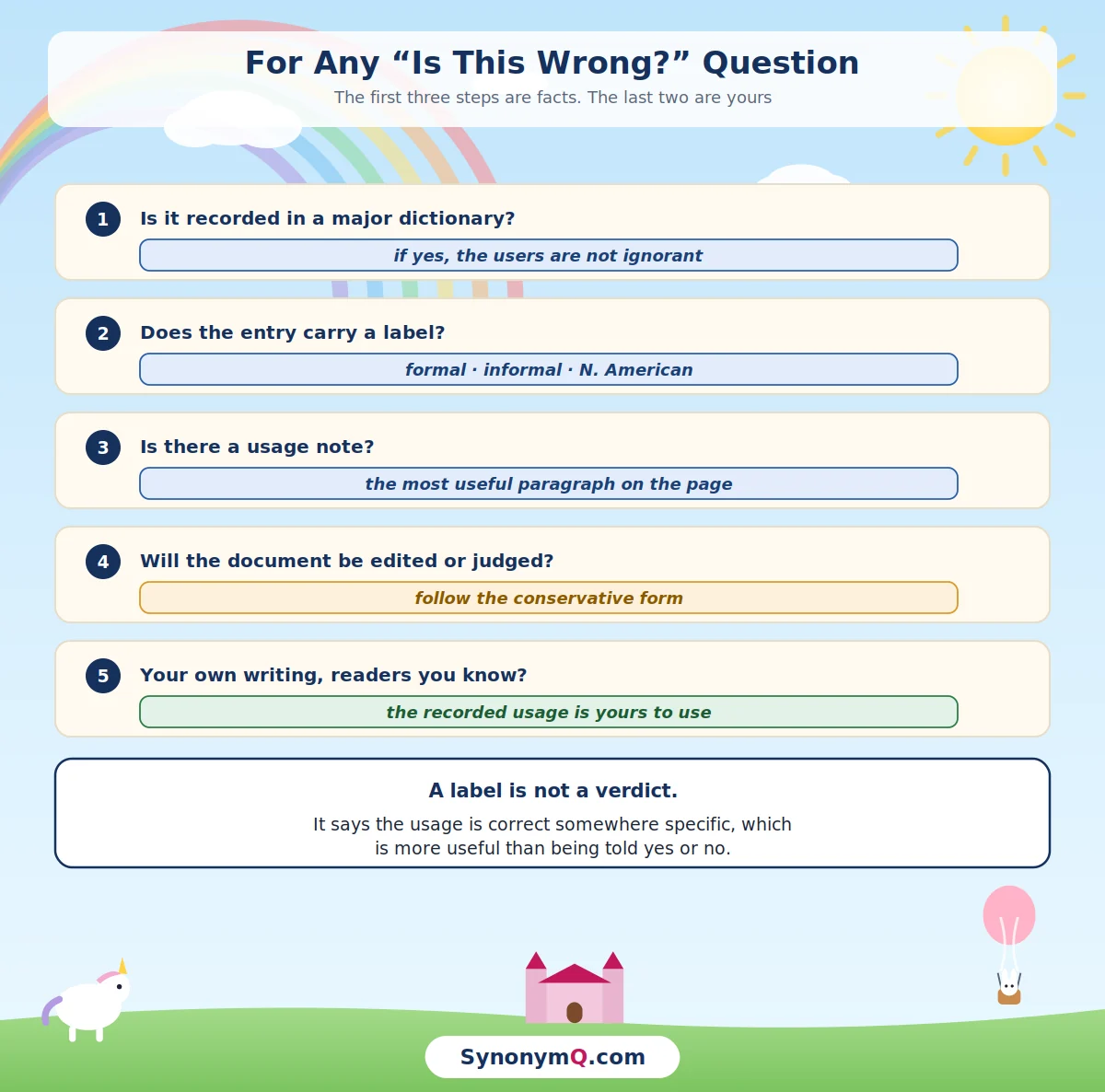
Notice that only the last two steps are about you. The first three are about prescriptive vs descriptive evidence, and they are the same whoever is asking.
Row two is exactly the situation at assure vs ensure vs insure, where Oxford labels a sense North American. Row three is flaunt vs flout.
And when two dictionaries simply disagree about a word’s tone, as they do at kindly in an email, the same rule applies: the recorded facts explain your reader’s reaction, and your reader still decides.
Frequently Asked Questions
What is the difference between prescriptive and descriptive grammar?
A prescriptive grammar tells you how the language should be used. A descriptive grammar records how it is actually used. Oxford defines each against the other, and neither claims the other is mistaken.
Are dictionaries prescriptive or descriptive?
Mainly descriptive. Merriam-Webster enters a word when it is used frequently, widely and meaningfully, and describes a dictionary as “a user’s manual for communication” rather than an idea museum.
If it is in the dictionary, is it correct?
It is established, which is not the same thing. Being recorded means enough people use it consistently. Whether it is correct for your document depends on who is reading and what they will accept.
Which approach is right?
Neither, because they answer different questions. Use the descriptive answer to understand why a usage exists, and the prescriptive answer to decide what to put in a document somebody else will judge.
Why do usage guides and dictionaries disagree?
They usually do not. A dictionary reports that a usage exists; a guide reports that it is unwelcome in a particular setting. Both statements can be true, which is why quoting one at the other settles nothing.
How This Page Was Checked
Read from the sources attributed, on 29 September 2026:
- Oxford Learner’s Dictionaries, prescriptive: the linguistics sense, “telling people how a language should be used, rather than describing how it is used.”
- Oxford Learner’s Dictionaries, descriptive: the matching sense, “saying how language is actually used, without giving rules for how it should be used.”
- Merriam-Webster, “How Does a Word Get Into the Dictionary?”: the three criteria, the summary sentence about many people agreeing on a meaning, and the “user’s manual for communication” line.
- Merriam-Webster, “Is It Wrong to Confuse Flaunt and Flout?”: the passage quoted in full in section three.

Naveed Akhtar writes every guide on SynonymQ. He is an SEO content writer with ten years of article-writing experience, working on the question a thesaurus never answers: which of these words belongs in this sentence, for this reader. Every page cites the dictionary entries it draws on and the date they were read.