
Kindly in an Email: 2 Dictionaries, 2 Different Readings
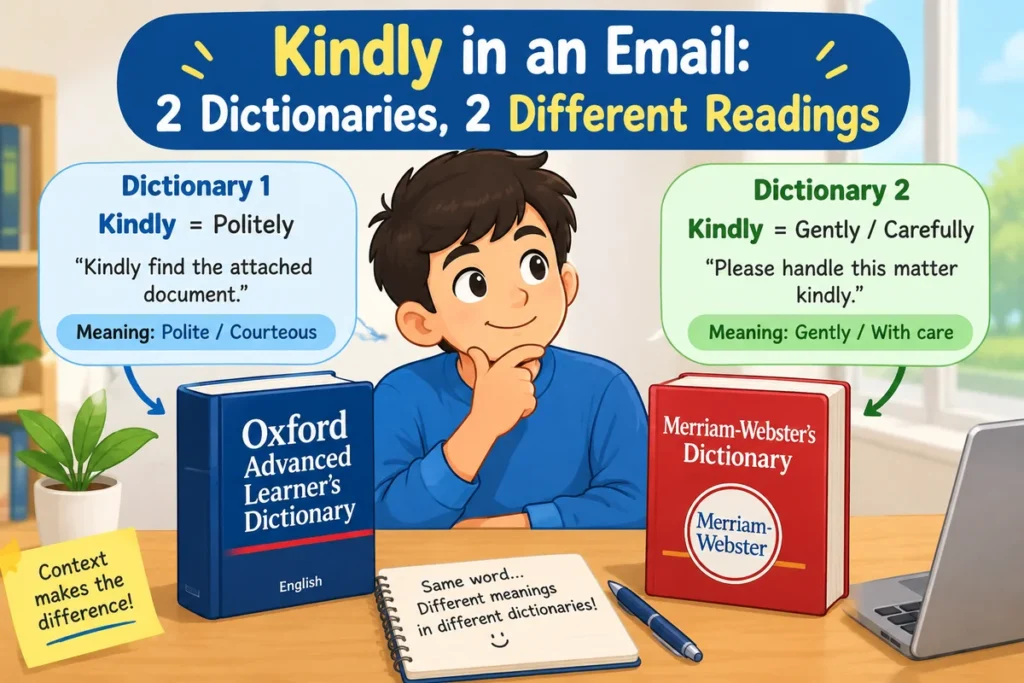
Writing kindly in an email is not rude, and it is not wrong. But Oxford records the request sense as formal and notes it is sometimes used when you are annoyed, while Merriam-Webster simply calls it courtesy. Two dictionaries, two readings, one word.
Written by Naveed Akhtar, an SEO content writer with 10 years of article-writing experience. About 8 minutes to read.
Where the Argument Actually Comes From
This is one of the most argued-about words in workplace email. Search for it and you will find the same question asked on language forums, on Quora and on workplace boards, usually by somebody who has just received an email and cannot tell whether they were snapped at.
The usual explanations blame the writer, or blame the reader, or blame a region. None of those is necessary, because the split is visible in the dictionaries themselves.
Kindly in an Email: What the Two Dictionaries Record
Put the two entries side by side. This is the whole finding, and it takes about ten seconds to check.
| Dictionary | How it defines the request sense | Warning attached? |
|---|---|---|
| Oxford Learner’s | “(old-fashioned or formal) used to ask or tell somebody to do something, sometimes when you are annoyed” | Yes. Formality and irritation, in the same sense |
| Merriam-Webster | “as a matter of courtesy : please” | No. No formal marking, no note about annoyance |
Oxford even gives both poles as examples in the same entry: Kindly leave me alone! and Visitors are kindly requested to sign the book.
One of those is a snap. The other is a notice on a museum wall. The dictionary is not confused; the word genuinely does both jobs, and nothing in the sentence tells you which one is meant.
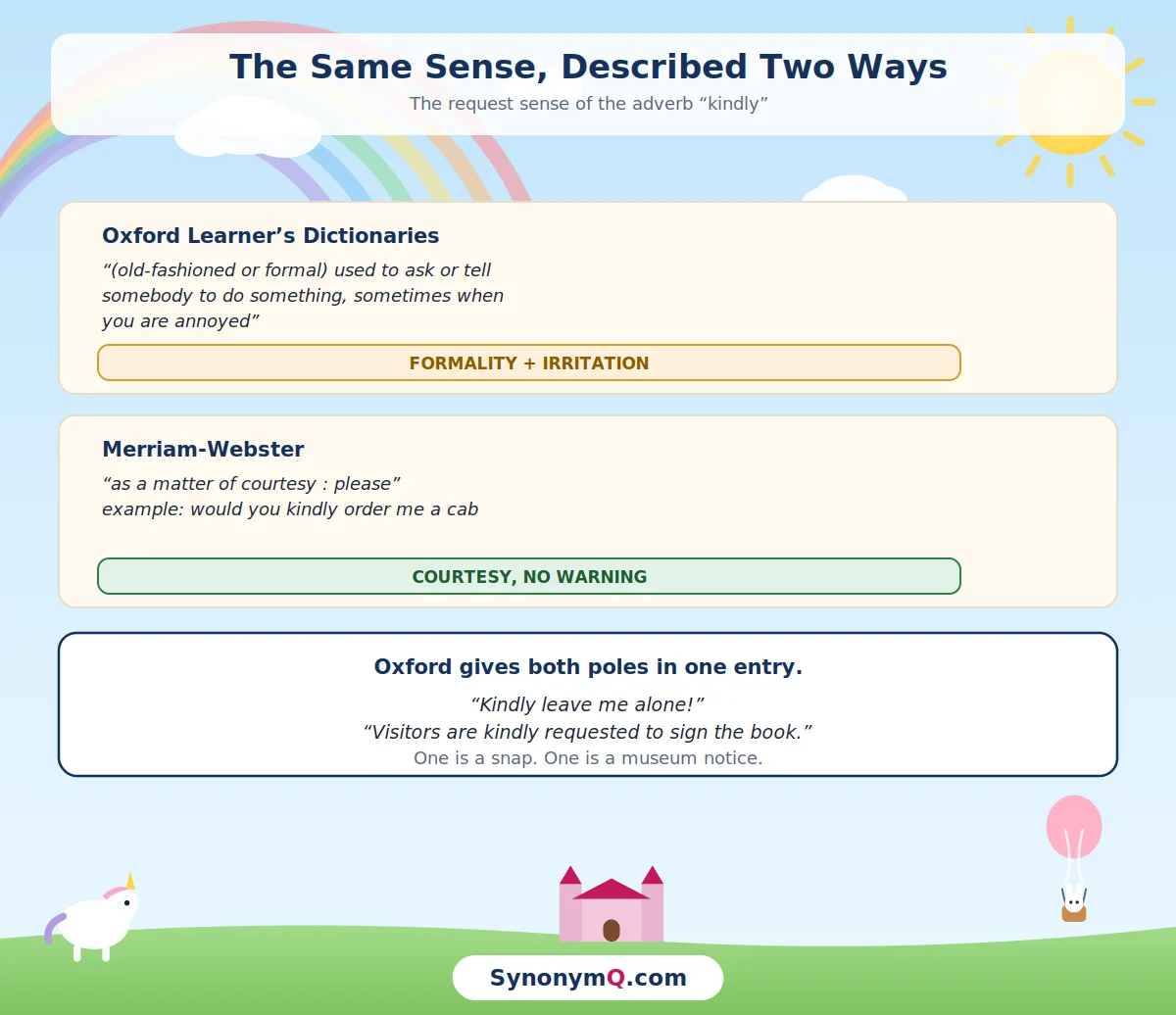
Merriam-Webster’s example is would you kindly order me a cab, which is plainly polite. Oxford’s is kindly leave me alone, which is plainly not. Both are real sentences that English speakers write.
Why the Same Email Reads Two Ways
Once you have seen the two entries, the office argument stops being mysterious.
A writer using kindly is almost always reaching for the formal, institutional register: the one in visitors are kindly requested. It signals care and distance, which is exactly what a polite request to a colleague wants.
A reader who has mostly met the word in its other use hears the other thing. To them it lands the way kindly leave me alone lands, because that is where they have heard it most.
| The email says | The writer means | Some readers hear |
|---|---|---|
| Kindly send the file by Friday. | A formal, careful request | An order, with impatience behind it |
| Kindly confirm receipt. | Standard business courtesy | A reminder that they should have already |
Neither side is misreading the word. Both readings are recorded. The writer is using a sense a dictionary supports, and so is the reader, and the email still goes wrong.
Words that arrive carrying a tone the writer did not put there are the recurring problem behind what to say instead of per my last email and please advise.
The Structure Predicts the Reading
Look again at Oxford’s two examples and you will notice they are not built the same way. That difference is the most useful thing on this page, because it is something you can check in your own draft.
| Structure | Example | How it lands |
|---|---|---|
| Kindly in front of a bare command | Kindly leave me alone! Kindly send the file. | Sharp. The word is decorating an order |
| Kindly inside a passive request | Visitors are kindly requested to sign the book. | Institutional. Nobody is being told off |
The imperative is what makes it bite. Put kindly in front of a command and you have softened nothing; you have added a formal word to an instruction, and some readers hear the instruction louder for it.
The passive version distributes the request across an institution rather than pointing at a person. That is why signage can use kindly in an email’s most formal register without anyone flinching.
Please Has No Such Split
The contrast is worth seeing, because it explains why the safe alternative is so ordinary.
Oxford gives please five senses. The ones that matter for a request are glossed as “used as a polite way of asking for something or telling somebody to do something” and “used to add force to a request.”
Only one minor sense carries any marking at all, the exasperated Children, please!, which Oxford labels informal and often humorous. Nothing in the request senses is marked formal, old-fashioned or annoyed.
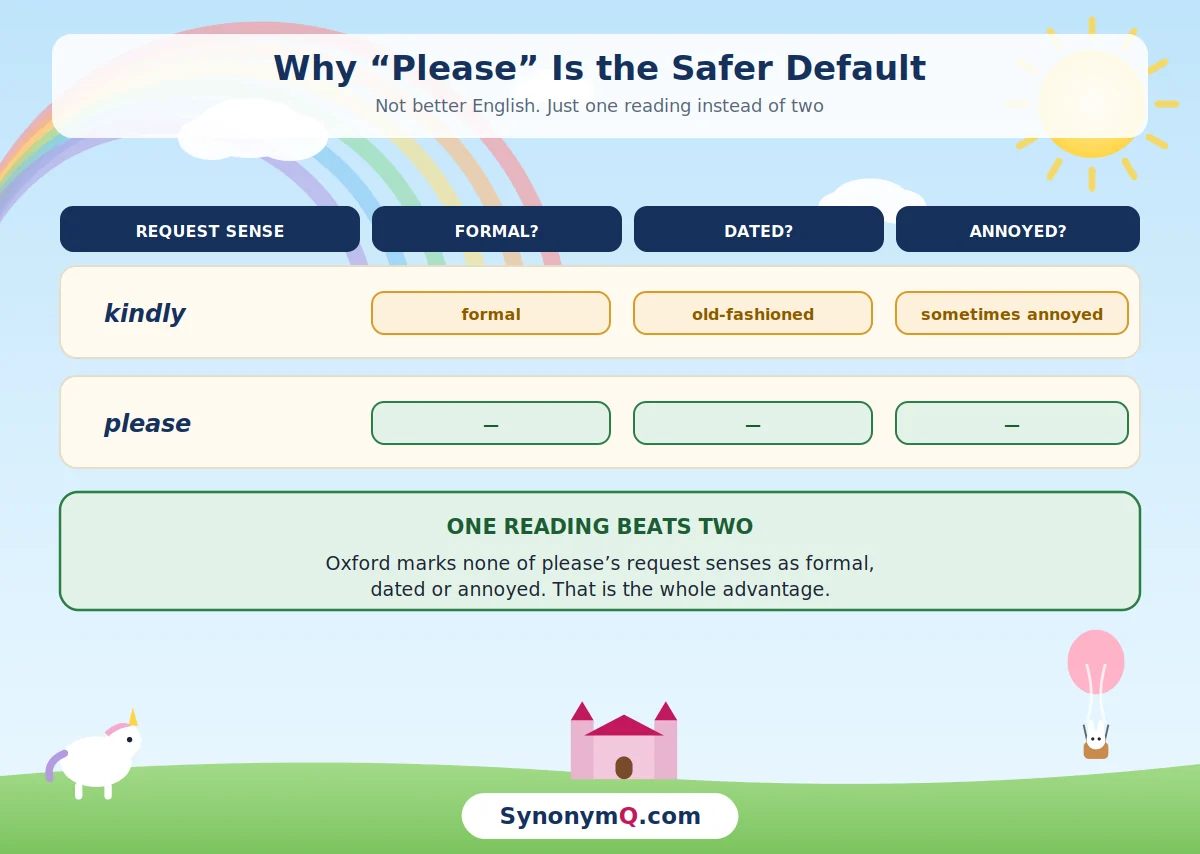
So please is not better English than kindly. It is simply a word with one reading instead of two, which is what you want when you do not know who is opening the email.
What to Write Instead, and When
You do not need a thesaurus for this. You need three constructions, and the choice between them is about how much distance you want.
| Instead of | Write | Register |
|---|---|---|
| Kindly send the file. | Please send the file. | Neutral, works everywhere |
| Kindly confirm receipt. | Could you confirm you have received this? | Warmer, and it makes the request a question |
| Kindly note the deadline. | The deadline is Friday 3pm. | No request at all. Often the best version |
That third row is the one people skip. A large share of sentences beginning kindly note are not requests, they are statements, and a statement does not need a politeness marker in front of it.
Choosing in a Real Sentence
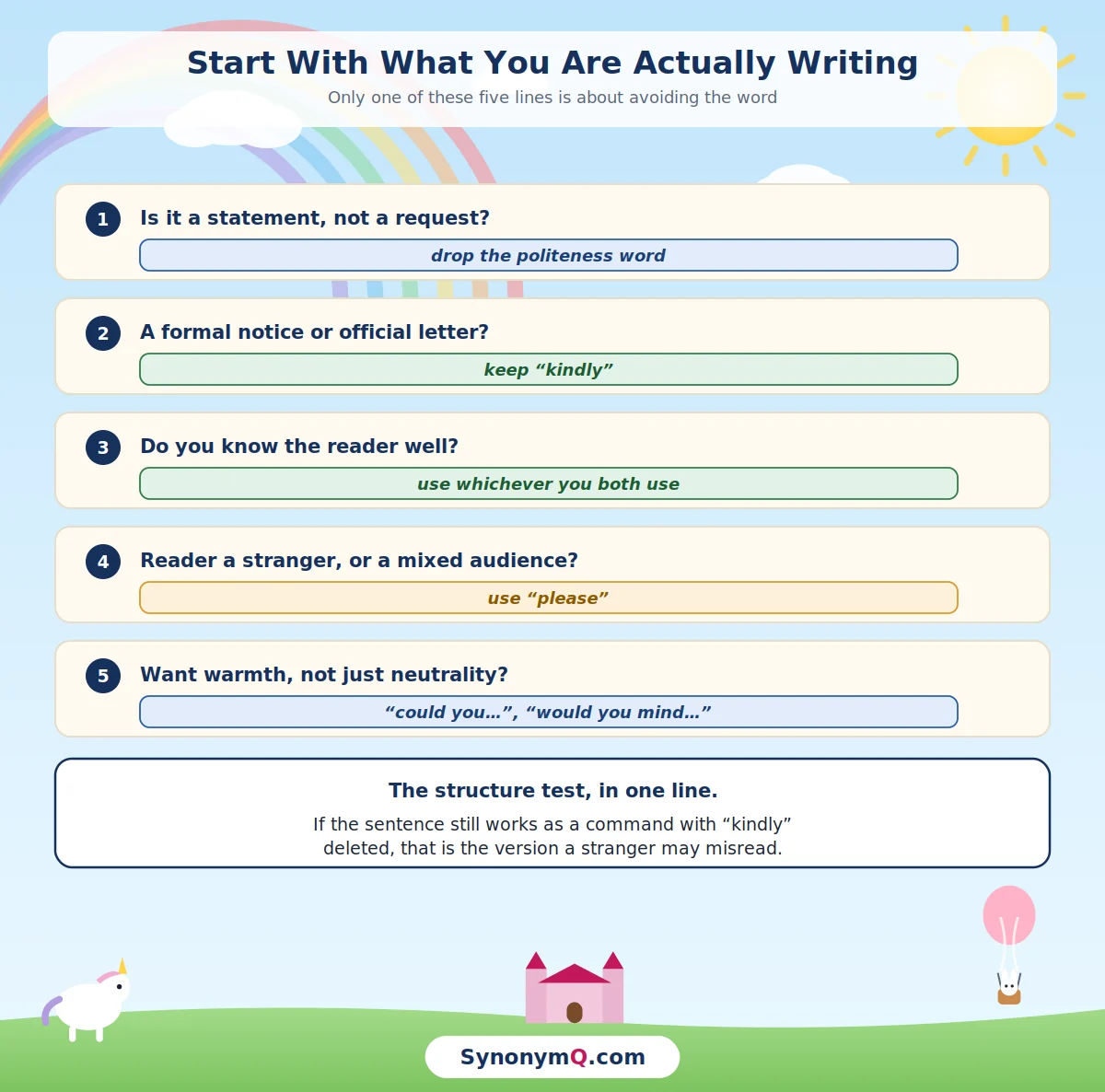
Work down this list and stop at the first line that matches.
- Is it actually a statement rather than a request? Drop the politeness word entirely and just say the thing.
- Is this a formal notice, or writing for an institution? Keep kindly. That is the register it belongs to.
- Do you know your reader and their habits? Use whichever you both use. This question only matters between strangers.
- Is the reader outside your usual circle, or a large mixed audience? Use please. One reading beats two.
- Do you want to sound warmer rather than just neutral? Turn it into a question: could you, would you mind.
| Where | Verdict | Why |
|---|---|---|
| kindly to please, in a request | Direct Swap | Merriam-Webster glosses kindly as “please” outright |
| kindly to could you | Swap With Adjustment | Same ask, but it becomes a question and gives the reader room to answer |
| kindly in a formal notice, to anything else | Requires Rewrite | The institutional register is the point; please remain seated reads as a different kind of document |
Choosing the word that cannot be misread, rather than the one that is merely defensible, is the same instinct that settles another word for please find attached.
Frequently Asked Questions
Is “kindly” rude in an email?
Not by itself. Merriam-Webster glosses the request sense as “as a matter of courtesy: please.” But Oxford marks the same sense old-fashioned or formal and notes it is sometimes used when the writer is annoyed, so some readers hear that instead.
Is it “kindly” or “please” in a professional email?
Both are correct. Please is the safer default with a reader you do not know, because Oxford marks none of its request senses as formal or annoyed. Kindly is the better fit in formal notices and official correspondence.
Why does “kindly” sound demanding to some people?
Because one of its recorded uses is exactly that. Oxford’s own example is Kindly leave me alone! A reader who has met the word mostly in that shape will hear the same force in a routine request.
Can I use “kindly” with a deadline?
You can, but consider whether you are making a request at all. Kindly note the deadline is Friday is a statement wearing a request’s clothes. The deadline is Friday 3pm says more and risks less.
Is “kindly” old-fashioned?
Oxford labels the request sense “old-fashioned or formal.” Merriam-Webster adds no such label. The word is current in formal and institutional writing; whether it reads as dated elsewhere depends on the reader.
How This Page Was Checked
Read from the sources attributed, on 27 September 2026:
- Oxford Learner’s Dictionaries, kindly: sense 2, “(old-fashioned or formal) used to ask or tell somebody to do something, sometimes when you are annoyed,” and both example sentences quoted above.
- Merriam-Webster, kindly: the adverb sense “as a matter of courtesy : please,” with would you kindly order me a cab, and the absence of any formality or annoyance label.
- Oxford Learner’s Dictionaries, please: the request senses, and the labelling of only the exasperated sense as informal and often humorous.
This page describes what two dictionaries record. It does not claim that any group of English speakers uses the word incorrectly, because neither dictionary supports that claim.

Naveed Akhtar writes every guide on SynonymQ. He is an SEO content writer with ten years of article-writing experience, working on the question a thesaurus never answers: which of these words belongs in this sentence, for this reader. Every page cites the dictionary entries it draws on and the date they were read.