
Please Find Attached: 5 Alternatives and the Right One to Use
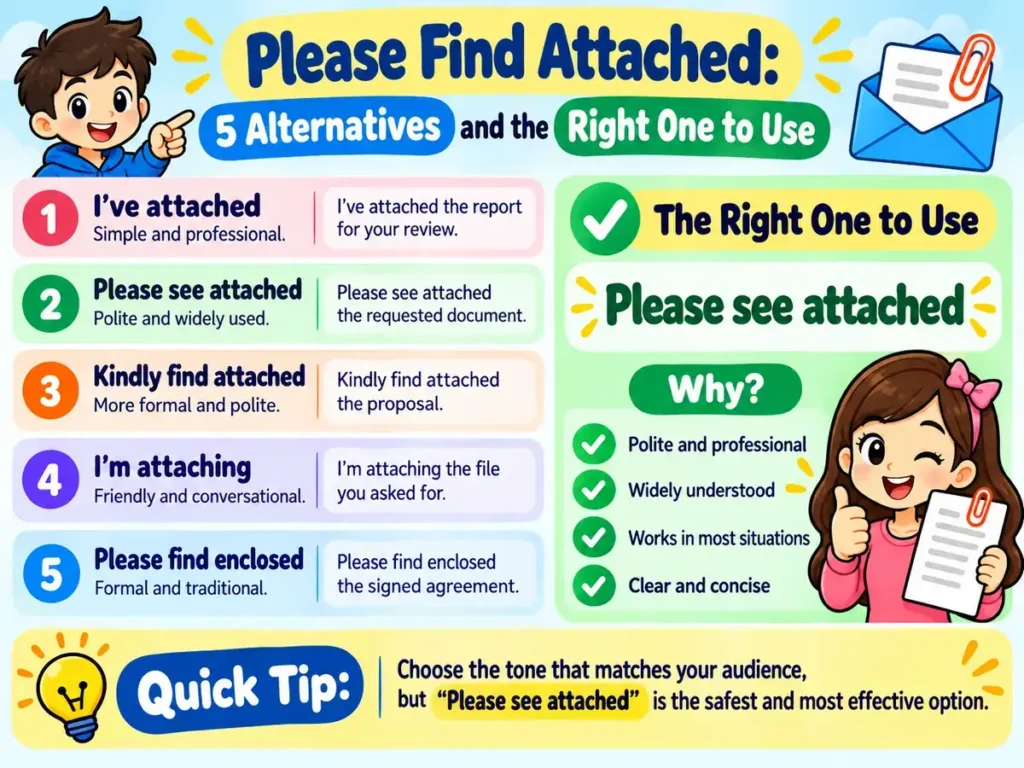
Please find attached has no shortage of replacements. What it lacks is a way to choose one. The alternatives are not synonyms: each asks your reader for something different — to note a fact, to look, to check a claim, or to act. Pick by the ask.
By Naveed Akhtar, an SEO content writer with 10 years of article-writing experience · Updated 22 September 2026 · About 8 minutes
Please Find Attached: What the Phrase Actually Asks For
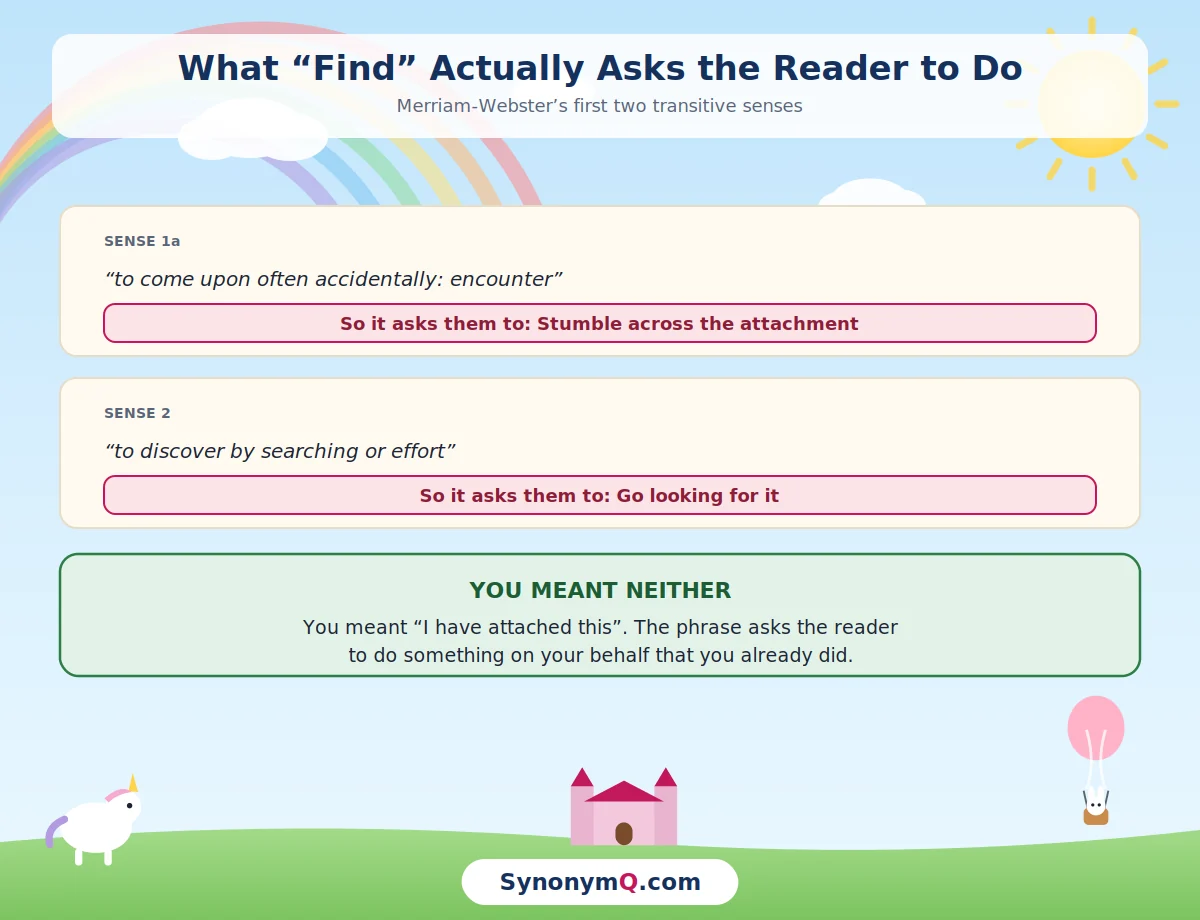
Start with what the words in please find attached are doing, because the usual complaint stops at “it sounds old” and that is not actionable.
Merriam-Webster’s transitive senses of find open like this:
| Sense | Reads | So the imperative asks the reader to… |
|---|---|---|
| 1a | “to come upon often accidentally: encounter” | Stumble across the attachment |
| 2 | “to discover by searching or effort“ | Go looking for it |
You meant neither. You meant “I have attached this.” The phrase asks the reader to do something on your behalf that you have already done.
Being precise about how strong that is. No sense of find is marked archaic, and Merriam-Webster carries no usage note condemning the formula. This is an observation about fit, not a ruling. The phrase is not an error.Please find attached is a fossil from commercial correspondence, and fossils are not wrong. They just stop matching what anyone is doing, and the reader notices the gap before they can name it.
Every List Online Gives You Options and No Axis
Search please find attached and you will get between fifteen and fifty replacements from every result on the page. Counting from the current top ten: thirty, fifteen, fifty, twenty, nineteen, thirty.
The strongest page on that page says the quiet part itself. HubSpot’s list of twenty offers no method for selecting among them, labels a few as formal or informal, and advises you to “sound human”.
A list of thirty with no axis is harder to use than a list of five with one. Faced with thirty, you pick the one that sounds nicest, which is how please find attached became the default in the first place.None of those pages explains what please find attached is doing wrong, either. They call it robotic and outdated, which tells you to stop using it and nothing about what to use instead.
So the useful cut is not a longer list. It is the question the listicles skip: what are you actually asking this reader to do?
The 5 Alternatives, Sorted by What You Are Asking
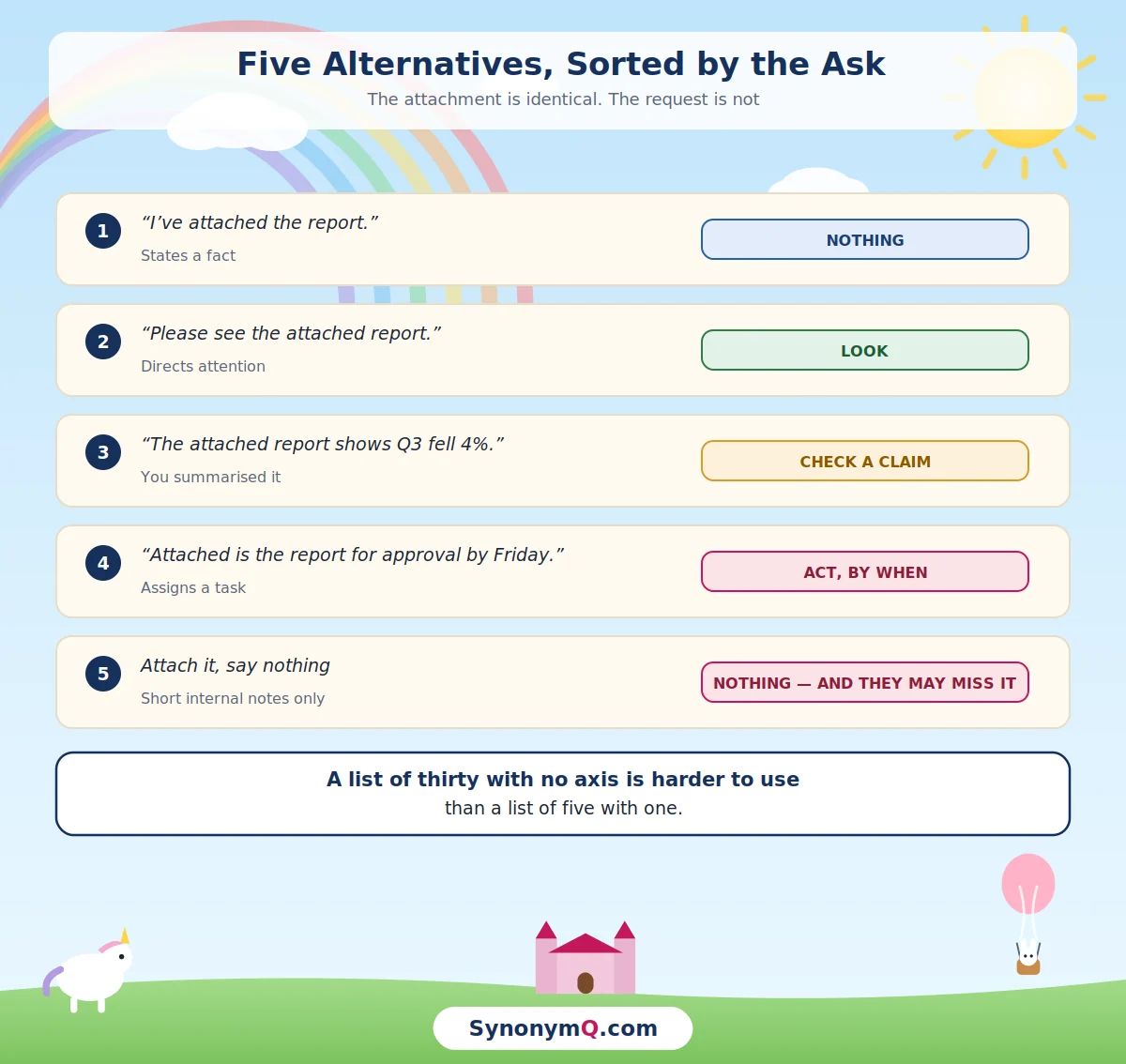
| # | Write | What it asks of the reader | Use when | Label |
|---|---|---|---|---|
| 1 | “I’ve attached the report.” | Nothing. States a fact | They are expecting it, or it is background | Direct Swap |
| 2 | “Please see the attached report.” | Look at it. Directs attention | The attachment is the point of the email | Direct Swap |
| 3 | “The attached report shows Q3 fell 4%.” | Check a claim. You have summarised it | You want them to engage with a finding, not a file | Swap With Adjustment |
| 4 | “Attached is the report for your approval by Friday.” | Do something, by when. Assigns a task | You need a decision, not a read | Swap With Adjustment |
| 5 | Attach it and write nothing about it | Nothing, and they may not notice | Short internal notes only | Requires Rewrite |
Row three is the one most writers skip and the one that saves the most time. Summarising the finding in the sentence means the reader can reply without opening anything.
Row five is on the list because it is common advice and it has a real cost. An attachment with no sentence is easy to scroll past, and you will be chasing a reply that never comes.
Notice what changed between rows one and four. The attachment is identical. What differs is the amount of work you are handing over, and the phrase you pick is what tells them.Which Ask Do You Have?
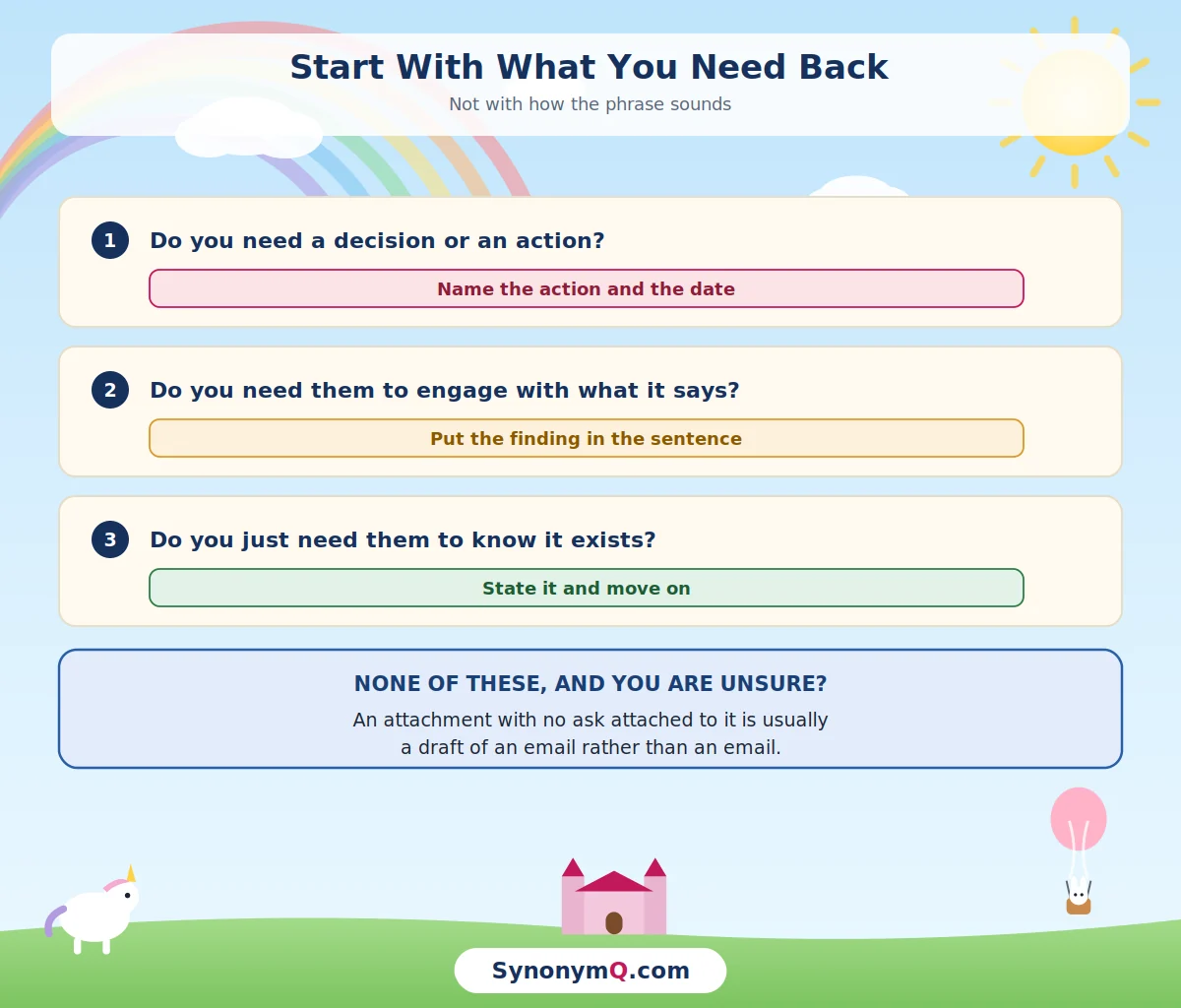
Three questions, and the first one settles most emails.
| Ask | If yes |
|---|---|
| Do you need a decision or an action? | Row 4. Name the action and the date |
| Do you need them to engage with what it says? | Row 3. Put the finding in the sentence |
| Do you just need them to know it exists? | Row 1. State it and move on |
| None of these, and you are unsure? | You may not need to send the attachment yet |
That last row is not a joke. An attachment with no ask attached to it is usually a draft of an email rather than an email.
Choosing a phrase by what it commits the reader to, rather than by how warm it sounds, is the same judgement behind please advise.
“Please Find Attached” or “Please Find the Attached”?
A smaller question turns up alongside please find attached, and it has a clean answer.
Both are grammatical. They attach to different things. Please find attached the report treats attached as describing where the report is. Please find the attached report treats it as an adjective on report.
Older, and it strands the objectPlease find attached the signed agreement and the schedule. Ordinary word orderI’ve attached the signed agreement and the schedule.The first is not wrong. It is the construction that makes the phrase feel like a form letter, because ordinary English does not usually put the object that far from the verb.
Kindly find attached adds a second layer of the same thing, and kindly in a request reads as pressure to a good many readers.
“For Your Reference” Is Ask Number One in Disguise
The longest version of please find attached that people write is please find the attached file for your reference, and it is worth taking apart because every added word removes an ask.
| Part | What it adds |
|---|---|
| please find | Asks the reader to locate something you sent |
| the attached file | Names the thing, which the attachment already does |
| for your reference | Explicitly cancels the ask. It means “no action needed” |
So the long version is row one of the table above, wearing nine words instead of four. If you genuinely mean “no action needed”, say that: “I’ve attached the file — no action needed.”
If you did not mean that, for your reference is actively working against you. It tells a busy reader they can safely file the email, which is the opposite of what you wanted when you attached something.
When the Old Phrase Is Still Fine
An honest counterweight, because the listicles all tell you to drop please find attached and none of them says when not to.
| Context | Why |
|---|---|
| Formal legal or contractual correspondence | The register is already formulaic and the phrase matches it |
| Writing into a house style that uses it | Consistency beats individual preference in a document set |
| Regional business English where it is the norm | Reader expectation decides, not a style blog |
Please find attached is dated, not broken. If your reader will not notice it, the cost of using it is zero, and rewriting a colleague’s email to remove it is a poor use of everyone’s afternoon.
Frequently Asked Questions
What can I say instead of “please find attached”?
Pick by what you need back. I’ve attached the report states a fact. Please see the attached report asks them to look. Attached is the report for your approval by Friday asks them to act. They are not interchangeable.
Is “please find attached” rude or wrong?
Neither. Please find attached is a fossil from commercial correspondence. No dictionary marks it as an error, and the senses of find simply do not match the job — you are asking the reader to come upon something you already sent.
Is it “please find attached” or “please find the attached”?
Both are grammatical. The first puts the object after attached, which is the word order that makes it sound like a form letter. I’ve attached… avoids the question.
Should I say “kindly find the attached file”?
It stacks two formal markers on one request. Kindly reads as pressure to many readers, and the phrase it modifies is already the stiffest part of the sentence.
Is it fine to attach a file and say nothing?
Only in short internal notes. An attachment with no sentence is easy to scroll past, and the reply you are waiting for may never arrive.
How This Page Was Checked
Read from the sources attributed, on 22 September 2026:
- The transitive senses of find, their order, and the absence of any archaic marking or usage note on the formula — Merriam-Webster.
- The twenty alternatives, the absence of a method for choosing between them, and the “robotic, outdated” characterisation — HubSpot.
On the counts in section two. The figures of thirty, fifteen, fifty, twenty, nineteen and thirty are taken from the titles of the current top ten results, which state them. Only the HubSpot page was read in full.
What is reasoning rather than a retrieved fact. That the senses of find do not match the job the phrase is doing is an argument from the definitions, not a claim any dictionary makes.
Sorting the alternatives by what each one asks of the reader is this page’s own framing, and the five rows are illustrative rather than exhaustive.
What is deliberately not claimed. No survey data exists here on how readers react to the phrase, so the section on where it still fits is judgement about register, offered as such.
Written by Naveed Akhtar, an SEO content writer with 10 years of article-writing experience.
Related: what to say instead of per my last email and another word for however in an email cover two more phrases in the same inbox.

Naveed Akhtar writes every guide on SynonymQ. He is an SEO content writer with ten years of article-writing experience, working on the question a thesaurus never answers: which of these words belongs in this sentence, for this reader. Every page cites the dictionary entries it draws on and the date they were read.