
Flaunt vs Flout: 2 Mix-Ups, Only 1 Is a Definition
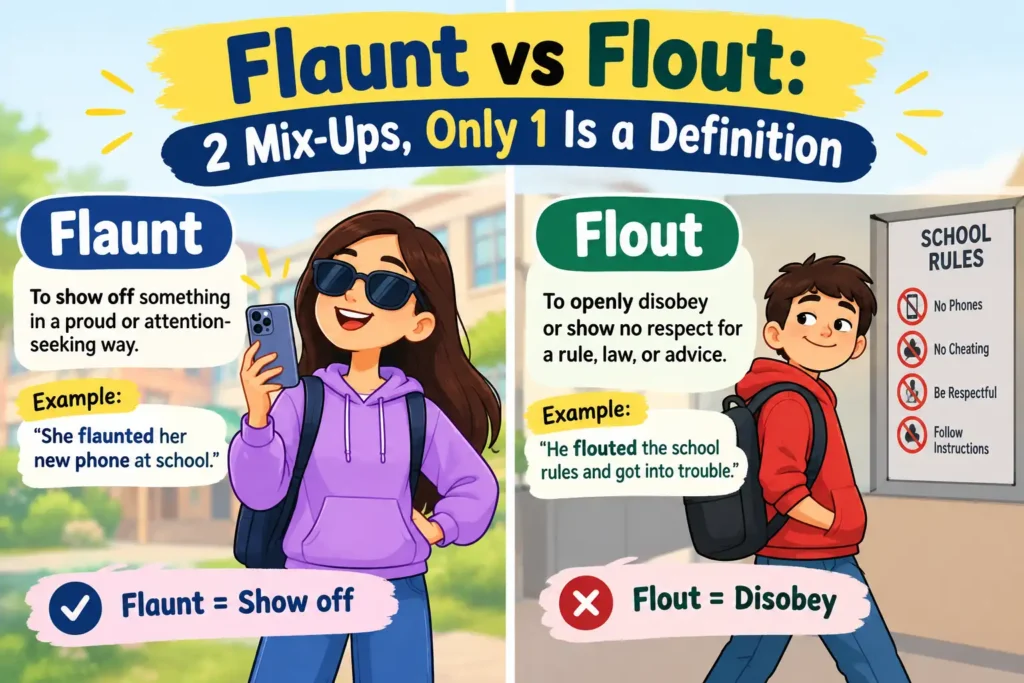
Flaunt vs flout is settled by the object, not the verb. You flout a law, a rule or a convention; you flaunt wealth, a body or a success. Both words get used for the other, but only one of those mix-ups has become a dictionary definition.
Written by Naveed Akhtar, an SEO content writer with 10 years of article-writing experience. About 8 minutes to read.
The Test Is the Object, Not the Verb
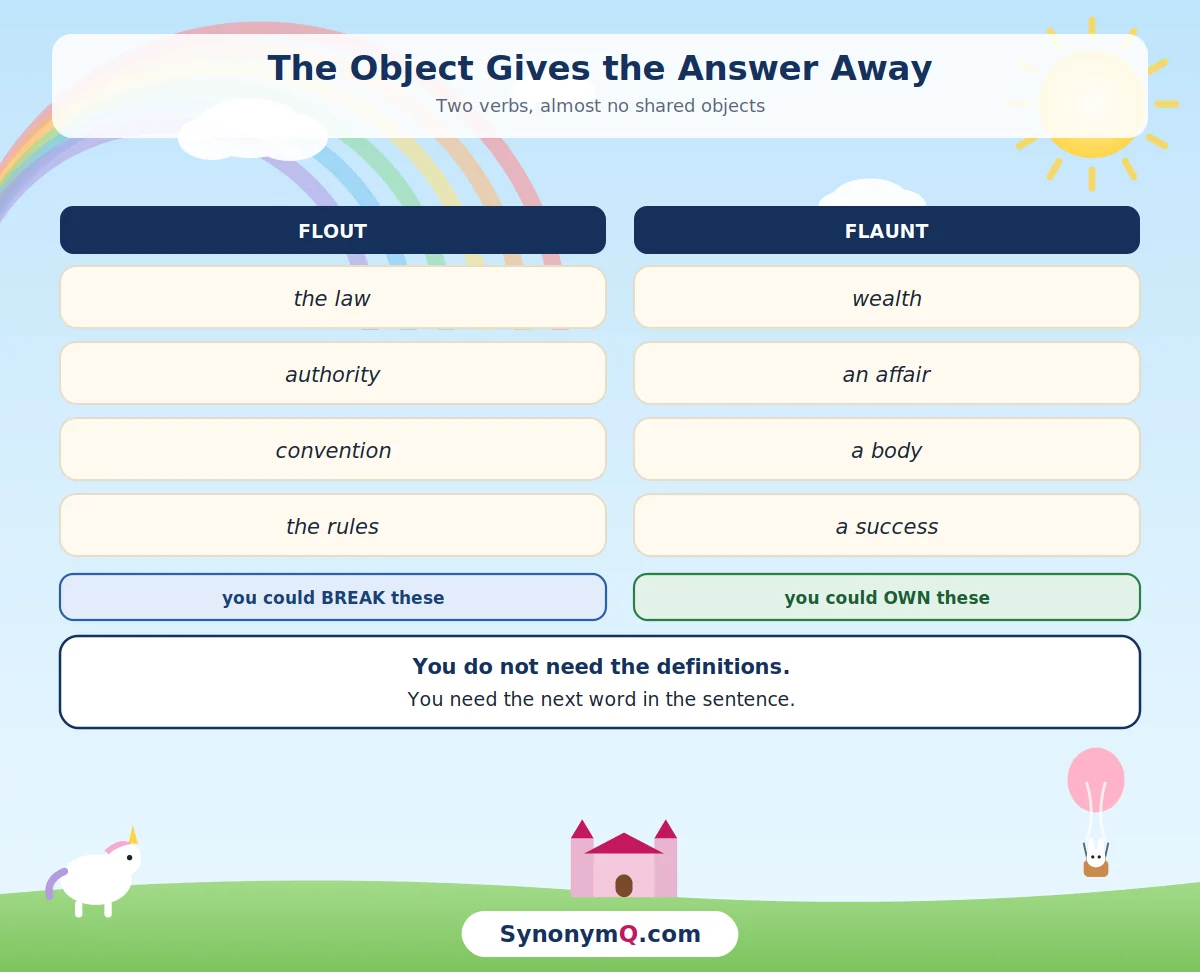
Most advice on this pair asks you to remember two definitions. That is harder than it needs to be, because these verbs take almost completely different objects and the object gives the answer away.
| Verb | Definition | What follows it |
|---|---|---|
| flout | “to show that you have no respect for a law, etc. by openly not obeying it” | the law, authority, convention, the rules |
| flaunt | “to show something you are proud of to other people, in order to impress them” | wealth, an affair, a body, a success |
If the thing after the verb is something you could break, it is flout. If it is something you could own, it is flaunt. That covers almost every sentence either word appears in.
Flaunt vs Flout: Both Mix-Ups Happen, and They Are Not Equal
The usual framing of flaunt vs flout is that people write flaunt the rules when they mean flout. That is the common error, but it is not the only one, and the dictionaries treat the two very differently.
| The mix-up | Merriam-Webster | Oxford Learner’s |
|---|---|---|
| flaunt used to mean flout “they flaunt the rules” | A numbered definition. Transitive sense 2: “to treat contemptuously” | Not recorded. Three senses, all about display |
| flout used to mean flaunt “flouting her refined upbringing” | A usage note only. “also found occasionally” | Not recorded. One sense, about disobeying |
One of these errors has been promoted to a definition. The other is a footnote. And a third dictionary declines to record either.
That is not two dictionaries contradicting each other. It is the same change caught at three different points on its way into the language.
How an Error Gets Recorded, in Three Stages
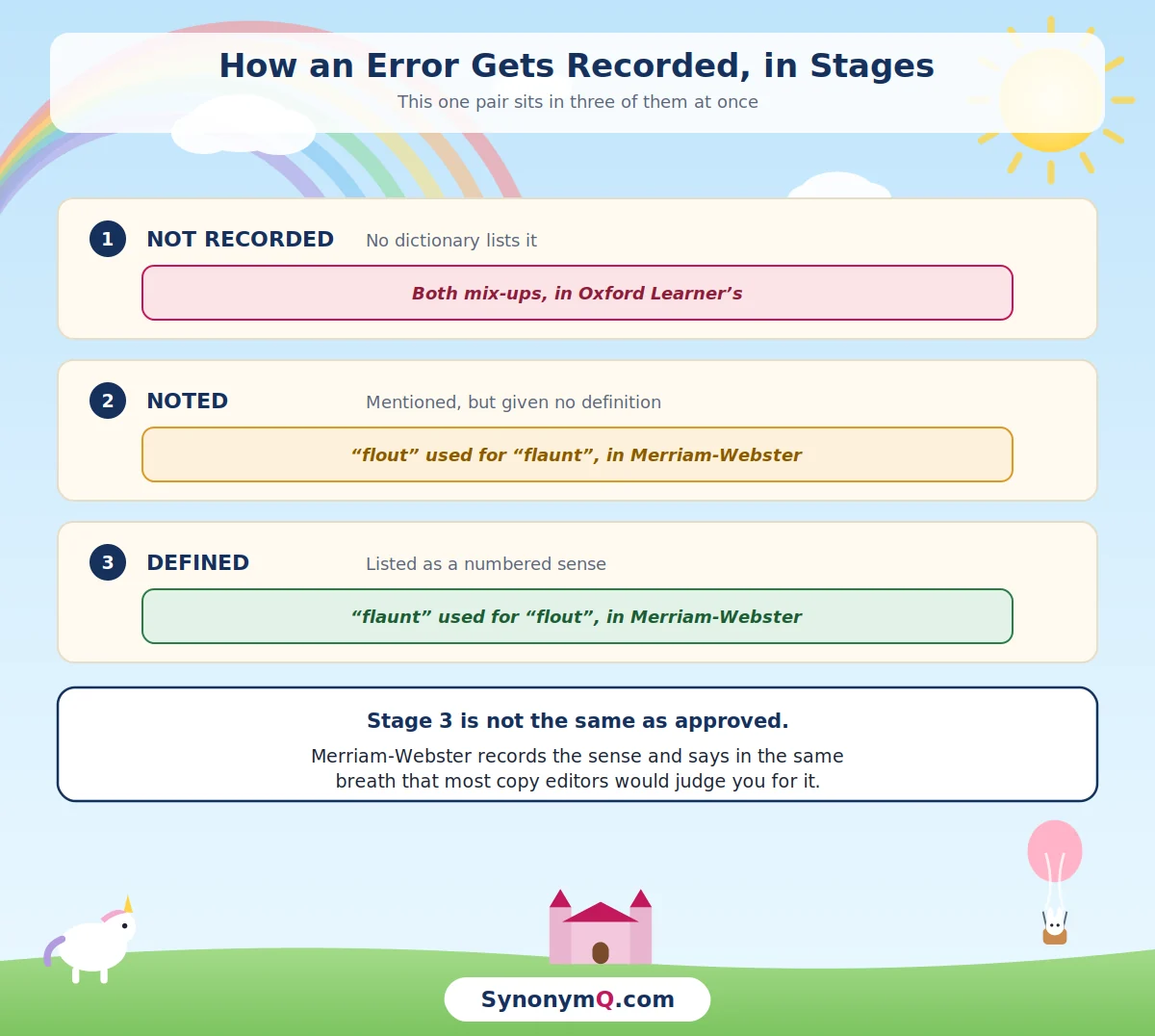
Words do not flip from wrong to right. They get written down in stages, and this pair happens to sit in three of them at once, which is why the advice you find is so inconsistent.
| Stage | What it means | Which usage is here |
|---|---|---|
| 1. Not recorded | No dictionary lists it; editors will treat it as a mistake | Both, in Oxford Learner’s |
| 2. Noted | Mentioned as occurring, without being given a definition | flout for flaunt, in Merriam-Webster |
| 3. Defined | Listed as a numbered sense of the word | flaunt for flout, in Merriam-Webster |
Stage 3 is not the same as approved. Merriam-Webster is explicit that recording a usage is not recommending it, and its own note says the sense “is considered by many to be incorrect.”
Watching a change be recorded in stages rather than accepted all at once is also what settles assure vs ensure vs insure, where the overlaps carry usage labels rather than verdicts.
So Is “Flaunt the Rules” Wrong?
Here is the honest answer, and it is more useful than yes or no.
Merriam-Webster addresses this directly, and its verdict is worth quoting in full.
Including the sense “does not mean that we are suggesting you use it in such a fashion, and most copy editors, usage guides, and grammatically inclined pickers of nits would judge you for doing so.”
And the reverse error has no such defence. Flouting her refined upbringing is noted as occasional, not defined, so a writer using it has nothing to point at. The two mistakes are not equally survivable.
Flaunt Has a Sense That Is Not About Showing Off
There is a quieter sense of flaunt that almost never appears in flaunt vs flout advice, and it is worth knowing because it is the one place the word takes no object at all.
| Verb | Intransitive sense |
|---|---|
| flaunt | “to display or obtrude oneself to public notice” “to wave or flutter showily” |
| flout | “to indulge in scornful behavior” |
Banners flaunt in the wind. Nothing is being shown off and nobody is being impressed; the word is simply describing movement, and it is the oldest flavour of the verb still in the dictionary.
It also explains why flaunt feels like the more flexible of the two. It has an objectless life that flout barely has, which is another small reason writers reach for it first.
The Dates, and Why This One Spread
Merriam-Webster traces the confusion with citations from 1905 and 1906, and notes it became notably more common in the 1930s and 1940s.
The direction it travelled is worth a moment. Flaunt is the more familiar word; flout is the rarer one. When a writer reaches for the rarer word and lands on the familiar one that sounds almost identical, the result is flaunt the rules.
That is why the commoner error runs from the rare word toward the common one, and why it is the direction that eventually earned a definition. Frequency did the work, not meaning.
Near-identical verbs drifting into each other’s territory is the same mechanism behind comprised vs compromised, except that pair never merged in any dictionary.
Choosing in a Real Sentence
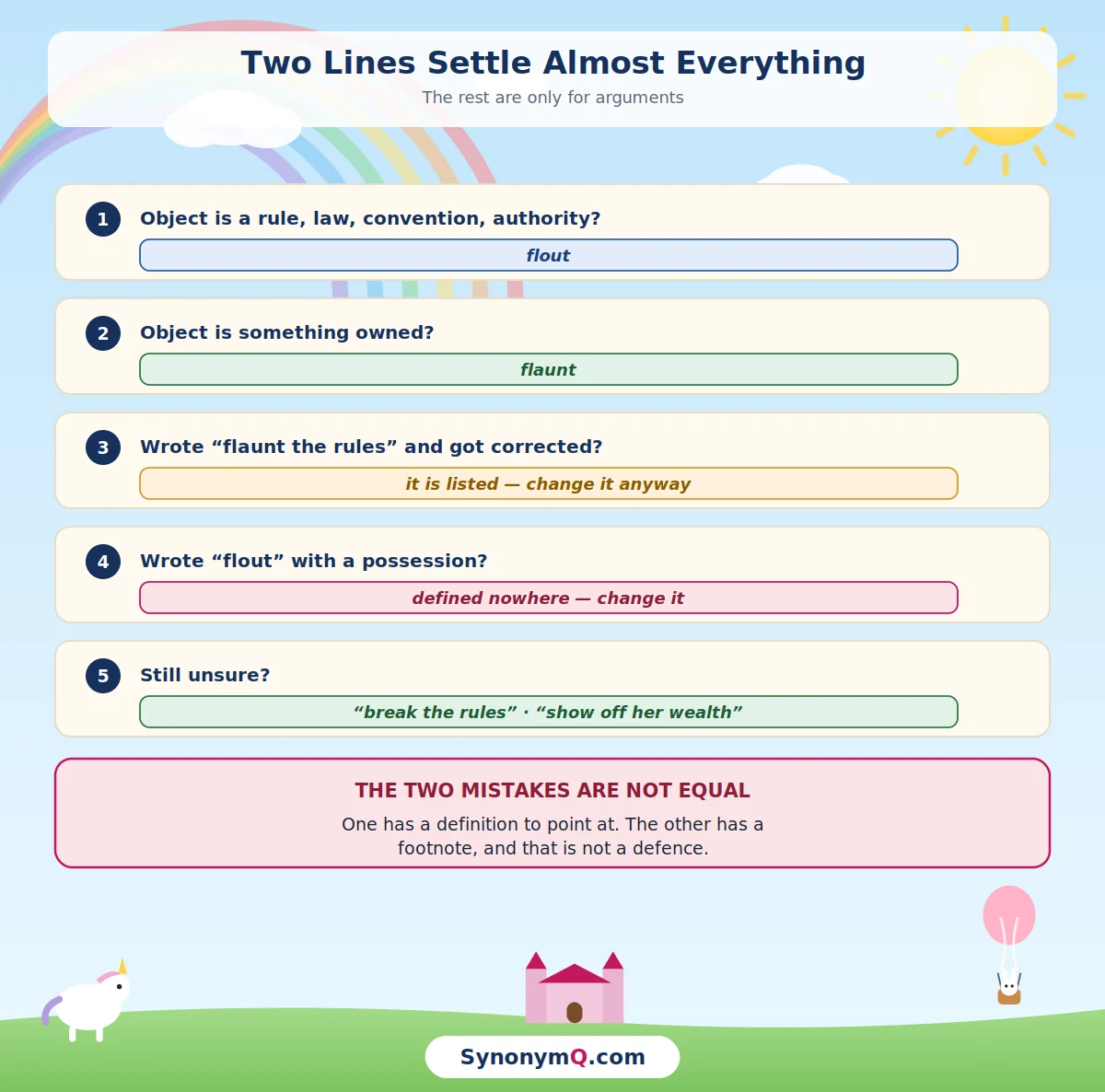
Work down this list and stop at the first line that matches. Flaunt vs flout is settled by the first two lines in almost every real sentence.
- Is the object a rule, law, convention, order or authority? Use flout. Nothing else is correct here.
- Is the object something owned or possessed? Use flaunt. Wealth, a body, a title, a success.
- Did you write flaunt with a rule, and somebody objected? Merriam-Webster does list that sense, but change it anyway if the document will be edited.
- Did you write flout with a possession? Change it. That direction is noted as occasional and defined nowhere.
- Still unsure? Replace the verb. Break the rules and show off her wealth cost you nothing and cannot be misread.
| Where | Verdict | Why |
|---|---|---|
| Neither word, in any sentence | Direct Swap: none | They share no sense that both dictionaries record. There is no safe interchange |
| flaunt the rules to flout the rules | Swap With Adjustment | Same meaning to the reader, and it removes the only thing an editor would mark |
| flout to flaunt with a possession, or back | Requires Rewrite | The sentence stops saying what it said; disobeying and displaying are not neighbours |
Choosing the word that cannot be marked up, rather than the one you could defend, is the same instinct behind kindly in an email.
Frequently Asked Questions
What is the difference between flaunt and flout?
Flaunt means to display something proudly to impress people. Flout means to show open disrespect for a rule or law by not obeying it. The object usually decides: rules are flouted, possessions are flaunted.
Is “flaunt the rules” correct?
Merriam-Webster lists “to treat contemptuously” as a numbered sense of flaunt, so it is recorded. But the same dictionary says most copy editors would judge you for it, and Oxford Learner’s does not record it at all.
Can “flout” mean to show off?
Only marginally. Merriam-Webster mentions in a usage note that flout is “found occasionally” in the sense of flaunt, but does not give it a numbered definition. It is the weaker of the two mix-ups.
When did people start confusing flaunt and flout?
Merriam-Webster cites newspaper examples from 1905 and 1906, and notes the confusion became notably more common in the 1930s and 1940s.
How do I remember which is which?
Look at what follows the verb rather than at the verb. If you could break it, you flout it. If you could own it, you flaunt it. That covers nearly every real sentence.
How This Page Was Checked
Read from the sources attributed, on 28 September 2026:
- Merriam-Webster, “Is It Wrong to Confuse Flaunt and Flout?”: the statement that the dictionary includes flout as a second definition of flaunt, the 1905 and 1906 citations, the 1930s and 1940s note, and the verdict quoted in full above.
- Merriam-Webster, flaunt: the transitive senses “to display ostentatiously or impudently: parade” and “to treat contemptuously.”
- Merriam-Webster, flout: “to treat with contemptuous disregard : scorn,” and the usage-guide note that flout in the sense of “flaunt, parade” is “found occasionally.”
- Oxford Learner’s Dictionaries, flaunt: three senses, all about display, and no sense meaning to disobey.
- Oxford Learner’s Dictionaries, flout: the definition and the examples quoted in the first table.

Naveed Akhtar writes every guide on SynonymQ. He is an SEO content writer with ten years of article-writing experience, working on the question a thesaurus never answers: which of these words belongs in this sentence, for this reader. Every page cites the dictionary entries it draws on and the date they were read.