
Purposely vs Purposefully: Which 1 Do You Actually Need?
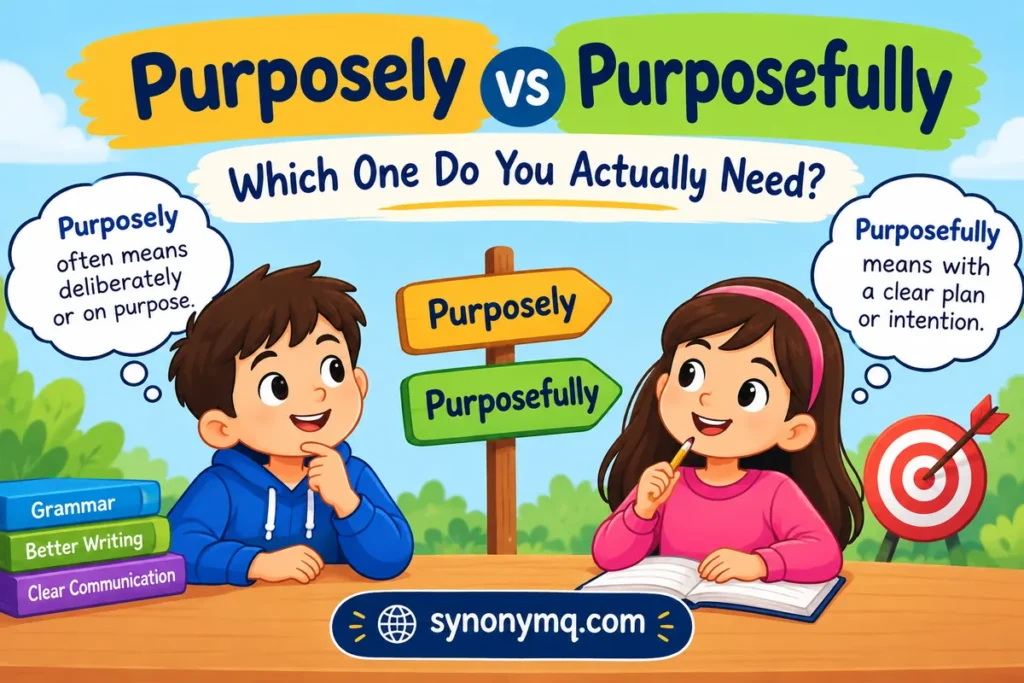
The purposely vs purposefully choice is about emphasis: purposely means on purpose; purposefully often stresses a clear aim or determination. Both can mean intentionally. Choose the word that makes your intended meaning clearest.

Purposely vs Purposefully: Meanings and Overlap
Purposely tells the reader that an action was intended. It answers a question such as “Was that a mistake?” or “Did someone choose to do that?” It does not automatically describe confidence, effort, or success.
In “The teacher purposely left the last question unanswered,” the omission was a choice. The sentence does not tell us whether the teacher wanted to start a discussion, save time, or test the class.
Merriam-Webster defines purposely in terms of a deliberate or express purpose. The word is standard English; replacing it just because it looks shorter is unnecessary.
Purposefully can describe acting with a clear aim or determination. In “The student walked purposefully toward the reading desk,” the emphasis falls on the focused manner of walking.
Oxford Learner’s Dictionaries connects purposefully with a useful purpose, a clear aim, and determination. This makes it a useful choice when you want the reader to picture directed action.
| What you want to emphasize | Clear choice | Example |
|---|---|---|
| The action was intentional | Purposely | We purposely kept the guest list small. |
| The manner showed determination | Purposefully | She moved purposefully toward the microphone. |
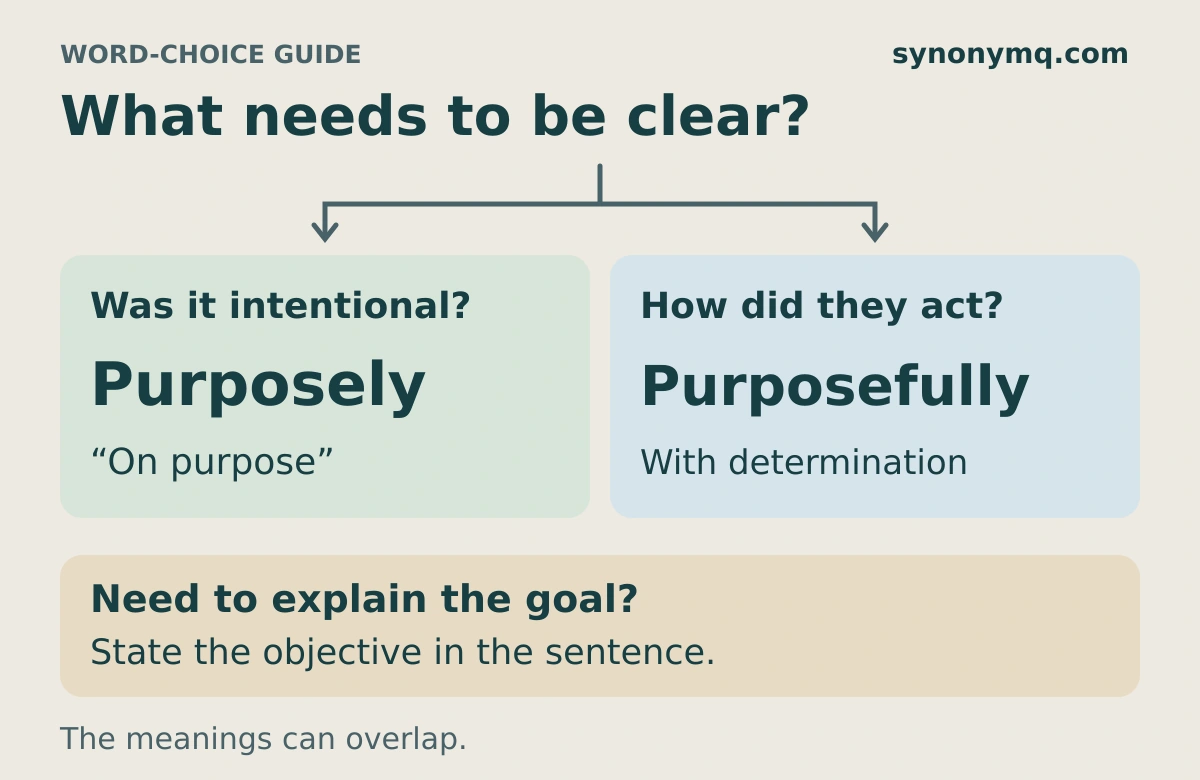
| A specific objective | State the objective | We kept the group small so everyone could speak. |
| An intentional action with a clear aim | Both may fit | They arranged the chairs purposely / purposefully to improve the view. |
The overlap matters. Dictionary.com also records an intentional meaning for purposefully. A sentence does not become incorrect merely because this longer word means “on purpose” in its context.
Treat the distinction as a way to control emphasis. For a simple accident-versus-intention contrast, purposely is a clear default. For determined movement or conduct, purposefully can make that manner more prominent.
Try These Three Meaning Checks
1. Does “on purpose” give the exact message?
Replace the adverb with on purpose, moving the phrase if necessary. If the sentence still says everything you need, purposely is usually a straightforward choice.
Original: “I purposely chose the blue card.”
Test: “I chose the blue card on purpose.” Both sentences present the selection as intentional. Neither tells us why blue was preferable.
This test is especially useful when someone could mistake a choice for an accident: leaving a space blank, skipping a meeting, changing a setting, or sending a shorter message. You are clarifying intention, not describing a grand objective.
2. Are you describing a determined manner?
Ask whether the sentence needs the reader to picture focused behavior. If the point is how a person moves or acts, purposefully may convey more of the intended scene.
“Maya walked purposefully toward the stage” suggests directed movement. “Maya purposely walked toward the stage” mainly tells us that walking there was deliberate. The second sentence could fit a contrast with being led there.
Do not read speed into this distinction. Someone can move slowly and purposefully. If pace matters, describe it separately; the guide to alternatives to quickly helps with that different choice.
3. Would either word leave the aim unclear?
Try this sentence: “The team arranged the chairs purposefully.” You may picture an organized approach, but you still do not know what the arrangement was supposed to achieve.
“The team purposely arranged the chairs” makes the action intentional, yet the objective remains missing. If the reader needs that information, changing one adverb to the other will not solve the problem.
Write “The team arranged the chairs so every guest could see the speaker.” The new version states the result being sought. Add purposely only if the contrast with an accidental arrangement also matters.
The Same Action Can Carry a Different Emphasis
The easiest way to hear the difference is to keep the action and change the context. The alternatives below are not a list of correct and incorrect sentences. They show what each wording asks the reader to notice.
Entering a room
“Leo purposely entered the classroom before the bell” makes early entry a choice. Perhaps he wanted a quiet moment to prepare. “Leo entered the classroom purposefully” draws attention to his directed manner of entering.
If both details matter, write “Leo entered before the bell to prepare his demonstration, heading straight for the front desk.” The reason and the observable behavior are now explicit.
Speaking at a meeting
“She purposely spoke after the other presenters” emphasizes the chosen order. “She spoke purposefully about the next steps” can suggest focused, directed speech. These sentences answer different questions about the same speaker.
For practical instructions, specificity may work better than either adverb: “She listed the next three tasks and assigned an owner to each.” The details show the focus instead of asking an adverb to carry the description.
Leaving something out
“We purposely omitted the client’s name” clearly marks the omission as intentional. “We purposefully omitted the client’s name” can also carry that meaning. The longer version is not automatically an error.
When the reason matters, add it: “We omitted the client’s name to protect their privacy.” The added phrase explains the objective; neither adverb alone supplies that information.
Should You Write “Purposely Obtuse” or “Purposefully Obtuse”?
Choose purposely obtuse if you want to say that someone is deliberately failing, or pretending to fail, to understand an obvious point. The emphasis is on intention.
Merriam-Webster’s entry for obtuse includes being slow to grasp something simple or obvious. Adding purposely frames the behavior as a choice rather than a difficulty with understanding.
“Purposefully obtuse” can also mean intentionally obtuse because the adverbs overlap. However, it may invite an additional reading of goal-directed behavior. For a plain accusation of deliberate misunderstanding, purposely keeps the point direct.
In a work message, an observable description may be more useful: “Your reply does not address the question about the deadline.” That wording identifies the problem without assuming you know another person’s intention.
If the difficulty concerns wording with more than one interpretation, see ambiguous versus ambivalent. An unclear message and an unwilling listener are different issues.
In Negative Sentences, Check What You Are Denying
Small changes around not can change the message more than the choice between the two adverbs. Compare a decision not to act with a denial that an action was intentional.
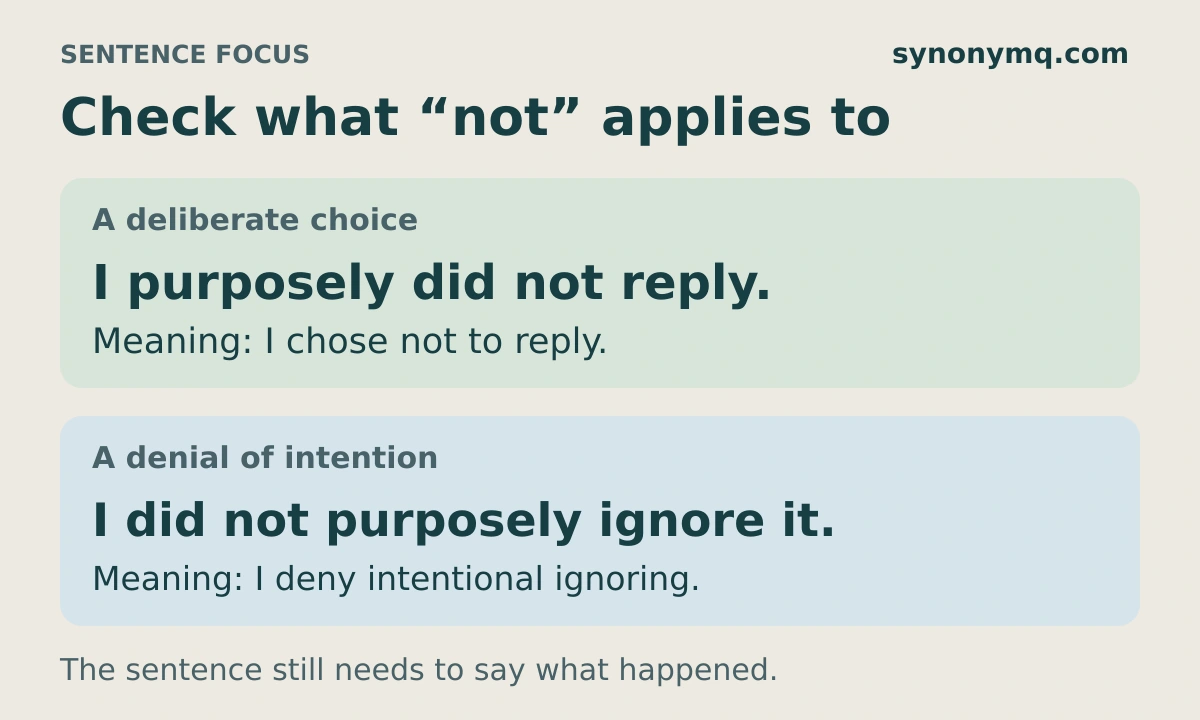
“I purposely did not reply.” This presents not replying as a deliberate choice. The speaker chose silence. A clearer expansion is “I chose not to reply.”
“I did not purposely ignore it.” This denies intentional ignoring. It leaves open whether the speaker overlooked the message or whether no ignoring occurred. It does not, by itself, explain what happened.
If you missed an email, write “I overlooked your email.” If you saw it and decided to wait, write “I saw your email and waited until I had the figures.” These statements give the reader more useful information than an ambiguous denial.
The same care applies to purposefully when it carries an intentional meaning. Replacing purposely with the longer word does not remove uncertainty about what not applies to.
Word position can also clarify focus. “I purposely sent only the summary” makes the limited document choice clear. If the important detail is the reason, “I sent only the summary to keep the email brief” states it directly.
Synonyms and Alternatives That Keep the Meaning
The best replacement depends on the sentence’s job. An alternative that preserves intentionality may lose determination. An alternative that describes focus may fail to explain whether something happened accidentally.
| Alternative and relationship | Substitution | Example and limit |
|---|---|---|
| Intentionally — exact synonym for the on-purpose sense | Direct Swap | “We intentionally left the box blank.” Preserves the claim that the omission was intended. |
| Deliberately — near-synonym | Direct Swap in this context | “We deliberately left the box blank.” Preserves intention here; the word also has another manner sense. |
| On purpose — exact equivalent for intentional action | Swap With Adjustment | “We left the box blank on purpose.” Move the phrase to a natural position. |
| With determination — contextual alternative for determined manner | Direct Swap after the verb | “She walked with determination toward the door.” Describes resolve; it does not state her destination’s purpose. |
| An explicit goal clause — contextual alternative | Requires Rewrite | “They moved the chairs so everyone could see.” States the aim instead of relying on a general adverb. |
Purposely versus deliberately: both work when you mean that an action was intended. In “He deliberately left the lights on,” purposely can replace deliberately without changing that central claim.
There is a useful boundary: Oxford also gives deliberately a slow-and-careful meaning. In “She packed slowly and deliberately,” replacing it with purposely changes the emphasis.
Purposely versus intentionally: for an ordinary on-purpose statement, either can work. Neither automatically explains the motive, proves the action was wise, or says the intended outcome actually happened.
Keep purposely when it already expresses the point naturally. A longer replacement is useful only when its meaning or the surrounding sentence better serves the reader.
Purpose, Purposeful, Purposefully, and Purposely
Yes, purposeful is a word. Merriam-Webster lists it as an adjective, with meanings connected to having a purpose, being intentional, and showing determination.
Use an adjective to describe a noun: “a purposeful approach,” “a purposeful discussion,” or “a purposeful expression.” Use an adverb when describing an action: “She moved purposefully.”
Purposely is also an adverb. Its shorter spelling does not make it incomplete. You can write “He purposely left early” without replacing it with purposefully or inventing a matching adjective.
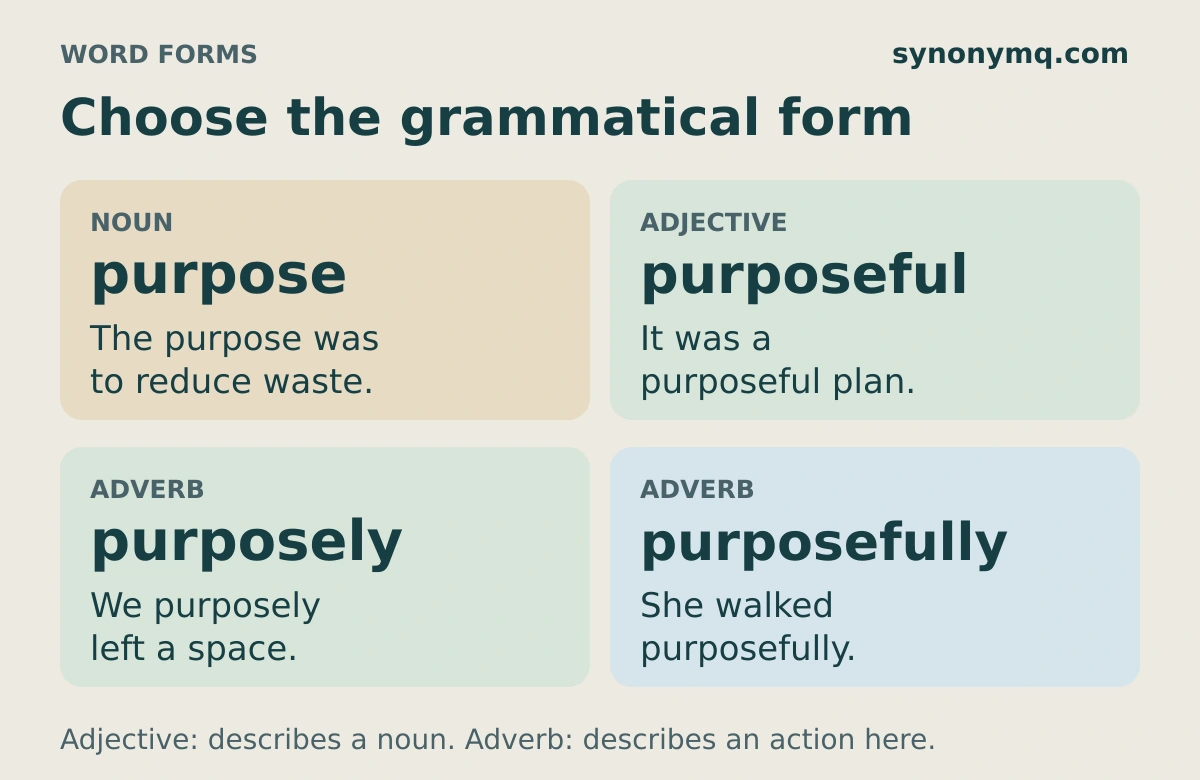
Noun example: “The purpose was to reduce waste.”
Adjective example: “It was a purposeful plan.” These examples show a noun naming an aim and an adjective describing a plan.
Adverb examples: “We purposely left a space.” “She walked purposefully.” In the first, the space was intentional; in the second, the walking is presented as determined.
Avoid “a purposely plan” when you need an adjective. Write “a purposeful plan” if you mean a plan with a useful aim. If you mean a plan chosen deliberately, write “a deliberately chosen plan.”
Likewise, “She walked purposeful” needs an adverb in standard written English: “She walked purposefully.” Changing the grammatical form solves a different problem from choosing the intended shade of meaning.
Three Useful Edits Without Overcorrecting
Make a missing objective explicit
Draft: “We purposefully shortened the meeting.”
Clearer when the goal matters: “We shortened the meeting so the team could finish the client proposal.”
The draft can be grammatical. The revision adds a specific aim, which neither purposely nor purposefully identifies on its own. Use it when the reader needs to understand the reason for the decision.
Describe evidence instead of assuming motive
Draft: “The author purposely ignored the figures.”
More precise when intention is unknown: “The article does not discuss the figures.”
Changing purposely to purposefully would leave the claim about intention in place. If you only know that the figures are absent, describe that absence. An adverb should not supply evidence you do not have.
Use the manner you actually want to show
Draft: “Amir purposely walked toward the front desk.”
For a focused manner: “Amir walked purposefully toward the front desk.”
Choose the draft if the walk itself was intentional and that distinction matters. Choose the revision if the scene needs determined movement. For a more concrete description, “Amir headed straight for the front desk” may be enough.
These edits solve three separate problems: an unstated objective, an unsupported intention, and an unintended emphasis. They are more useful than applying a blanket rule that the two adverbs can never share a meaning.
What Is the Opposite of “Purposely”?
For the usual intentional meaning, the opposite of purposely is accidentally, unintentionally, or by accident. Choose a form that fits the sentence.
“I purposely deleted the file” presents the deletion as intended. “I accidentally deleted the file” says it was an accident. “I deleted the file by accident” expresses the same contrast with a phrase placed after the action.
Do not automatically use aimlessly as the opposite of purposely. Someone can intentionally wander without a destination. Intentionality and having a clear direction are separate features.
For a determined or directed sense of purposefully, a contextual contrast might be “without a clear aim” or “hesitantly.” Those alternatives change different aspects of the action, so choose the contrast you actually mean.
Before replacing either word, decide what the sentence needs to settle: whether the action was intentional, how it was carried out, or what it was meant to achieve. Then use the shortest wording that makes that point clear.
How This Page Was Checked
Definitions were checked against Merriam-Webster, Oxford Learner’s Dictionaries, and Dictionary.com. The examples are original, and the recommendations distinguish dictionary meanings from advice about clearer wording.
Merriam-Webster’s usage discussion supports a practical distinction in emphasis. The intentional meaning recorded by Dictionary.com also explains why some substitutions remain acceptable.
For more comparisons that require attention to context, browse SynonymQ’s commonly confused words guide.

Naveed Akhtar writes every guide on SynonymQ. He is an SEO content writer with ten years of article-writing experience, working on the question a thesaurus never answers: which of these words belongs in this sentence, for this reader. Every page cites the dictionary entries it draws on and the date they were read.