
Rich vs Wealthy vs Affluent: 3 Word-Choice Traps
Rich vs wealthy vs affluent is mostly a choice of tone and context. All three can mean having substantial money or possessions. Rich is everyday wording; affluent is more formal. Rich also has meanings unrelated to money.

An editor changes “rich customers” to “affluent customers.” The sentence sounds more formal, but the customers have not moved into a new financial category. A vocabulary change does not create a new fact.
Three traps cause most of the confusion: treating the words as fixed wealth levels, mistaking formal wording for precision, and replacing rich when it has nothing to do with money.
1. Rich vs Wealthy vs Affluent: Avoid a Fixed Ranking
It is tempting to arrange these words on a ladder: affluent, then rich, then wealthy. Ordinary English does not give them universal income brackets or a compulsory order.
Oxford’s wealthy entry treats rich and wealthy as equivalent in their central money-related meaning. Both can describe a person, family, city, or country.
| Word | Useful starting point | Original example |
|---|---|---|
| Rich | Plain, direct wording for having a lot of money or property | Her uncle became rich after selling his business. |
| Wealthy | A close alternative when discussing substantial possessions or resources | A wealthy collector lent the painting to the gallery. |
| Affluent | More formal wording, often describing households, areas, or living standards | The survey included several affluent suburbs. |
Does rich mean income while wealthy means assets?
You may encounter that contrast in personal-finance writing. A writer can define rich as high income and wealthy as accumulated resources for a particular argument. Those definitions are not a binding rule of English.
Income and assets are different concepts; the adjectives do not consistently divide them. If that distinction matters, write “a high income” or “substantial assets” instead of expecting rich or wealthy to supply the detail.
Collins discusses a suggestion of stability in wealthy. That is a possible association, not proof of permanent security, inherited money, or a particular investment strategy.
“A rich family” and “a wealthy family” can describe the same family. Neither wording tells you whether the money was earned, inherited, borrowed against, or recently acquired.
A report may define its own affluent category using a stated measure. Quote that definition when discussing the report. Do not silently turn a category used by one organization into a worldwide language rule.
2. Formal Wording Does Not Make a Claim More Precise
Oxford labels affluent as formal and connects it with having money and a good standard of living. It fits naturally in descriptions of populations, households, and places.
Compare “The shop attracts rich customers” with “The shop attracts affluent customers.” The second suits a business report. It does not, by itself, tell us more about those customers’ income, savings, or spending.

What does an affluent neighborhood mean?
An affluent neighborhood is generally associated with residents who have considerable financial resources and a high standard of living. It is a broad description of the area, not a statement about every household.
“An affluent lifestyle” similarly suggests material comfort and access to expensive goods or experiences. The phrase does not establish how someone pays for that lifestyle or whether they can sustain it.
Less affluent does not automatically mean poor
Less affluent is comparative: it means having fewer financial resources than the people or group being compared. Two comfortable households can differ in affluence without either household being poor.
Use poor when that is the meaning you intend. Use less affluent when you are making a relative comparison. If you mean lower income, say lower income; it is more specific than a broad description of affluence.
For a report, explain the measure behind the label when it matters. “Households with lower incomes than the regional average” tells readers what is being compared; “less affluent households” leaves that open.
Financial vocabulary contains other differences that are easy to blur. Our economic versus economical guide separates an economy-related description from one about avoiding waste.
3. Keep Rich When the Meaning Is Not Financial
A chocolate cake can be rich. So can soil, a voice, a color, or a region’s cultural history. Wealthy and affluent do not normally replace rich in these senses.
Oxford’s rich entry separates money from abundance, food, fertility, and strong or deep sensory qualities. Check which meaning your sentence uses before choosing a synonym.
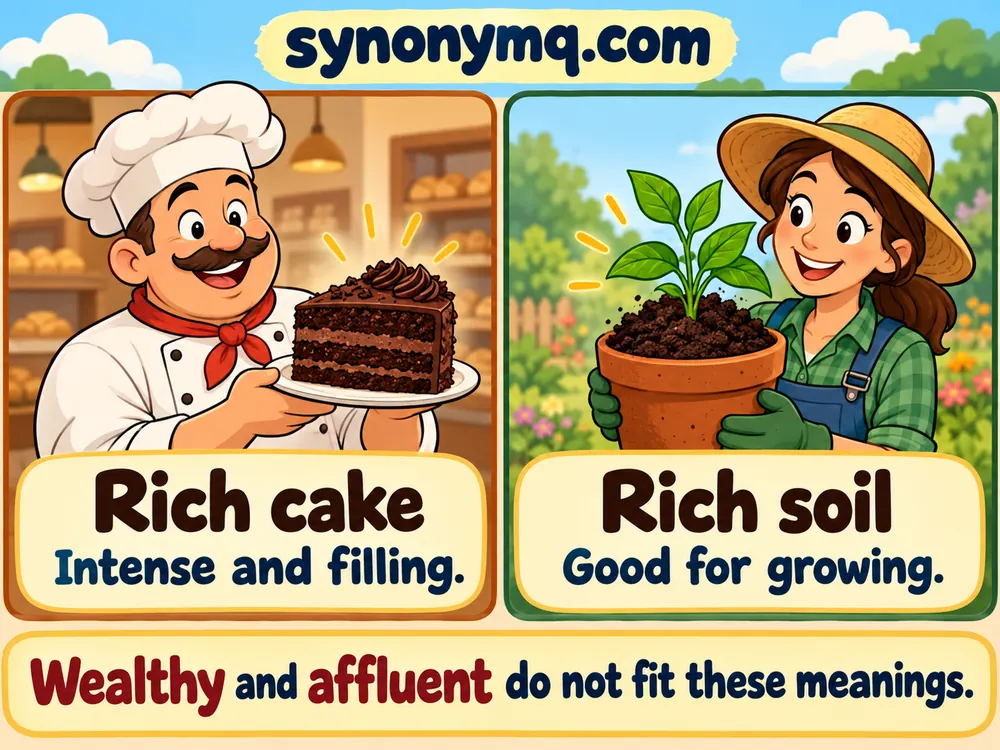
| Natural wording | Meaning here | Avoid as an ordinary replacement |
|---|---|---|
| The dessert is rich. | Heavy or filling, often because of ingredients such as butter or cream | The dessert is wealthy. |
| The seedlings need rich soil. | Fertile soil that supports growth | The seedlings need affluent soil. |
| The valley is rich in wildlife. | Wildlife is abundant there | The valley is wealthy in wildlife. |
| She sang in a rich voice. | A full, deep, pleasing sound | She sang in an affluent voice. |
Rich in is especially useful for abundance: “The archive is rich in personal letters.” You could rewrite that as “The archive contains many personal letters.” Affluent in personal letters would not express the same idea naturally.
Try the Replacement in the Whole Sentence
A synonym needs to fit both the meaning and the surrounding words. The following alternatives work under the stated conditions; they are not a ranking from least money to most.
| Original | Replacement | Relationship and test |
|---|---|---|
| A rich household | A wealthy household | Near-Synonym; Direct Swap in this financial sense, with no necessary change of category. |
| Rich customers | Affluent customers | Near-Synonym; Direct Swap, with a more formal tone. |
| A rich family | A well-off family | Near-Synonym; Direct Swap, often a less emphatic description of financial comfort. |
| A rich town | A prosperous town | Near-Synonym; Direct Swap when success or flourishing is also intended. |
| An affluent household | A household with a high income | Contextual Alternative; Requires Rewrite and evidence about income. It makes a narrower claim. |
Prosperous introduces the idea of success, so it is useful for a flourishing town or business. Well-off can be a gentler description, but neither word comes with a universal monetary cutoff.
For more comparisons organized by meaning, tone, and grammar, browse our commonly confused words guide.
Rich Is an Adjective; Wealth Is a Noun
In “They are rich,” rich describes the people. In “They became wealthy,” wealthy also describes the people. Affluent works the same way: “The district is affluent.”
Wealth and affluence name conditions or resources. Write “They have considerable wealth,” not “They are wealth.” For a person, write “an affluent person,” rather than “an affluent” in ordinary prose.
The usual related adverb is richly: “The hall was richly decorated.” It does not simply mean that the hall had money; here it describes elaborate decoration.
In “She became rich,” became links the subject to a description. Rich remains an adjective even though it follows a verb. Position alone does not make a word an adverb.
For the spoken form of affluent, Oxford provides British and American pronunciation audio. Its entry also gives the related noun affluence.
Frequently Asked Questions
What are 7 levels of wealth?
Seven-level lists depend on the model or author. Rich, wealthy, and affluent do not define seven universal categories. Check how a particular list measures resources and sets its boundaries.
Is Elon Musk rich or wealthy?
Both words fit in ordinary English. Forbes’ profile documents his substantial fortune. Choosing wealthy does not make rich incorrect; the two share their core financial meaning.
What are the 5 levels of wealth?
There is no single five-level classification built into these words. Different frameworks choose different categories. Identify the source before treating a particular list as a standard.
Does affluent mean rich?
Yes, in the money-related sense. Affluent is more formal and often describes households, neighborhoods, or living standards. It does not normally replace rich in expressions such as rich soil or rich flavor.

Naveed Akhtar writes every guide on SynonymQ. He is an SEO content writer with ten years of article-writing experience, working on the question a thesaurus never answers: which of these words belongs in this sentence, for this reader. Every page cites the dictionary entries it draws on and the date they were read.