
Smart vs Clever vs Intelligent: 3 Key Differences That Matter
Smart vs clever vs intelligent: all three can describe mental ability. Smart also suits a sensible choice; clever often highlights an inventive solution; intelligent describes understanding and reasoning. Context matters more than a supposed ranking.
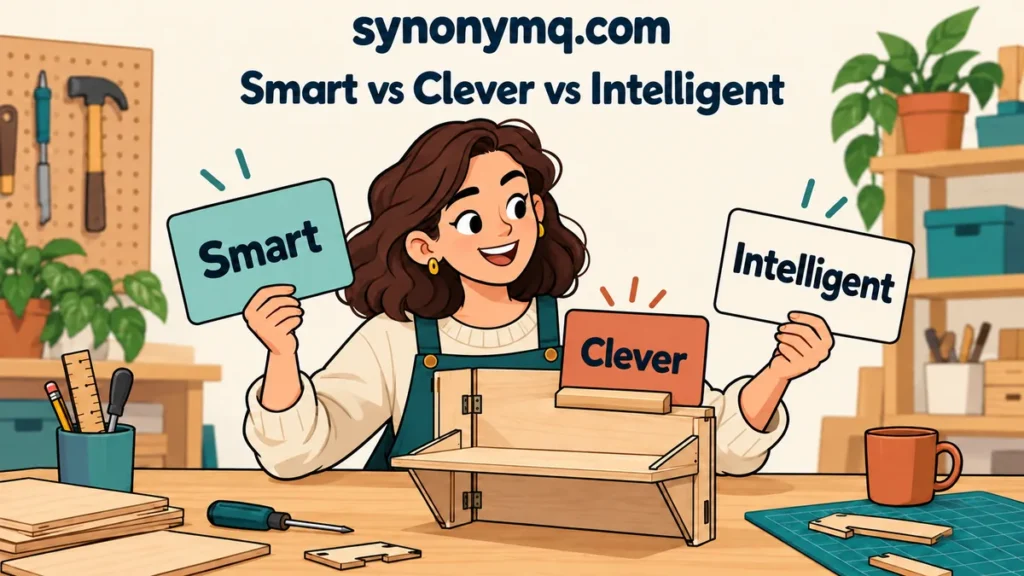
Smart vs Clever vs Intelligent: Where They Overlap
“Maya is smart,” “Maya is clever” and “Maya is intelligent” can all praise her mental ability. None of these sentences, by itself, tells you whether she learned a skill at school, through experience or unusually quickly.
Oxford Learner’s Dictionaries groups these adjectives together and describes intelligent as the most general. The differences are often about emphasis, context and tone.
| Word | What it can highlight | Original example | Do not assume |
|---|---|---|---|
| Smart | Mental ability or a sensible, advantageous choice | Booking a later train was a smart decision. | It only means practical ability. |
| Clever | Quick understanding, skill or ingenuity | A clever fold turns the cover into a stand. | It always implies dishonesty. |
| Intelligent | Understanding, learning and reasoning | Her intelligent question exposed a missing assumption. | It only means academic achievement. |
A student who understands a difficult argument may be called smart, clever or intelligent. Calling that student clever does not rule out deep understanding; calling them intelligent does not rule out practical skill.
For word choice, treat the three differences below as checks on your sentence. They are not psychological categories or an intelligence scale. If a discussion gives the words special definitions, those definitions need to be stated.
1. Decide What Kind of Praise You Mean
Start with the thing you are describing: a person, a method, a question or a decision. More than one adjective may fit, but each can draw attention to a different feature.
A smart choice: the decision makes sense
“Leaving room for questions was a smart choice.” The praise concerns a useful decision. You do not need to claim that the speaker invented a new presentation method.
Merriam-Webster also gives smart the meaning of having mental ability. “A smart researcher” can therefore refer to someone’s intellect, not just their ability to handle everyday situations.
A clever design: the method deserves attention
“The clever lid doubles as a measuring cup.” Here, the inventive feature matters. Clever directs the reader toward how the design solves a problem.
Merriam-Webster’s entry for clever includes mental quickness, skill and ingenuity. The word can praise a neat technique without claiming that its creator excels at every task.
An intelligent question: the thinking deserves attention
“Her intelligent question asked whether the survey included night workers.” The question shows that she understood a possible weakness in the evidence.
Merriam-Webster includes sound thought and good judgment under intelligent. It need not describe a qualification, an examination result or a person’s store of facts.
These examples guide emphasis; they do not reserve each noun for one adjective. A clever question may also be intelligent, and an intelligent decision may also be smart.

2. Check Whether the Tone Praises or Criticizes
“That was clever” can be warm praise. Add a skeptical tone or a phrase such as “too clever by half,” and the listener may hear criticism of someone’s manner or motives.
Oxford’s clever entry records both approving uses and disapproving ones. Clever is not automatically an insult when it describes an adult.
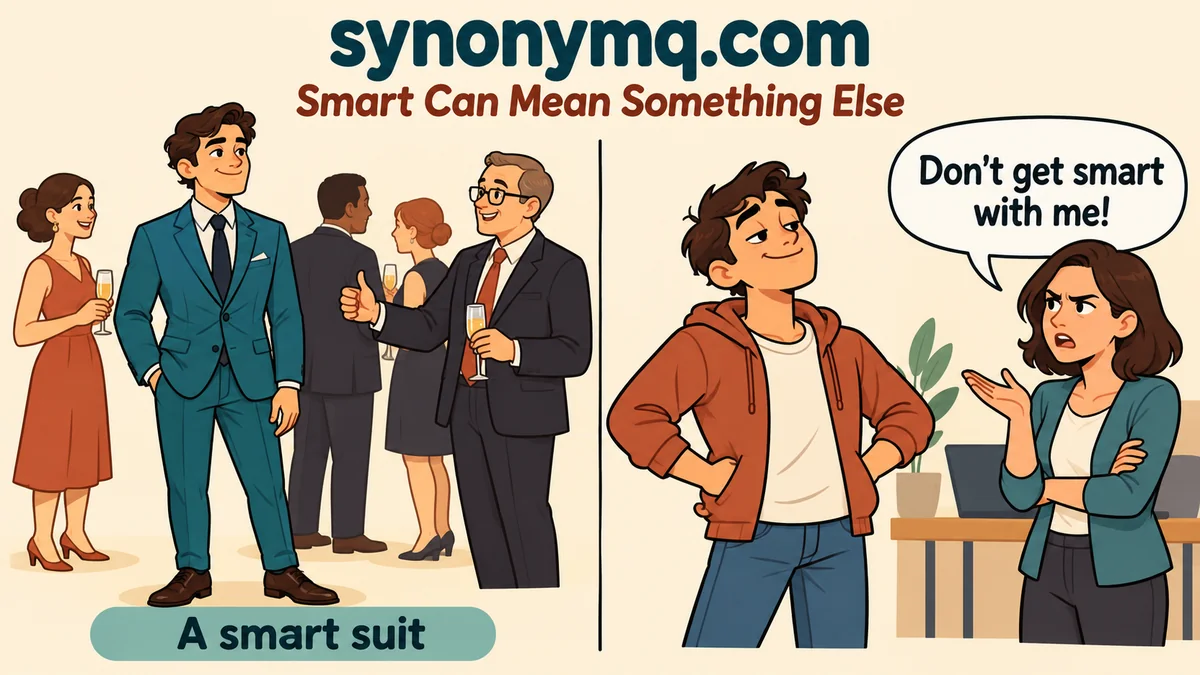
Smart has a critical use too. In “Don’t get smart with me,” it concerns disrespect, not a request to stop thinking. Merriam-Webster records this informal meaning separately from mental ability.
For clear feedback, name the thing you admired: “That was a clever way to organize the cables.” The added detail gives the reader a reason to interpret clever as praise.
British and American preferences are not absolute rules
Oxford labels the general intelligence sense of clever especially British English and that of smart especially North American English. These labels describe preferences; they do not forbid either word in the other variety.
For an international audience, intelligent is a clear choice when mental ability is exactly what you mean. For ingenuity in a particular idea, clever may be more precise. This is an editorial recommendation, not a regional restriction.
3. Notice When Smart Means Something Else
In “He wore a smart suit,” smart describes appearance. Oxford labels this neat, well-dressed sense especially British English. An intelligent suit would not preserve that meaning.
Smart can also describe a computer-controlled device. A smart washing machine and a clever washing-machine design make different claims: one concerns the machine’s controls; the other praises its design.
Technology complicates the comparison further: Merriam-Webster also records a computer-controlled sense of intelligent. Do not assume that smart and intelligent always contrast when they describe equipment.
Read the noun and the situation together. “You look smart” at a formal dinner may praise someone’s clothes; “That was a smart answer” after a difficult question may praise their thinking.
Keep the Sentence Pattern When You Swap Words
All three words are adjectives in the main comparison. They can appear before a noun or after a linking verb: “an intelligent colleague” and “my colleague is intelligent.” Longer phrases need a closer check.
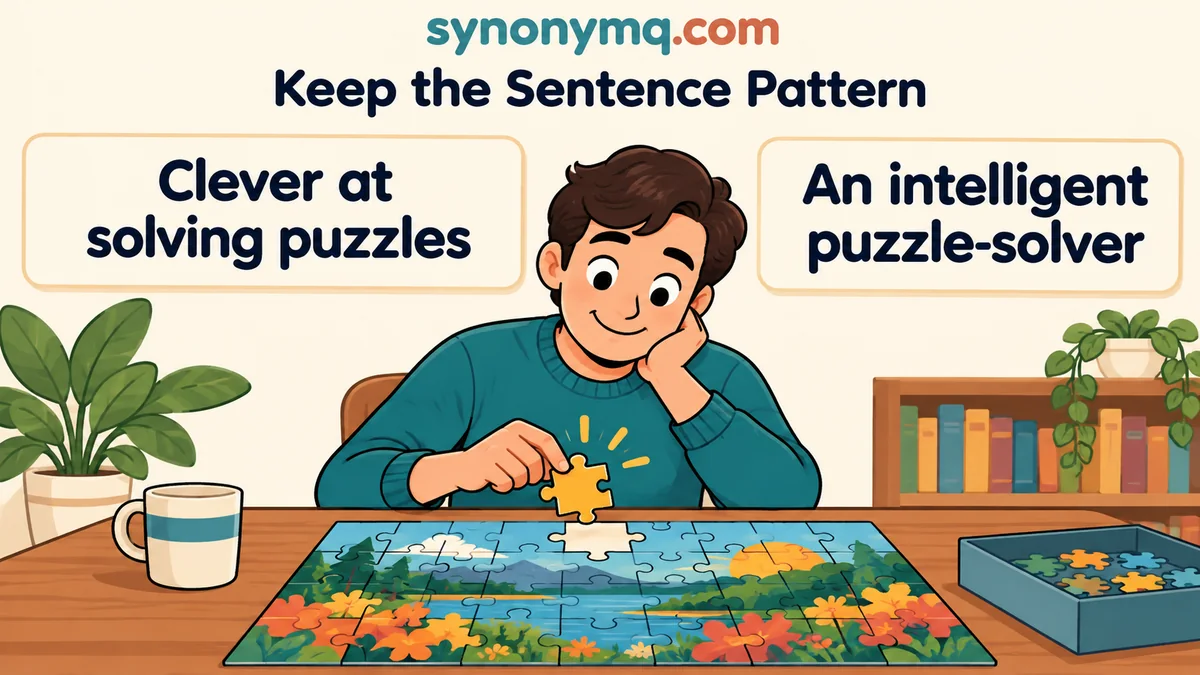
Oxford records clever at something, clever at doing something and clever with something. “Clever at repairing clocks” names a particular skill. It does not make a claim about every kind of reasoning.
| Starting sentence | Possible replacement | Relationship and change |
|---|---|---|
| Noor is a smart student. | Noor is an intelligent student. | Near-Synonym. Swap With Adjustment: change a to an. |
| The student is smart. | The student is intelligent. | Near-Synonym. Direct Swap: the intelligence meaning fits this frame. |
| He found a clever solution. | He found a smart solution. | Near-Synonym. Direct Swap: the grammar stays; ingenuity may receive less emphasis. |
| Amir is clever at solving puzzles. | Amir is an intelligent puzzle-solver. | Contextual Alternative. Requires Rewrite: recast the skill phrase as a description of the person. |
The last rewrite changes emphasis. If the evidence is specifically about puzzle skill, keeping “clever at solving puzzles” may be more accurate. A grammatical replacement is not automatically the best edit.
Direct Swap means the replacement fits the stated structure. It does not mean the words share every meaning. Swap With Adjustment changes nearby grammar; Requires Rewrite rebuilds the phrase.
Bright, Wise, Brilliant and Genius Add Different Claims
A longer list of intelligence words does not create a reliable ranking. Choose an alternative because its extra meaning fits the evidence, not because it sounds more impressive.
| Alternative | Relationship | Substitution test | When it helps |
|---|---|---|---|
| Bright | Near-Synonym | “A smart student” → “a bright student.” Direct Swap. | Praises mental ability. It does not promise extraordinary achievement. |
| Ingenious | Near-Synonym | “A clever mechanism” → “an ingenious mechanism.” Swap With Adjustment. | Emphasizes inventive originality; change the article to an. |
| Resourceful | Near-Synonym | “A clever organizer” → “a resourceful organizer.” Direct Swap. | Highlights finding ways to deal with a situation. It narrows the praise. |
| Wise | Contextual Alternative | “A smart decision” → “a wise decision.” Direct Swap. | Highlights sound judgment. It does not simply mean a higher level of intelligence. |
| Brilliant | Near-Synonym | “A clever researcher” → “a brilliant researcher.” Direct Swap. | Makes the praise stronger. Use it when exceptional ability is intended. |
| Genius | Contextual Alternative | “She is intelligent” → “she is a genius.” Requires Rewrite. | The noun construction makes a much stronger claim. It is not a routine upgrade. |
The linked Merriam-Webster entries support these meanings. The substitution labels and recommendations apply to the examples here; they are editorial judgments rather than claims of universal interchangeability.
Genius also has an informal adjective use, as Merriam-Webster notes. “That idea is genius” is possible. The table uses the noun meaning in “a genius”; it does not claim the word can only be a noun.
If you mean inventiveness, see ingenious vs ingenuous before choosing between those similar spellings. For wording centered on sound judgment, see judicial vs judicious.
Make Your Praise Specific Enough to Be Useful
In a reference, lesson comment or work message, one clear detail can do more than a stronger adjective. Describe what the person understood, designed or decided.
General: “Priya is very intelligent.”
More specific: “Priya spotted that our estimate counted the same order twice.”
General: “It was a clever design.”
More specific: “The clever design lets the shelf fold flat without removing a screw.”
The first revision replaces an assessment with evidence. The second keeps the assessment and explains it. Both help the reader understand what the praise is based on.
Keep your original word when it already fits. Replacing every smart with intelligent can change tone without improving meaning. Replacing every clever with genius can turn a modest compliment into an unsupported claim.
How This Page Was Checked
Definitions, regional labels and sentence patterns were checked against Oxford Learner’s Dictionaries and Merriam-Webster. Their relevant entries are linked beside the explanations.
The teaching examples and editing recommendations were written for this page. They illustrate word choice; they do not classify people’s intelligence or replace a psychological assessment.
Frequently Asked Questions
What is the difference between “smart,” “intelligent,” and “clever”?
All three can describe mental ability. Clever often highlights ingenuity, smart can praise a sensible choice, and intelligent describes understanding and reasoning. Their meanings overlap.
Is clever better than intelligent?
Neither is automatically better. Clever may suit an inventive solution, while intelligent may suit thoughtful reasoning. Choose the word that identifies what you want to praise.
Can a person be smart but not intelligent?
Yes, if smart refers to stylish clothing or a sensible action. When smart means mentally able, it overlaps with intelligent. The words alone cannot establish someone’s overall abilities.
Is smart better than clever?
No. Smart and clever overlap, and either can be a compliment. A smart choice stresses its sense or advantage; a clever solution stresses its ingenuity.

Naveed Akhtar writes every guide on SynonymQ. He is an SEO content writer with ten years of article-writing experience, working on the question a thesaurus never answers: which of these words belongs in this sentence, for this reader. Every page cites the dictionary entries it draws on and the date they were read.