
Please Advise Is Correct English: 4 Times to Skip It Anyway
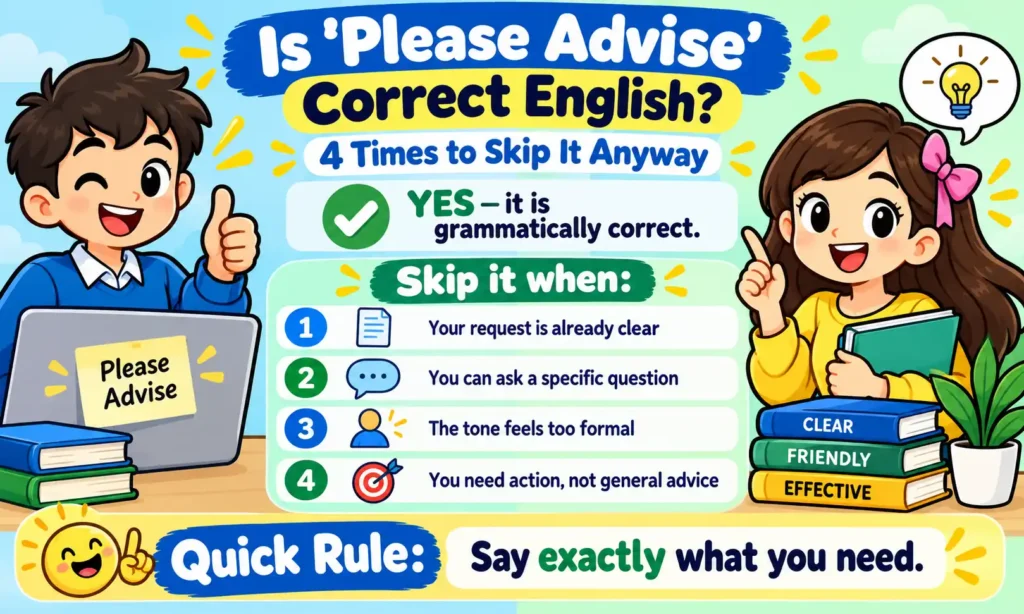
Please advise is correct English. Merriam-Webster lists advise as an intransitive verb, so it needs no object. What makes it grate is position: after a question you have already asked, it adds nothing, and a redundant prod at the end of a request reads as pressure.
By Naveed Akhtar, an SEO content writer with 10 years of article-writing experience · Updated 20 September 2026 · About 8 minutes
Is “Please Advise” Correct? The Dictionary Settles That Part
The usual complaint about please advise starts with grammar. Advise whom? Of what? A verb like that needs an object, so the bare phrase must be a clipped, lazy fragment.
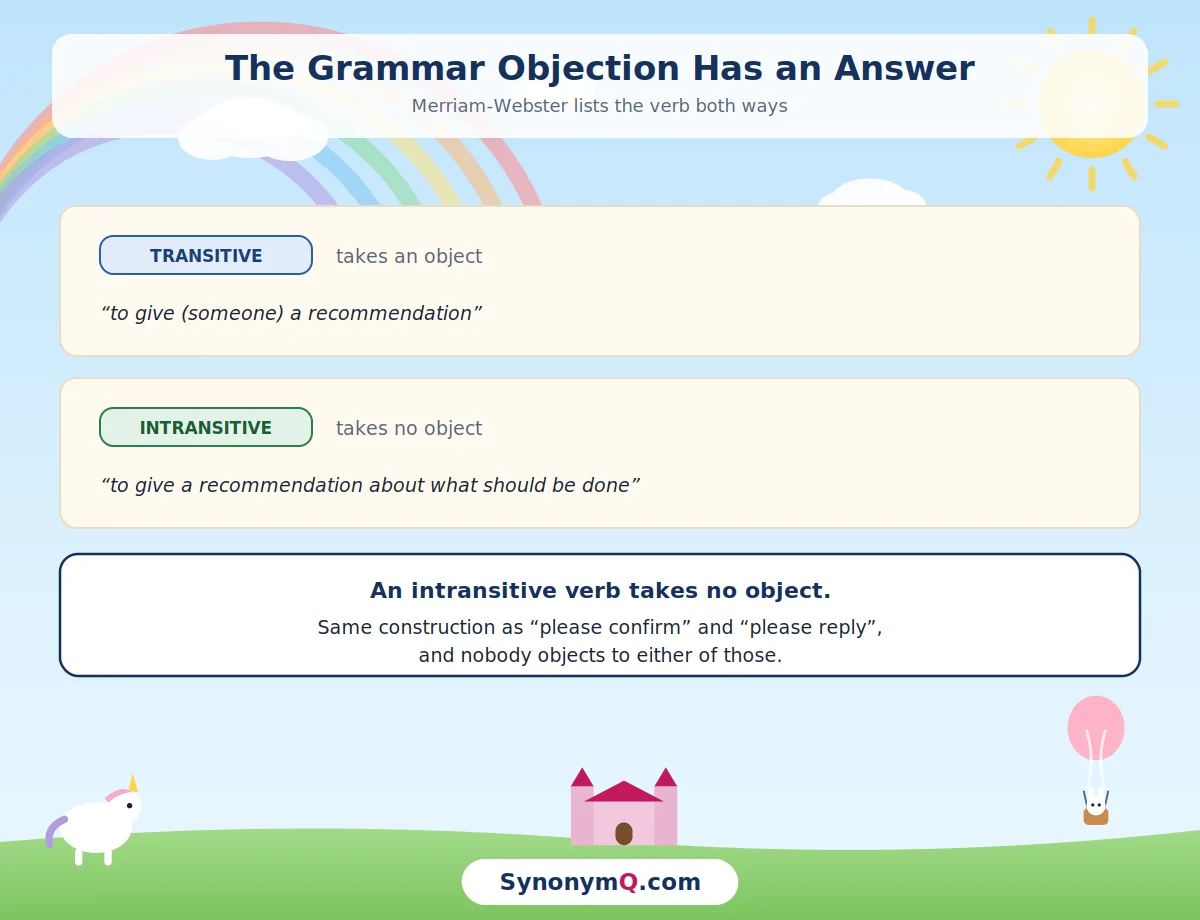
That objection does not survive the dictionary. Merriam-Webster lists advise under both headings, and the intransitive senses are not marked rare or archaic.
| Type | Senses given |
|---|---|
| Transitive | “to give (someone) a recommendation about what should be done” · “to give information or notice to: inform” |
| Intransitive | “to give a recommendation about what should be done” · “to talk with someone in order to decide what should be done: consult” |
An intransitive verb takes no object by definition. “Please advise” is the same construction as “please reply” or “please confirm”, and nobody objects to those.
So the grammar question is settled and it is not the real question. People who dislike this phrase are not confused about transitivity. They are reacting to something else, and it is worth naming precisely.The Real Objection Is Not Grammar
The most-read discussion of please advise is not on a grammar site. It is on a workplace advice blog, and that placement tells you what kind of question it actually is.
A reader asked whether ending emails this way was inappropriate, admitting the phrase provoked a strong negative reaction in them.
The answer was that there is nothing wrong with using it, and that people reach for it to mean “can you give me your thoughts on this?”
Ask a Manager, on ending an email with the phraseThe commenters did not agree with each other. Some called it demanding, condescending or passive-aggressive. Others defended it as the clearest way to mark an email as needing a reply rather than filing.
One observation in that thread explains the split better than any rule. Please advise annoys most when it arrives from a colleague who already annoys you, which is a fact about the relationship rather than the wording.
That is why “is it rude?” has no general answer. Reading the same four syllables, two people will disagree, and both are reporting something real about their own office. A page that tells you it is fine, or that it is rude, is overreaching.What can be said generally is narrower and more useful: there is one position where the phrase is genuinely redundant, and redundancy is what most of the irritation is actually tracking.
It Only Reads as a Prod in One Position
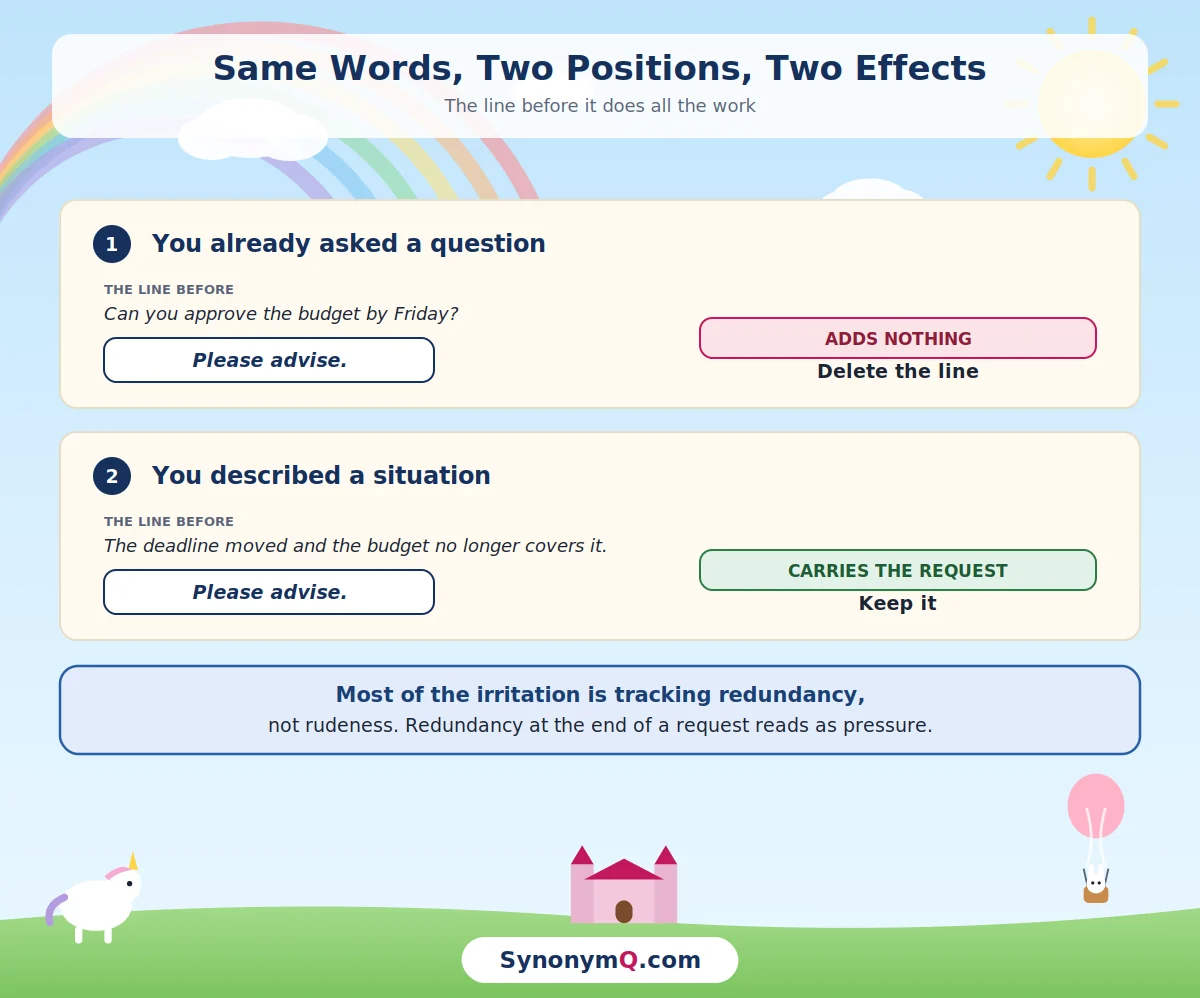
Compare two emails that differ only in what came before the last line.
Redundant — the question was already askedCan you approve the budget by Friday? Please advise. Doing real work — no question was askedThe client has moved the deadline and the budget no longer covers it. Please advise.In the first, the reader has already been asked a direct question. The closing adds no information and functions only as a nudge, so it lands as one.
In the second, there is no question to answer. The sender has described a situation and is asking for judgement, and the phrase is carrying the entire request.
The test. Read the sentence before it. If you already asked something the reader can answer, delete the closing. If you did not, it is doing a job and something has to.That test also explains why please advise clusters in certain jobs. Work that involves describing situations and requesting judgement uses it constantly, and nobody there finds it odd.
The One Job It Does That Alternatives Do Worse
Most guides end by telling you to delete please advise. That advice is right for the redundant position and it throws something away in the other one.
A long email with no explicit question is ambiguous by default. The reader cannot tell whether it is for information or whether a reply is expected, and that ambiguity has a real cost in a busy inbox.
| Closing | What the reader hears | Marks a reply as needed? |
|---|---|---|
| Please advise. | I need your judgement on this | Yes, unambiguously |
| Let me know. | Reply if you want to | Weakly. Easy to file and forget |
| Thanks for your help. | This is closed, or nearly | No. Sounds like a sign-off |
| Thoughts? | Casual, and fine among peers | Yes, but too light upward |
| Nothing at all | Unclear | No |
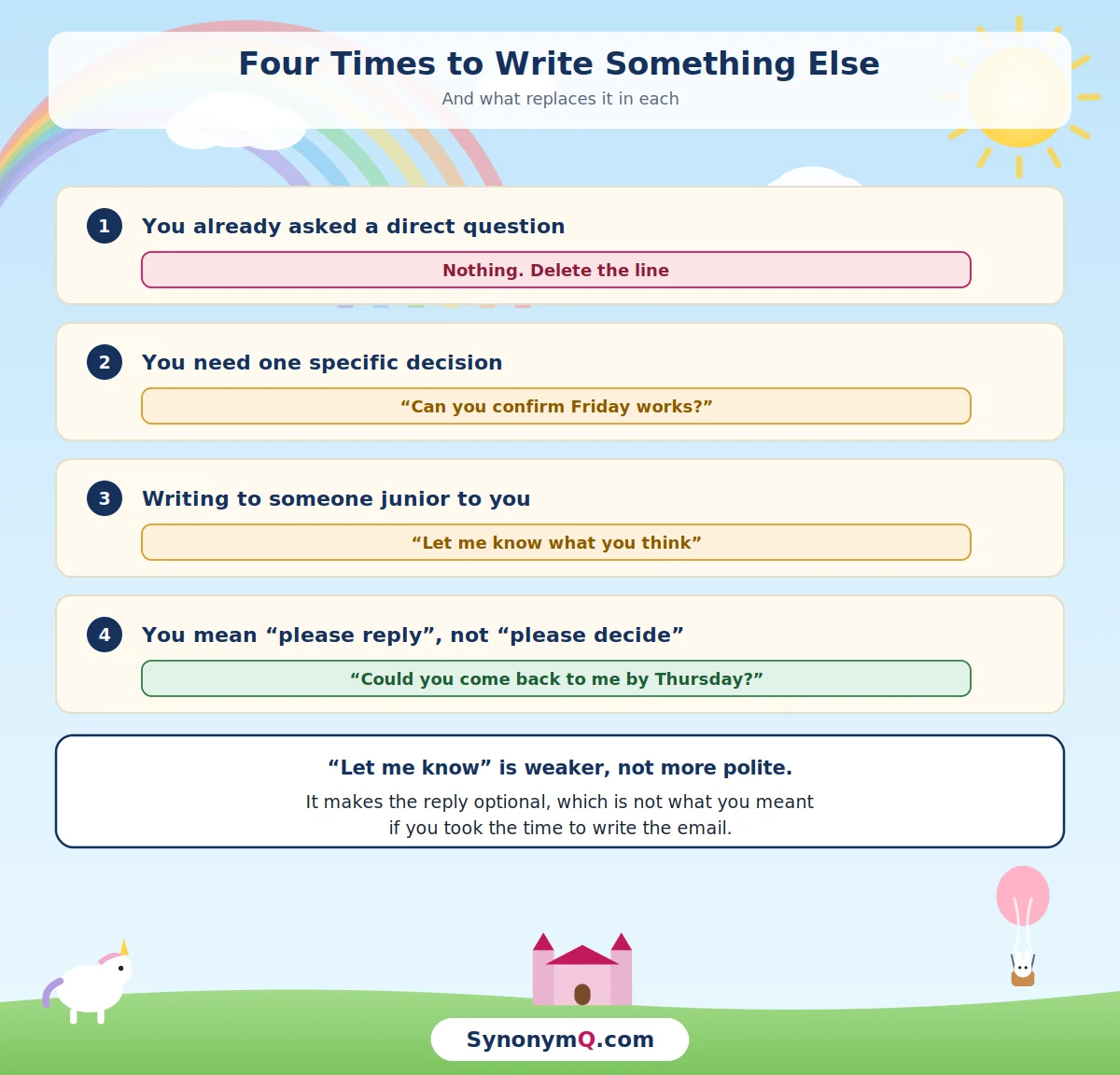
“Let me know” is the usual substitute and it is weaker, not more polite. It makes the reply optional, which is exactly what you did not mean if you took the time to write the email.
Choosing a closing by what it commits the reader to, rather than by how warm it sounds, is the same judgement behind what to say instead of per my last email.
Four Times to Write Something Else
| # | The situation | Write instead | Kind of change |
|---|---|---|---|
| 1 | You already asked a direct question | Nothing. Delete the line and stop | Requires Rewrite |
| 2 | You need one specific decision, not general judgement | Ask for the decision: “Can you confirm Friday works?” | Swap With Adjustment |
| 3 | Writing to someone junior to you | “Let me know what you think”, because the formality reads as a summons downward | Direct Swap |
| 4 | You mean “please reply”, not “please decide” | “Could you come back to me by Thursday?” | Swap With Adjustment |
Row one is not a substitution. The correct replacement for a redundant closing is no closing, which is why it is labelled a rewrite rather than a swap.
Row three is the one people get wrong most often. Please advise is neutral upward and to peers, and stiff downward, because formality from a manager reads as distance.
Row four is worth separating because the two requests are different. Reply asks for a message. Advise asks someone to think first, and asking for the wrong one wastes a round trip.
“Please Advice” Is a Different Problem
This one is a straightforward error rather than a judgement call, and it is common enough to be worth stating plainly.
Advise is the verb. Advice is the noun. “Please advice” asks the reader to please a noun, which is not a sentence.
Wrong: that is the nounPlease advice on the attached. Right: the verbPlease advise on the attached.The spelling test: the verb has an s, like rise and surprise. The noun has a c, like ice. Merriam-Webster’s own note calls it a stealthy c.
The same one-letter split runs through practise and practice, and questions of whether a common phrase is acceptable at all are collected at is “I’m humbled” correct.
Frequently Asked Questions
Is “please advise” rude?
Not in itself, and the honest answer is that it depends on your office. It reads as a prod when it follows a question you already asked, and as an ordinary request when it does not. Sent downward it can sound stiff.
Is it “please advise” or “please advice”?
Advise, with an s. That is the verb. Advice with a c is the noun, and it cannot follow please in a request.
Is “please advise” grammatically correct with no object?
Yes. Merriam-Webster lists advise as intransitive as well as transitive, and an intransitive verb takes no object. The construction matches “please confirm” and “please reply”.
What should I say instead?
It depends what you need. If you already asked a question, nothing. If you need a specific decision, ask for it directly. “Let me know” is softer but makes the reply optional, which is usually not what you meant.
Is “please advise” too formal for email?
Please advise is formal, which is why it sits comfortably in professional correspondence and awkwardly in a message to a close colleague. Among peers, “thoughts?” does the same job at the right register.
How This Page Was Checked
Read from the sources attributed, on 20 September 2026:
- The transitive and intransitive senses of the verb, and the note on the noun’s spelling — Merriam-Webster.
- The workplace discussion, the answer given, and the range of reactions in the comments — Ask a Manager.
- The incumbent treatment, for what it covers and what it leaves out — Grammarly.
What is reasoning rather than a retrieved fact. That the irritation tracks redundancy, and that position rather than politeness is the useful test, is this page’s own argument. The dictionary senses and the reported reactions are retrieved.
No claim is made about how any particular reader will take it, because the retrieved discussion shows that readers disagree.
What could not be checked. No corpus data on how often the phrase appears in professional versus personal email was available, so the observation about which jobs use it is offered as an impression, not a measurement.
Written by Naveed Akhtar, an SEO content writer with 10 years of article-writing experience.
Related: another word for however in an email covers a smaller register decision in the same kind of message.

Naveed Akhtar writes every guide on SynonymQ. He is an SEO content writer with ten years of article-writing experience, working on the question a thesaurus never answers: which of these words belongs in this sentence, for this reader. Every page cites the dictionary entries it draws on and the date they were read.