
Revert Back: 2 Problems, and the Correct Fix for Each
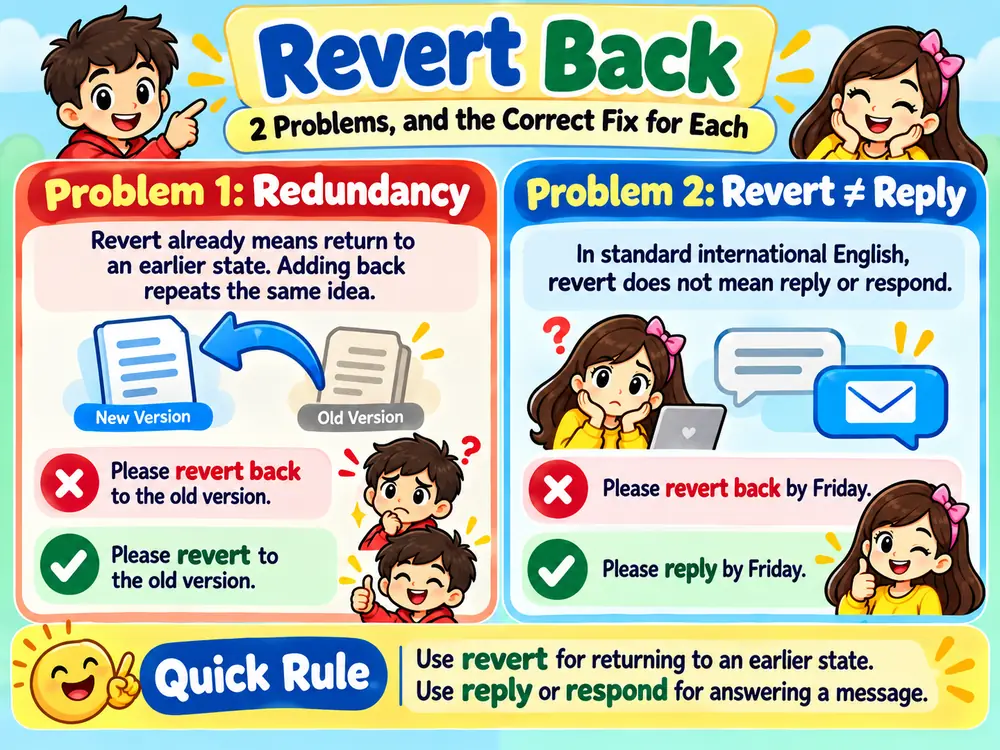
Revert back is redundant. Revert comes from Latin re- plus vertere, to turn back, so back is already inside the word. That is the smaller of two problems. Many people writing it mean reply, and deleting back does not fix that.
By Naveed Akhtar, an SEO content writer with 10 years of article-writing experience · Updated 21 September 2026 · About 8 minutes
Revert Back: Problem One Is the Redundancy
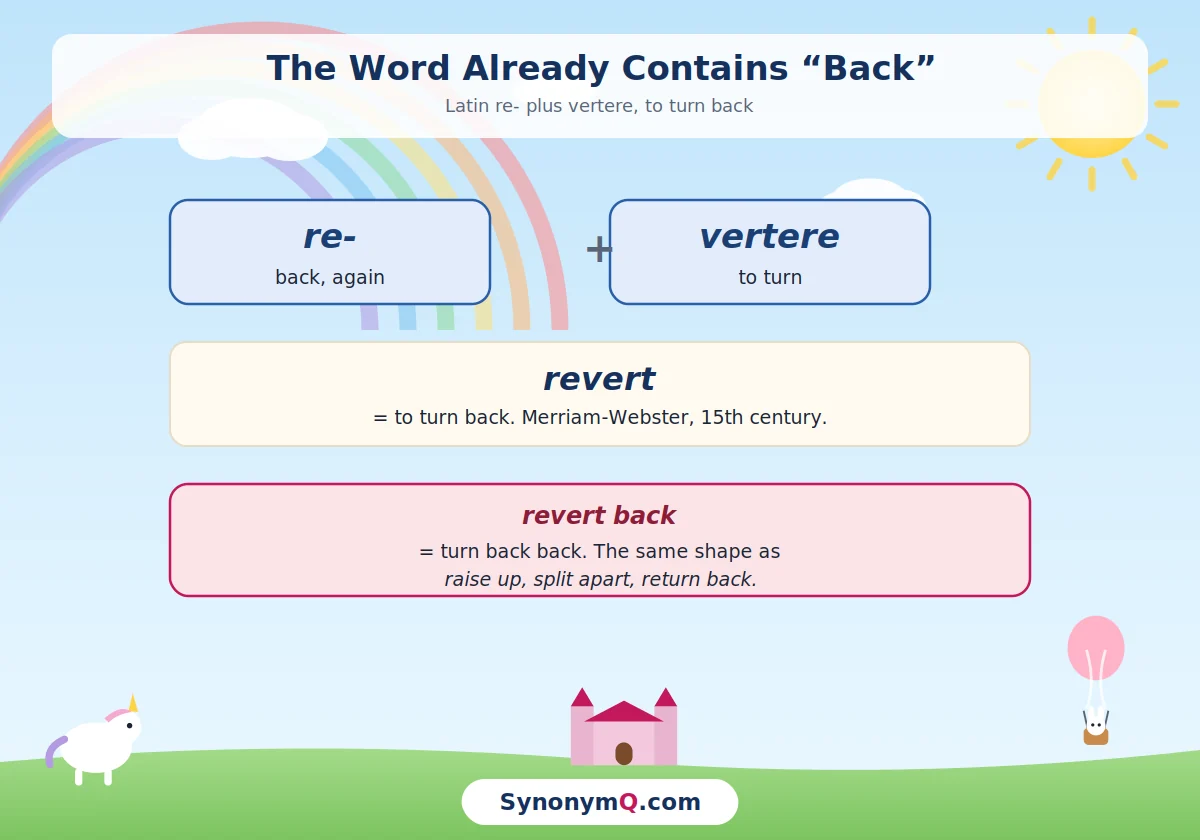
The redundancy in revert back is straightforward, and every guide gets this part right. Revert descends from Latin revertere, built from re- and vertere, to turn. Turn back.
Merriam-Webster dates it to the 15th century and gives three senses, all of them about returning: to a former condition, to an original owner in law, or to an ancestral type.
So back repeats what the prefix already says. It belongs with raise up, split apart and return back: tautologies that are understood perfectly well and still read as loose writing.Washington State University’s usage guide puts it plainly: since revert means go back, many people feel the longer form is a pointless redundancy, and the bare verb is better.
Delete the second word: that is the fix everyone offers for revert back. It is correct as far as it goes, and on a large number of the sentences people actually write, it does not go far enough.
Problem Two Is the Verb Itself
Read this sentence, which turns up constantly in business email: “Please revert back to me by Friday.”
Delete the redundant word and you get “Please revert to me by Friday.” The sentence is still not saying what the writer meant, because the writer meant reply.
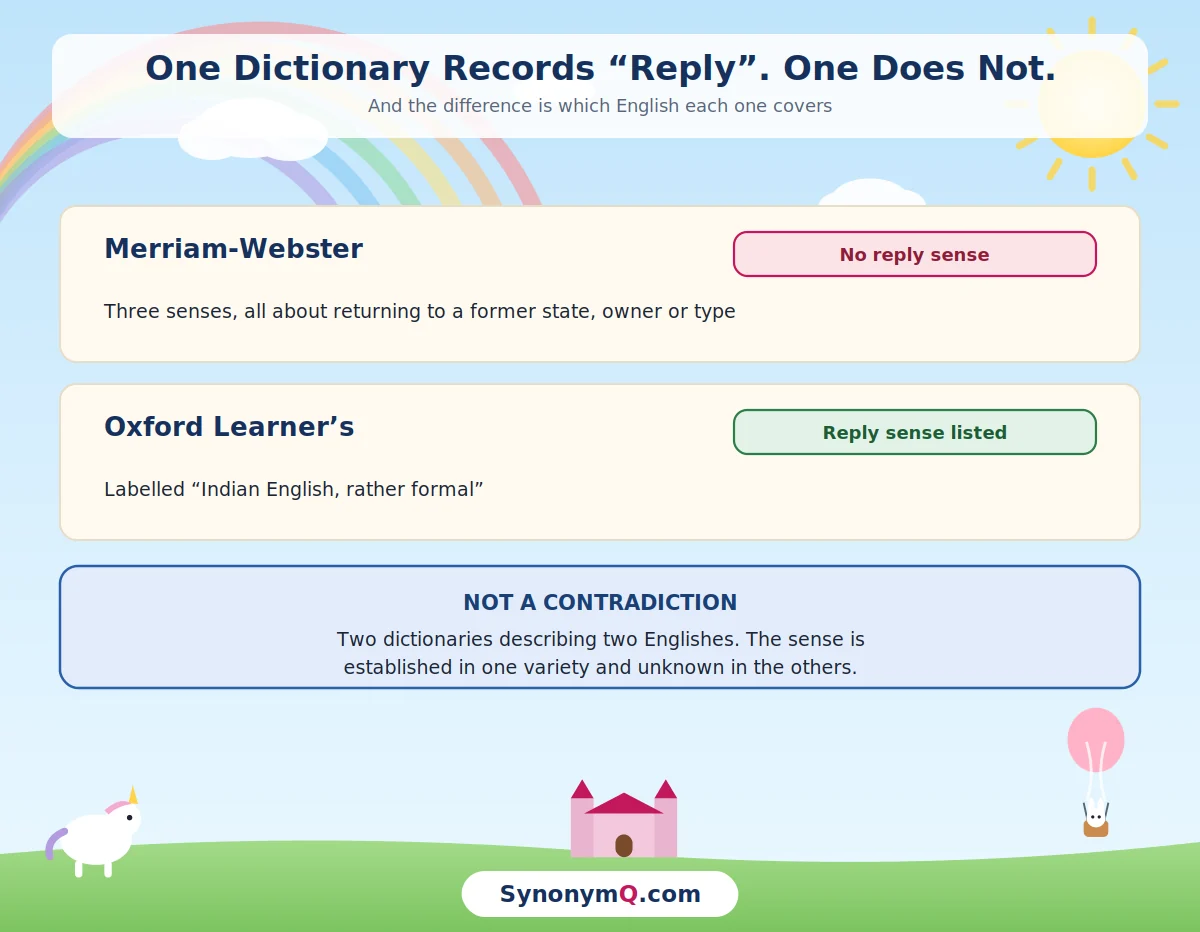
Merriam-Webster records no reply sense. Its three senses are returning to a state, a legal owner, or an ancestral type. By that entry, “please revert to me” asks the reader to change back into a former version of themselves.
Oxford records it, and labels it. Oxford Learner’s Dictionaries lists to reply as a sense of revert, marked “Indian English, rather formal”, with the example “kindly revert with your updated CV.”
| Dictionary | Is there a “reply” sense? | How it is marked |
|---|---|---|
| Merriam-Webster | No | Three senses, all about returning |
| Oxford Learner’s | Yes | “Indian English, rather formal” |
That is not a contradiction. It is two dictionaries describing two Englishes. In Indian English the reply sense is established, documented and formal in register. Outside it, most readers have never met it.
Why Deleting “Back” Can Leave the Sentence Broken
The two problems in revert back interact, and that is what the standard advice misses.
Both problems presentPlease revert back to me by Friday. Redundancy fixed, meaning still off for most readersPlease revert to me by Friday.Taking revert back down to one word makes the sentence tidier and no clearer. A reader in London or Chicago now sees a correctly formed sentence using a verb in a sense their dictionary does not carry.
The redundancy is visible and the meaning problem is not. That is why the redundancy gets all the attention. It is the one you can see without knowing anything about your reader.When both are present, the fix is not deletion. It is a different verb.
Which Fix You Need
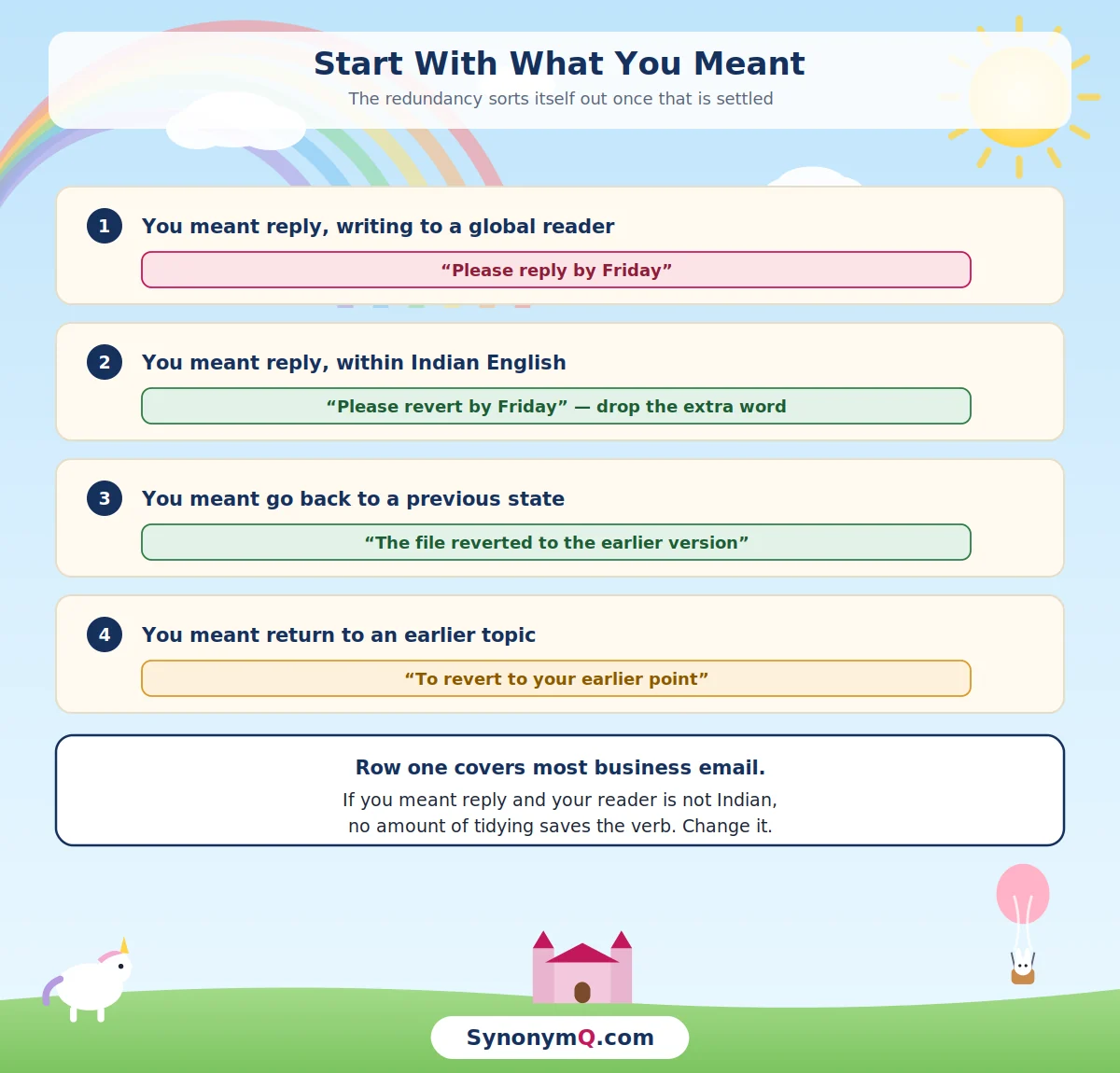
Ask what you meant first. The redundancy in revert back takes care of itself once that is settled.
| What you meant | Write | Kind of change |
|---|---|---|
| Reply to me, and your reader is outside Indian English | “Please reply by Friday” or “please get back to me by Friday” | Requires Rewrite |
| Reply to me, writing within Indian English | “Please revert by Friday” — established there, and drop the redundant word | Direct Swap |
| Go back to a previous state | “The file reverted to the earlier version” | Direct Swap |
| Return to an earlier topic | “To revert to your earlier point” — formal but standard everywhere | Swap With Adjustment |
Row one covers most of the business email that produces revert back. If you meant reply and your reader is not Indian, no amount of tidying saves revert. Change the verb.
Row two is the case the harsher guides skip. Within the variety where it is documented, the usage is correct, and the only edit needed is the redundant word.
The Same Shape in Other Phrases
Revert back belongs to a family, and recognising the shape is more useful than memorising one case. Each of these repeats something the verb already carries in its prefix or its root.
| Phrase | What the verb already means | Tighter |
|---|---|---|
| revert back | re- plus vertere, to turn back | revert |
| return back | re- plus tourner, to turn back | return |
| reply back | re- plus plicare, to fold back | reply |
| repeat again | re- already means again | repeat |
| merge together | Merging is something two things do together | merge |
| raise up | Raising is upward by definition | raise |
The test that catches all of them. Take the second word out and read the sentence again. If nothing was lost, it was not doing anything.
None of these is an error that will be misunderstood, which is why they survive. They cost a word each and they signal writing that has not been read back, so they are worth removing in anything that will be forwarded.
One caution about the test. It is a redundancy test, not a meaning test. It catches the first problem in revert back and is silent on the second, which is exactly the trap this page is about.The Top Result Is Harsher Than Oxford Is
One more thing is worth noting about revert back, because it changes what you should conclude.
The Australian Writers’ Centre covers both problems and calls the reply sense “definitely not acceptable English”, adding that it is trending without the critical mass to be accepted yet.
Oxford’s own entry does not say that. It records the sense and gives it a variety label, which is what dictionaries do with regional usage rather than exclude it.
The practical reading. Treat it as a question about your reader, not about correctness. Indian English is a documented variety with a very large number of speakers, and a usage labelled by Oxford is not an error. It is simply not portable.Judging a phrase by who is reading rather than by whether it is permitted is the same call behind please advise, where the dictionary settles less than people expect.
Frequently Asked Questions
Is “revert back” grammatically wrong?
Revert back is not ungrammatical, just redundant. Revert already contains the sense of back, from Latin re- plus vertere. It reads the way raise up reads: understood, and loose.
Can “revert” mean “reply”?
In Indian English, yes. Oxford Learner’s lists that sense and labels it “Indian English, rather formal”. Merriam-Webster carries no such sense, so readers elsewhere will not recognise it.
What should I write instead in a business email?
If you mean reply, write reply or get back to me. Both are understood everywhere and neither is less formal.
Is “please revert” correct?
It depends who is reading. Within Indian English it is established and formal. Outside it, the verb will be read as “return to a former state”, which is not what you meant.
What other phrases have the same problem?
Raise up, split apart, return back and merge together all repeat something the verb already carries. None is wrong exactly, and all of them tighten by deletion.
How This Page Was Checked
Read from the sources attributed, on 21 September 2026:
- The three senses of the verb, the absence of a reply sense, the Latin etymology and the 15th-century date — Merriam-Webster.
- The reply sense, its “Indian English, rather formal” label and the quoted example — Oxford Learner’s Dictionaries. Read directly rather than taken second-hand.
- The redundancy ruling — Washington State University, Common Errors in English Usage.
- The quoted “definitely not acceptable English” judgement — Australian Writers’ Centre.
What is reasoning rather than a retrieved fact. That the two problems interact, and that the visible one gets the attention because it needs no knowledge of the reader, is this page’s own argument. The dictionary senses, labels and etymology are retrieved.
A position taken deliberately. This page treats the Indian English sense as a documented variety rather than an error, because that is how Oxford records it. Where a source takes a harsher line, it is quoted and named rather than followed.
Written by Naveed Akhtar, an SEO content writer with 10 years of article-writing experience.
Related: is “most favorite” correct is another redundancy the dictionaries treat more gently than the style guides do, and what to say instead of per my last email covers the same inbox.

Naveed Akhtar writes every guide on SynonymQ. He is an SEO content writer with ten years of article-writing experience, working on the question a thesaurus never answers: which of these words belongs in this sentence, for this reader. Every page cites the dictionary entries it draws on and the date they were read.