
Comprised vs Compromised: 3 Checks to Avoid the Wrong One
Comprised and compromised are not two spellings of one word. Comprise descends from Latin comprehendere, to seize; compromise from compromittere, to promise. They share the com- prefix and nothing else. Both are real words, so spellcheck never flags the swap.
By Naveed Akhtar, an SEO content writer with 10 years of article-writing experience · Updated 21 September 2026 · About 7 minutes
Comprised vs Compromised: A Shared Prefix and Nothing Else
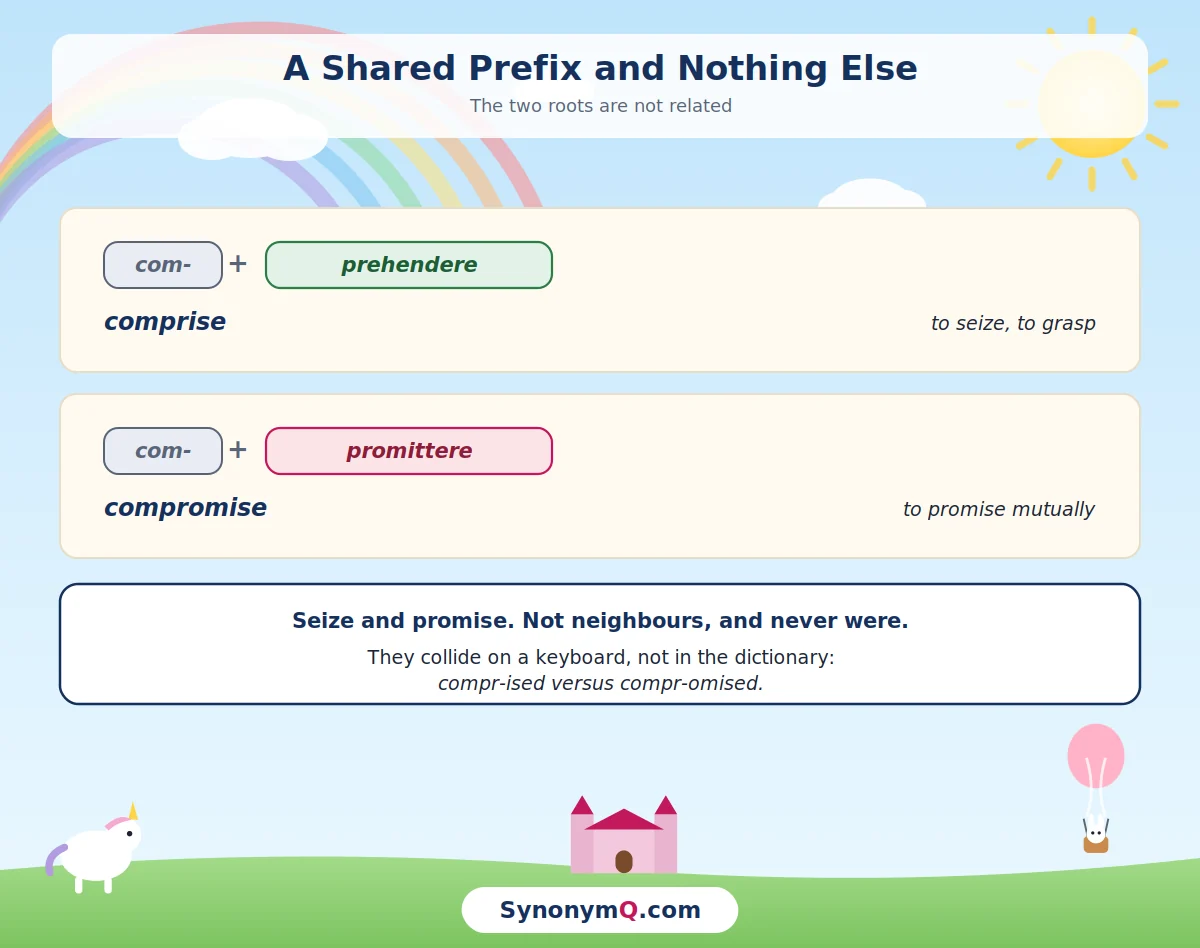
Comprised and compromised look like relatives. They are not, and the etymologies are not close.
| Word | Root | Literally | First known use |
|---|---|---|---|
| comprise | Latin comprehendere, via Anglo-French compris | to seize, to grasp | 15th century |
| compromise | Latin compromittere, from com- plus promittere | to promise mutually | 1598, as a verb |
Seize and promise. The only shared element is com-, which turns up in combine, compare, compute and several hundred others, and tells you nothing.
So this is not a sense problem. The words are not close in meaning and never were. They are confused because of how they look on a keyboard: compr-ised and compr-omised differ by two letters dropped into the middle.That matters for how you catch it, because the usual method for near neighbours — think about which meaning you want — does not apply when the two meanings are not neighbours at all.
What “Compromised” Actually Says
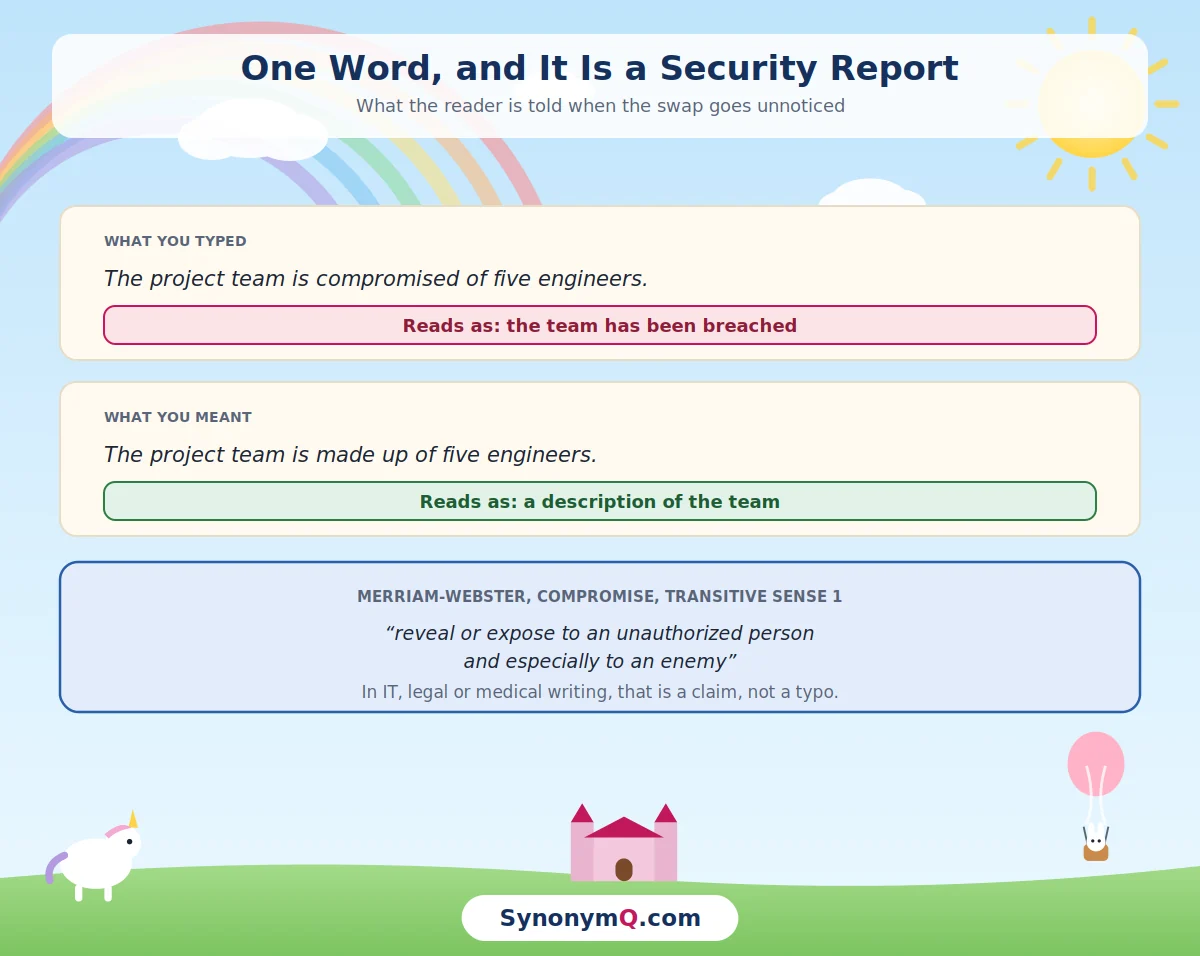
This is the part most guides leave out, and it is the reason writing compromised for comprised is worth catching.
Merriam-Webster’s transitive senses of compromise include “reveal or expose to an unauthorized person and especially to an enemy”, “cause the impairment of”, and “expose to suspicion, discredit, or mischief”.
What you typedThe project team is compromised of five engineers. What you meantThe project team is made up of five engineers.The first sentence does not read as a typo to someone scanning quickly. It reads as a report that the team has been breached, which in a security, legal or medical context is a serious thing to have written.
This is why it outranks an ordinary slip. Most word-choice errors make a sentence slightly less precise. This one makes a sentence say something alarming that you did not mean and would not defend.In everyday writing it reads as careless. In a status report, an incident summary or a patient note, it reads as a claim.
Why Spellcheck Never Catches It
Both words are correctly spelled English words with their own dictionary entries. A spell-checker compares your string against a word list, finds compromised on it, and moves on.
Grammar checkers do better but not reliably, because “is compromised of” is grammatically well formed. It is a real verb in a real construction; only the meaning is wrong.
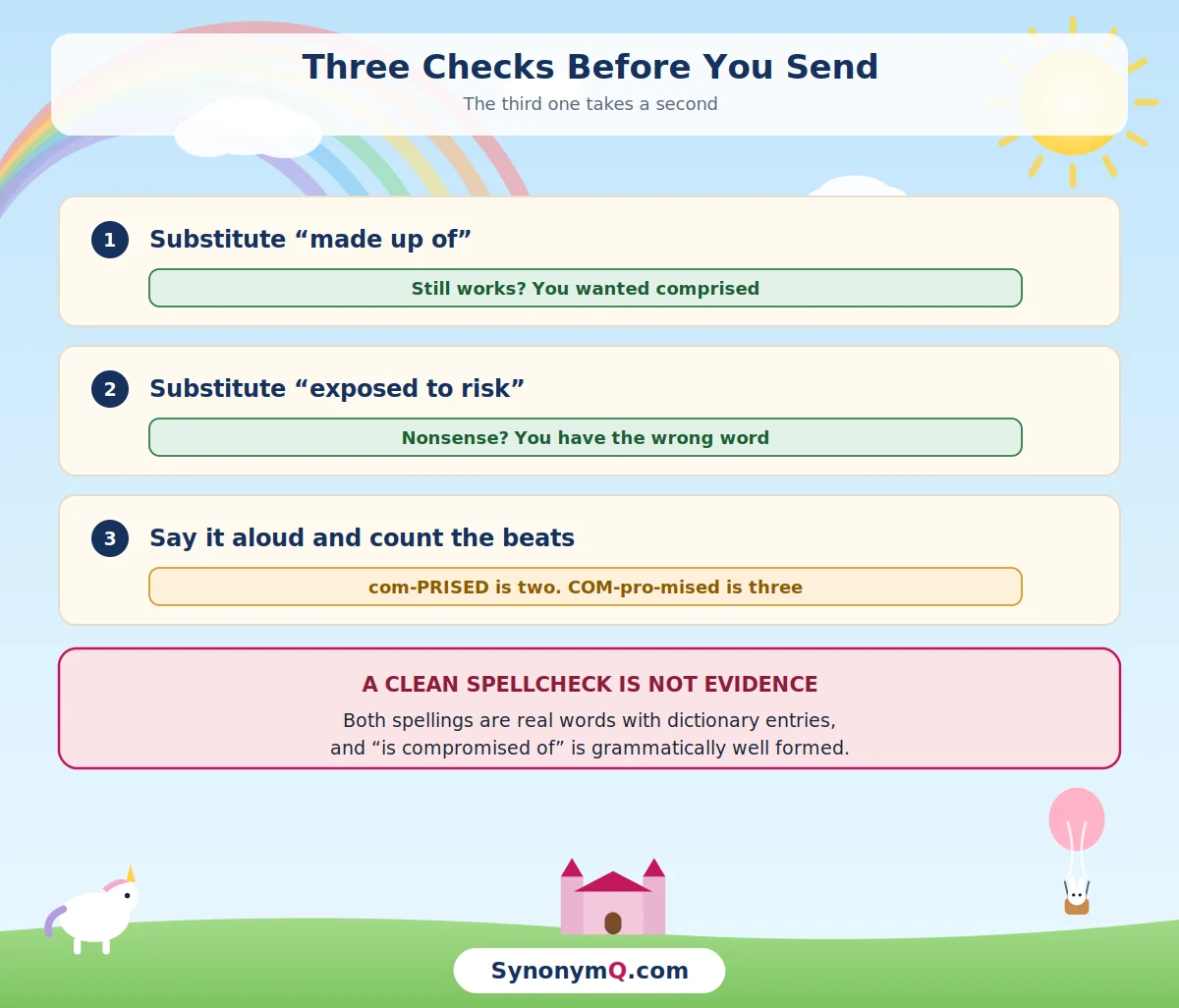
What this means in practice. A clean spellcheck is not evidence. This error survives every automated pass you are likely to run, and it survives a fast proof-read too, because the eye reads the shape of the word rather than its letters.Errors that pass automated checks are worth a manual habit, which is the argument for the three checks below rather than a rule to memorise.
3 Checks to Catch It Before Sending
| # | The check | What it tells you | Label |
|---|---|---|---|
| 1 | Substitute “made up of”. Does the sentence still work? | If yes, you wanted the parts-and-whole word, and made up of is usually the better final choice anyway | Direct Swap |
| 2 | Substitute “exposed to risk”. Does that make sense here? | If yes, compromised is right. If it is nonsense, you have the wrong word | Direct Swap |
| 3 | Say it aloud and count. Two beats or three? | com-PRISED is two. COM-pro-mised is three. The one you hear in your head is the one you meant | Swap With Adjustment |
Check three is the one to keep. Comprised and compromised look alike on screen and sound nothing alike, so moving the problem from your eye to your ear resolves it immediately.
Using a test the grammar allows rather than one that depends on meaning is the same approach that separates impressive and impressed.
Where the Error Turns Up Most
Worth knowing, because the places compromised turns up for comprised are the places it costs most.
| Context | What the wrong word claims |
|---|---|
| Security and IT writing | A system has been breached. The word already has a technical meaning here, so nobody reads it as a typo |
| Medical notes | An immune system or organ function is impaired. Merriam-Webster’s sense 1(b) exactly |
| Legal and HR documents | Someone has been exposed to suspicion or discredit |
| Company profiles and bios | Reads as careless rather than alarming, but it is the most public place it appears |
In the first three, compromised where you meant comprised is a plausible sentence in that field, so a reader has no cue that you meant something else.
The Other Errors Spellcheck Cannot See
Comprised and compromised are one instance of a category, and the category is more useful than the pair. Each of these is two real words, so no checker flags the swap, and in each case the wrong one produces a sentence that parses.
| Pair | What the wrong one quietly says |
|---|---|
| comprised / compromised | That something has been exposed or impaired |
| discreet / discrete | That something is separate, rather than that someone is tactful |
| principal / principle | That you mean a rule, when you meant the main one |
| complement / compliment | That you praised something, when you meant it completed something |
| stationary / stationery | That the paper is not moving |
| casual / causal | That a relationship is relaxed, rather than that one thing caused another |
What they have in common is not meaning. These pairs are not near neighbours the way hate and loathe are. They are unrelated words that collide on a keyboard, and the meanings are far enough apart that the wrong one is conspicuous once a reader notices it.
That is the case for reading proper nouns and technical claims aloud before sending. The ear separates what the eye merges, which is the same reason check three above works.
A Different Question: Is “Comprised Of” Correct?
Once comprised is the word on the page, a second argument is waiting, and it is worth knowing that it exists rather than assuming your sentence is now safe.
Comprised of, as in “the committee is comprised of nine members”, is separately contested, on grounds that have nothing to do with compromised.
Merriam-Webster notes that this use is now more frequent in general use than the older one, while recording that it is still attacked as wrong. Style authorities take a harder line than the dictionary does.
The practical shortcut, without relitigating it here. Made up of and consists of are accepted by everyone and cost you nothing. If you would rather not have the argument, they end it.Pairs where the dictionary and the style guides disagree are a category of their own, examined at is “most favorite” correct.
Frequently Asked Questions
Is it “comprised of” or “compromised of”?
Compromised of is always wrong: it says the thing has been exposed or impaired. Comprised of is the word people mean, though it is itself disputed. Made up of avoids both problems.
Do comprise and compromise come from the same root?
No. Comprise traces to Latin comprehendere, to seize. Compromise traces to compromittere, to promise mutually. Only the com- prefix is shared, and it is shared with hundreds of words.
Why doesn’t spellcheck catch this?
Because both are correctly spelled words with dictionary entries. The checker finds the string on its word list and passes it. The construction is grammatical too, so grammar checkers often miss it as well.
What does “compromised” mean in a security context?
Exposed to an unauthorised person, especially an enemy. That is Merriam-Webster’s first transitive sense. That is why the mistake is costly in IT and incident writing: the wrong word is a normal sentence in that field.
How do I remember which is which?
Count the syllables aloud. Comprised has two beats, compromised has three. They look alike written down and sound completely different spoken.
How This Page Was Checked
Read from the sources attributed, on 21 September 2026:
- The etymology from comprehendere via Anglo-French, the 15th-century date, the three senses, and the usage note on comprised of — Merriam-Webster.
- The etymology from compromittere, the 1598 verb date, and the transitive senses including “reveal or expose to an unauthorized person and especially to an enemy” — Merriam-Webster.
- The incumbent treatment of the pair, for what it covers and what it leaves out — Grammarist.
What is reasoning rather than a retrieved fact. That the error survives spellcheck because both strings are real words is a property of how checkers work, stated here rather than measured.
The contexts table is judgement about where the mistake costs most rather than survey data, and the syllable test is this page’s own suggestion.
What is deliberately not settled here. Whether comprised of is acceptable is a live argument with authorities on both sides, and this page gives the shortcut rather than the ruling.
Written by Naveed Akhtar, an SEO content writer with 10 years of article-writing experience.
Related: revert back is another case where the visible problem is not the one that damages the sentence, and the commonly confused words index groups the pairs worked through here.

Naveed Akhtar writes every guide on SynonymQ. He is an SEO content writer with ten years of article-writing experience, working on the question a thesaurus never answers: which of these words belongs in this sentence, for this reader. Every page cites the dictionary entries it draws on and the date they were read.