
Eager vs Excited: 4 Patterns, Only 1 Works for Both
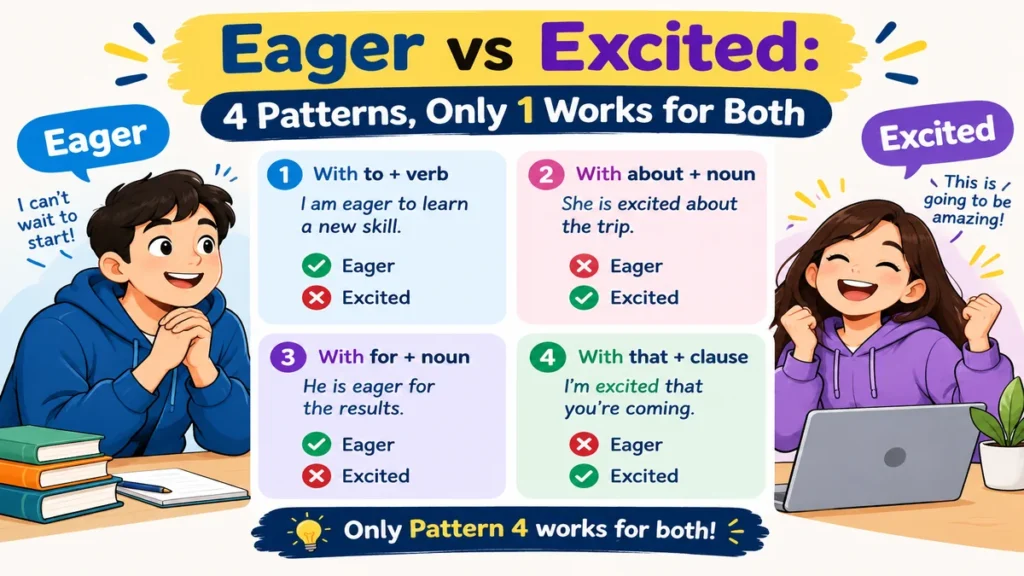
Eager vs excited comes down to one shared pattern: both take to plus a verb, so eager to start and excited to start are both fine. Elsewhere they split. Eager takes for; excited takes about, at or by. Eager about the trip is not English.
Written by Naveed Akhtar, an SEO content writer with 10 years of article-writing experience. About 7 minutes to read.
The One Sentence Where Both Words Fit
Start with the sentence where the two genuinely swap. I am eager to hear what she says. I am excited to hear what she says. Both are correct, both are natural, and most writers stop there and conclude the words are interchangeable.
They are not, and the reason is easier to see in the shared sentence than anywhere else. Eager points forward at the hearing, naming something you want to do. Excited points back at you, and names the state you are currently in.
One word is aimed at an action. The other describes a condition. That single difference decides every other sentence the two words appear in, and it decides them by grammar rather than by feel.
Which is what makes this pair easier to settle than most. You are not weighing two shades of enthusiasm against each other; you are checking what the next word in the sentence will allow.
Eager vs Excited: The Four Patterns Side by Side
Oxford Learner’s Dictionaries lists the grammar patterns for each word explicitly, which turns an argument about connotation into a table you can check.
| Pattern | eager | excited |
|---|---|---|
| to + verb | eager to leave | excited to leave |
| for + noun | eager for news | not listed, see below |
| about + noun | not a pattern | excited about the trip |
| at or by + noun | not a pattern | excited at the news, excited by the offer |
Four patterns, one shared. That is the whole of eager vs excited, and it is why writers who swap the two freely get caught out: the swap has one valid cell and three invalid ones.
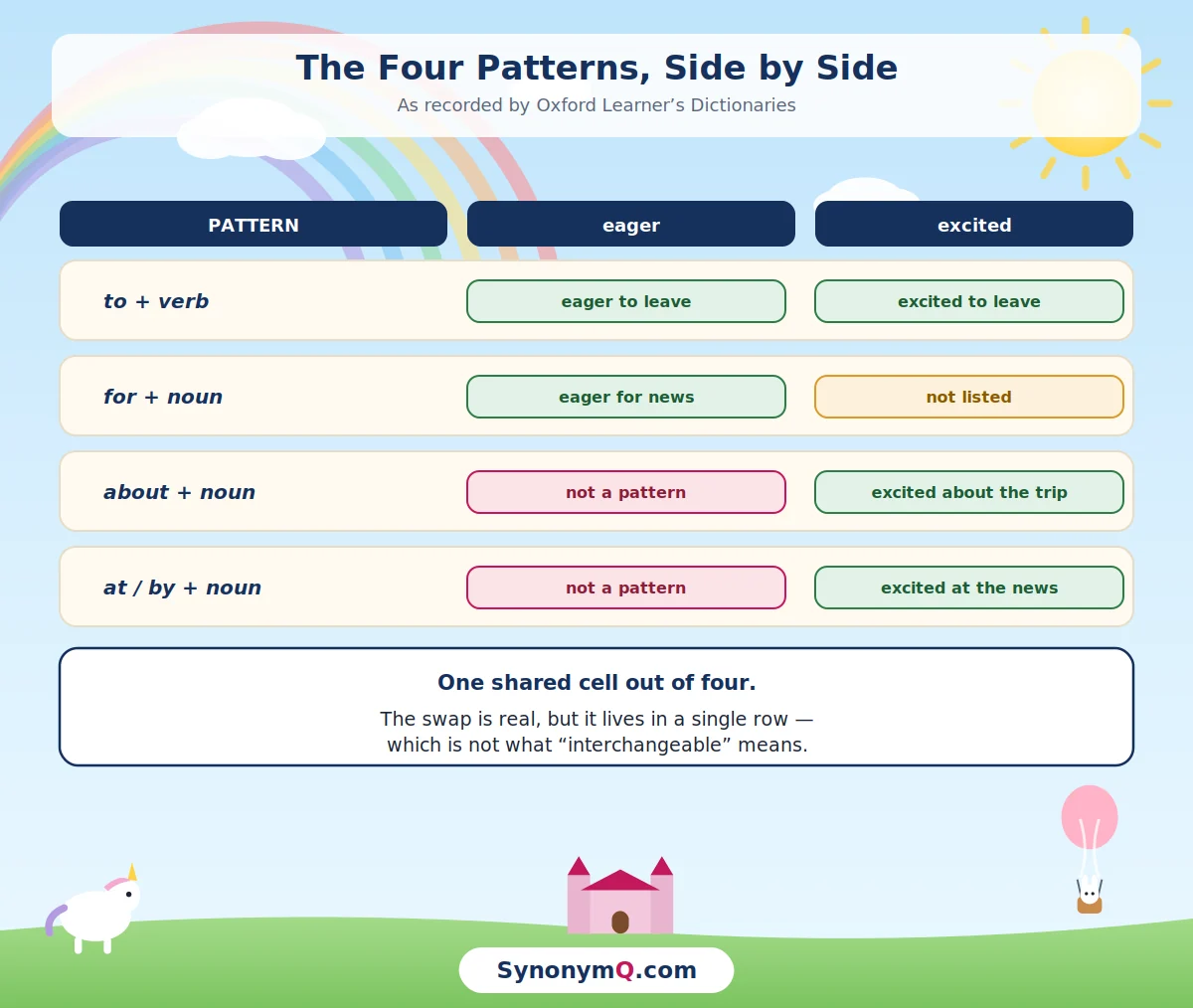
That grid answers the question most writers are actually asking, which is not what the two words mean but whether one can be dropped in for the other.
| Where | Verdict | Why |
|---|---|---|
| to + verb, no sense of waiting | Direct Swap | I am eager to hear and I am excited to hear carry the same weight |
| to + verb, impatience doing work | Swap With Adjustment | Eager to get started loses its pressure as excited; put the pressure back with a word like finally |
| Any pattern with a noun | Requires Rewrite | Eager for news becomes excited about the news; the preposition changes with the word |
Why “Eager About” Sounds Wrong
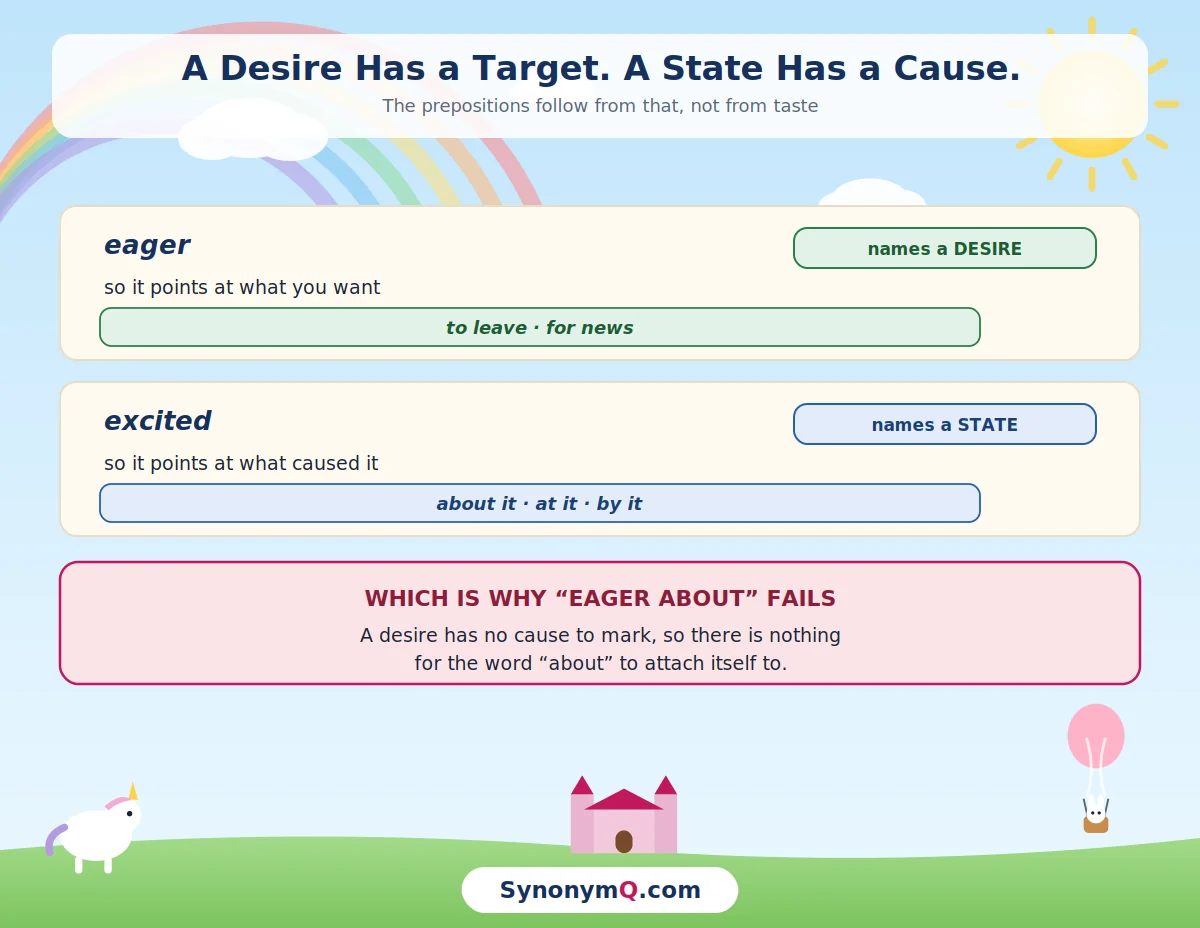
The grid is not arbitrary. It follows from what each word actually is, and once you see the reason you stop needing to memorise the prepositions.
Eager names a desire, and a desire needs a target. You can want to do something, which gives you eager to leave. You can want a thing, which gives you eager for news. Both point at what you are reaching for.
Excited names a state, and a state has a cause. Something put you in it. The prepositions that mark causes are about, at and by, so those are the ones excited takes.
| Sentence | Verdict |
|---|---|
| She was eager for the results. | Correct: the results are what she wants |
| She was excited about the results. | Correct: the results are what put her in that state |
| She was eager about the results. | Wrong: a desire has no cause to mark |
| She was excited for the results. | Contested: see the section below |
This is the same mechanism that decides classic vs classical, where the choice is settled by which word a phrase has already fixed itself to rather than by any rule about meaning.
The Dictionary Defines One Word Using the Other
There is a smaller finding sitting in the two Merriam-Webster entries, and it points the same direction as the grammar.
| Word | The gloss |
|---|---|
| eager | “marked by enthusiastic or impatient desire or interest” |
| excited | “having, showing, or characterized by a heightened state of energy, enthusiasm, eagerness, etc.” |
The definition of excited contains eagerness. The definition of eager contains no excitement. The containment runs one way, exactly as the swap does.
Treat that as confirmation rather than proof. Dictionary glosses are written by people making choices, not generated from a rule. But when the grammar and the definitions point the same way, the reading is worth trusting.
“Excited For” Is the Live Argument
Oxford Learner’s lists about, at and by for excited. It does not list for. Yet excited for is everywhere, and usage guides have been objecting to it for over a decade.
The objection is not as broad as it looks, because excited for covers two different constructions and only one of them is disputed.
| What follows for | Example | Status |
|---|---|---|
| A person | You’re engaged? We’re so excited for you! | Long established, not disputed |
| An event or thing | I’m excited for the weekend. | Common in speech, objected to in edited writing |
The first means on your behalf, which is a job no other preposition does. The second means about, which already has a preposition, and that is the whole basis of the complaint.
In speech, or in anything conversational, excited for the weekend will not cost you a reader. Usage that widespread tends to end up in the dictionaries eventually. It is simply not there yet.
Eager Has an Edge, and That Is Not a Metaphor
Merriam-Webster traces eager through Anglo-French egre and aigre to Latin acer, meaning sharp, and notes the word is related to edge. The entry still records an archaic sense “sharp” and an obsolete sense “sour.”
That history is still audible. Merriam-Webster’s synonym note says eager emphasises ardour and enthusiasm and sometimes impatience at delay or restraint. Excited carries no impatience at all.
So eager to leave and excited to leave are not the same sentence even in the one cell where both are legal. The first can imply you are being kept waiting. The second only says how you feel.
The dates widen the gap. Eager reaches English in the 14th century. Excited is first recorded in 1855, about five hundred years later, which is part of why the older word carries associations the newer one never picked up.
Words that look interchangeable until one of them smuggles in a feeling you did not intend are the same hazard covered at notable vs noteworthy.
Choosing Between Them in a Real Sentence
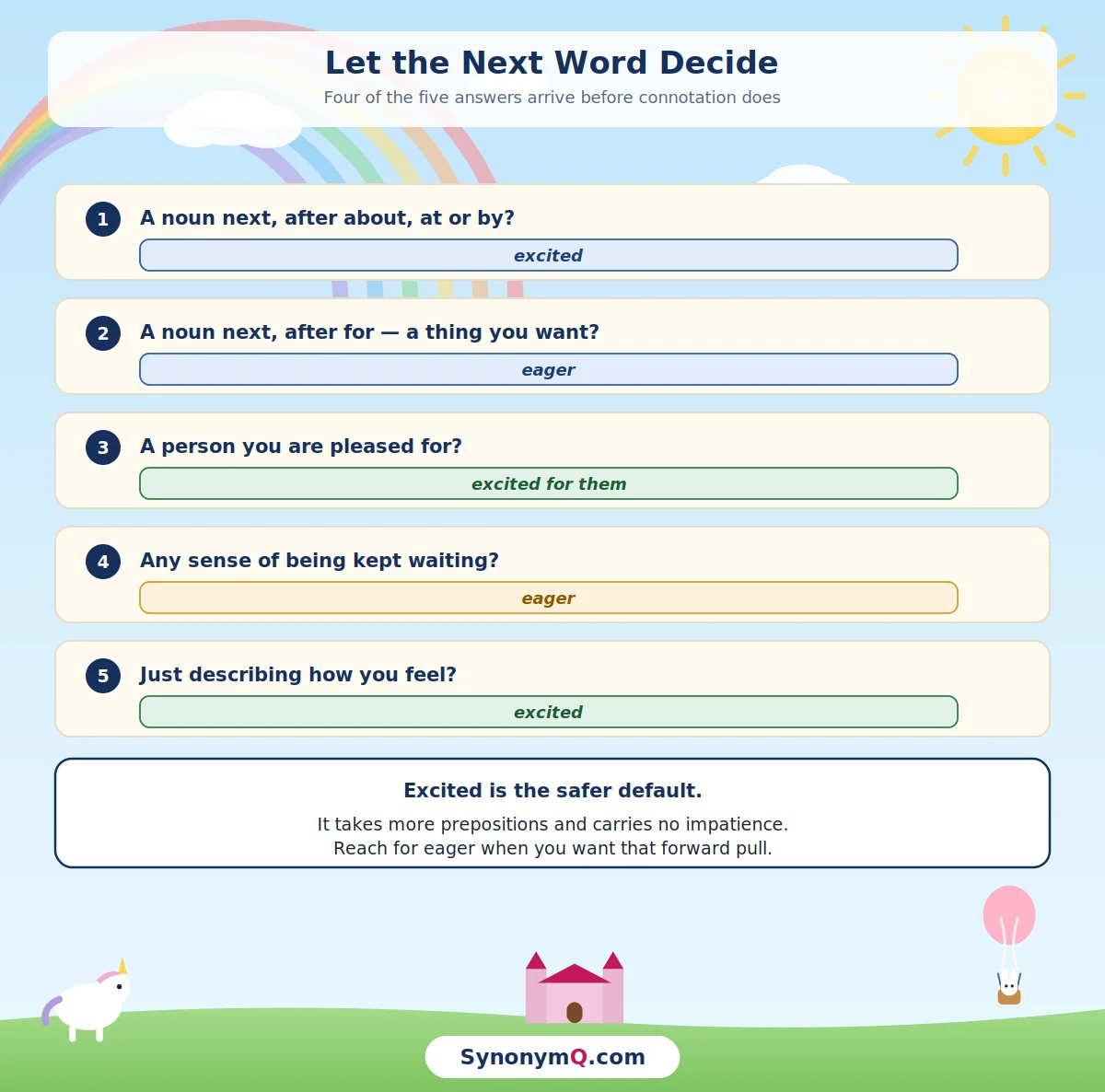
Work down this list and stop at the first line that matches. Four of the five answers settle eager vs excited before connotation enters the picture at all.
- Is a noun coming next, not a verb? Then the preposition decides for you. About, at or by means excited. For plus a thing you want means eager.
- Is the next word a person you are pleased for? Excited for them. Eager cannot do this at all.
- Is to plus a verb coming next? Both are legal. Continue to the next question.
- Is there any sense of being kept waiting? Use eager. That impatience is in the word and not in excited.
- Otherwise, are you describing how you feel rather than what you want? Use excited, which is what it is for.
If you are weighing the strength of a feeling rather than its grammar, the scale at hate vs dislike vs loathe covers that problem for the opposite emotion.
Frequently Asked Questions
Can eager and excited be used interchangeably?
Only in one construction: to plus a verb. Eager to start and excited to start are both correct. In every other pattern one of the two words is wrong, because they take different prepositions.
Is “eager about” ever correct?
No. Oxford Learner’s records only eager for something and eager to do something. About marks the cause of a state, and eager names a desire rather than a state, so there is nothing for about to attach to.
Is “excited for” wrong?
It depends on what follows. Excited for you, meaning on your behalf, is long established. Excited for the weekend, meaning about it, is common in speech but objected to by usage guides and not listed in Oxford Learner’s.
Which word is stronger?
Neither is reliably stronger. They differ in direction rather than intensity: eager points at something you want, excited describes a state you are in. Eager can add impatience, which sometimes reads as more intense.
What is the difference between eager and anxious?
Dictionaries record “ardently or earnestly wishing” as a standard sense of anxious, so the two overlap more than usage guides admit. The practical split is the preposition: anxious about is always worry, anxious to is the eager sense.
How This Page Was Checked
Read from the sources attributed, on 25 September 2026:
- Oxford Learner’s Dictionaries, eager: the patterns eager for something and eager to do something, and the absence of any about pattern.
- Oxford Learner’s Dictionaries, excited: the patterns excited about, excited at and excited by, and the absence of excited for.
- Merriam-Webster, eager: sense 1, the archaic “sharp” and obsolete “sour” senses, the Latin acer etymology, the relation to edge, the 14th-century date, and the synonym note on impatience.
- Merriam-Webster, excited: sense 1 including the word eagerness, and the 1855 date.
- The Grammarphobia Blog, “Does this excite you?”: the split between excited for a person and excited for an event, and the recommendation to prefer about or by with events.
- Merriam-Webster, anxious: the standard sense quoted in the FAQ.

Naveed Akhtar writes every guide on SynonymQ. He is an SEO content writer with ten years of article-writing experience, working on the question a thesaurus never answers: which of these words belongs in this sentence, for this reader. Every page cites the dictionary entries it draws on and the date they were read.