
Hard vs Difficult vs Challenging: 3 Differences That Explain What Makes It Hard
Hard vs difficult vs challenging is mainly a choice of emphasis. Hard and difficult mean not easy; challenging highlights a test of ability and can sound encouraging. Choose the word that honestly describes the task, not just the most positive one.
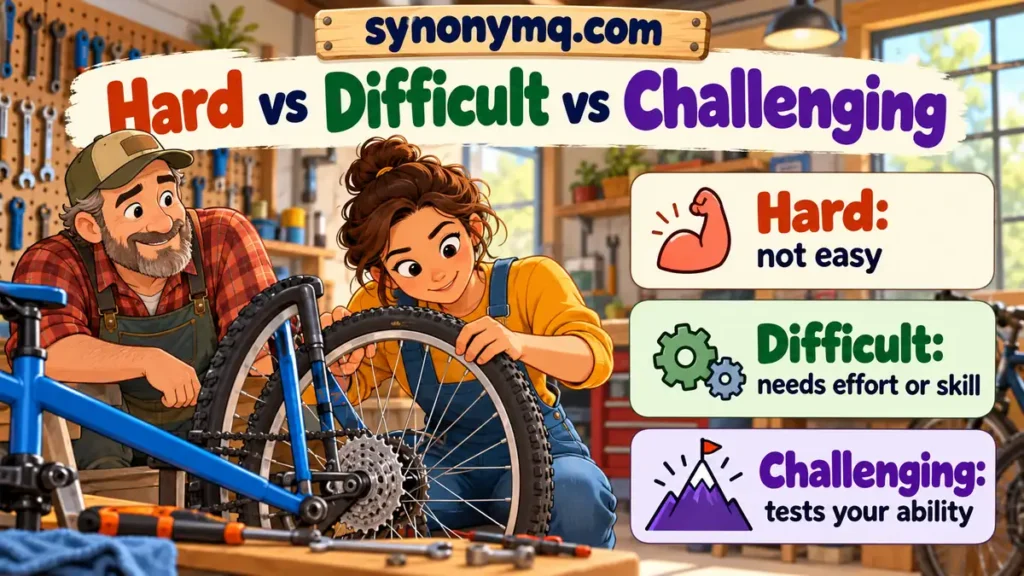
“The repair was challenging.” That could describe an enjoyable afternoon learning to fix a bicycle. It could also be a polite way of saying that the instructions were poor and nothing fitted.
The adjective alone leaves room for both readings. Add the reason: “The repair was difficult because two parts were missing.” Now the reader knows whether the problem was the task, the equipment, or your experience.
Start with the reason something is not easy
A task can take skill, time, concentration, or patience. Hard and difficult leave that reason fairly open. Challenging draws attention to the demands on the person doing it.
| Word | Main emphasis | Example | What it does not establish |
|---|---|---|---|
| Hard | Not easy; a direct, everyday description | Keeping the wheel straight was hard. | It does not specify whether the effort was mental or physical. |
| Difficult | Something takes effort or skill, or presents a problem | The missing diagram made assembly difficult. | It does not mean the task was impossible. |
| Challenging | Something tests ability or resources | Building my first bicycle was challenging. | It does not guarantee enjoyment or success. |
In “The last question was hard,” difficult is a direct swap with little change in meaning. Challenging is also grammatical, but can suggest a worthwhile test rather than simply an obstacle.
There is no reliable ranking in which hard is mild, difficult is stronger, and challenging is strongest. A challenging puzzle might be easier than a difficult repair. The task and the person matter.
Oxford’s difficult entry covers both effort and troublesome circumstances. Hard overlaps with it, but has additional meanings that need separate treatment.
Can hard be used in formal writing?
Yes. Hard is standard English. “The result is hard to explain” is clear in an essay as well as a conversation. Difficult may suit a more measured tone, but replacing hard does not automatically improve a sentence.
For an essay, explain the obstacle: “The result is difficult to interpret because the two groups used different scales.” The explanation provides precision; the longer adjective alone does not.
Challenging can encourage—or conceal the problem
“A challenging course” often suggests material that stretches your abilities. Oxford explicitly includes an interesting test of ability in its definition of challenging.
That makes it useful when describing a task someone may want to attempt. It can sound constructive in feedback, course descriptions, and conversations about learning.
But challenging is not always a compliment. A challenging situation may be deeply unwelcome. The word can also describe a confrontational manner, as in a challenging look. Context decides whether the tone is encouraging.

Two ways to make feedback more useful
- Vague: “The new booking system is challenging.”
Specific: “The new booking system is difficult to navigate because the search button is hidden.” - Vague: “The project was hard.”
Specific: “The project was challenging because I had to learn a new design tool.”
The first rewrite identifies a usability problem. The second identifies a demand on the learner. Neither promises that a different adjective will change how the listener feels.
If the real problem is insufficient time, say that directly. Our guide to describing an aggressive timeline examines schedule wording in more detail.
Be especially careful when describing people. “A difficult customer” judges how someone behaves or interacts. A factual description such as “The customer changed the delivery address twice” may be more useful in a work note.
A hard surface is not a difficult surface
Hard can describe something resistant to pressure: a hard seat or a hard piece of wood. Difficult does not express that property. A seat might be difficult to move, but that is a different claim.
Merriam-Webster records hard as both an adjective and an adverb. In “a hard task,” it describes the task. In “They worked hard,” it describes the effort they put in.
To replace “They worked hard” with a phrase about difficulty, you must rewrite: “Their work was difficult.” Even then, the meaning changes. Effort and task difficulty are related, but they are not identical.
Someone can work hard at a straightforward job. Someone else can face difficult work while making little effort. Do not use one sentence as proof of the other.
Work hard and hardly work
“Leena works hard on her model boat” means she puts effort into it. “Leena hardly works on her model boat” means she does very little work on it.
In this everyday use, hardly means almost not. It is not the form you need to turn hard into an adverb of effort: hard already serves that purpose.
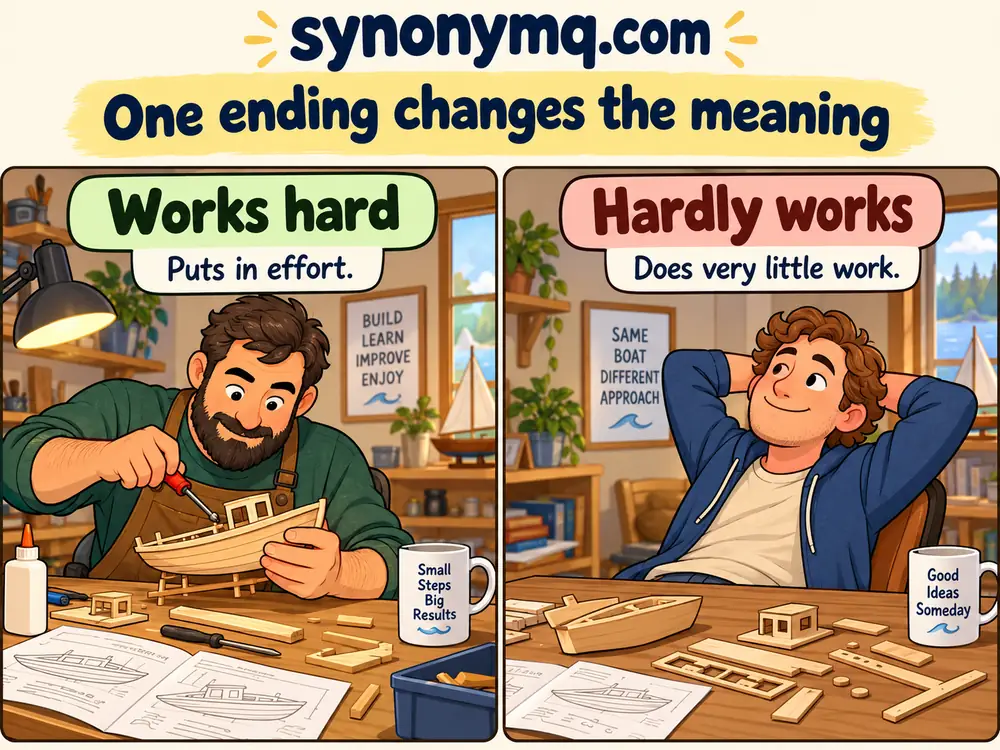
The opposite also depends on the meaning. Easy contrasts with a hard task. Soft contrasts with a hard cushion. A single opposite cannot cover both uses.
Difficult to do, but difficulty doing
Difficult is an adjective. Difficulty is a noun, not a verb in the patterns below. Switching between them changes the sentence structure.
| Pattern | Original example |
|---|---|
| It is hard/difficult to + verb | It is difficult to align the two marks. |
| Something is hard/difficult for someone | The last stage was hard for the beginners. |
| Find something challenging | I found the final sketch challenging. |
| Have difficulty + -ing | We had difficulty finding the right cable. |
| With difficulty | The lid opened with difficulty. |
Use “I had difficulty opening the file,” not “I had difficulty to open the file.” Oxford’s difficulty entry also allows “difficulty in opening.”
Difficulty can refer to the general experience of something being hard. Difficulties can name particular problems: “We encountered difficulties with the payment system.” Do not replace either noun directly with the adjective difficult.
For comparisons, use harder, more difficult, and more challenging. The corresponding superlatives are hardest, most difficult, and most challenging.
Choose an alternative that names the obstacle
Tough and demanding are useful near-synonyms in particular contexts. Complicated is more specific about structure; unmanageable makes a stronger claim about control. None is a universal replacement for difficult.
| Alternative | Replacement example | Relationship and substitution |
|---|---|---|
| Tough | a difficult choice → a tough choice | Near-synonym; Direct Swap. A direct description of something hard to face or resolve. |
| Demanding | a difficult role → a demanding role | Near-synonym; Direct Swap when the role requires sustained effort, time, or attention. |
| Complicated | The process is difficult → The process is complicated because its steps depend on one another. | Contextual alternative; Requires Rewrite to state the structural problem. Difficulty alone does not prove complexity. |
| Unmanageable | a difficult workload → an unmanageable workload | Stronger contextual alternative; Direct Swap only if the workload cannot be handled in the circumstances. |
Demanding emphasizes what something requires of you. A repetitive task may be demanding because it takes hours, even if none of its steps is difficult to understand.
Complicated concerns involved parts or relationships. For more choices in that narrower sense, see alternatives to complex.
Unmanageable means not manageable; it should not be used merely to make a routine inconvenience sound impressive. Keep difficult when the stronger claim is not justified.
Tough or tuff?
Use tough for a difficult task: “The last repair was tough.” Tuff is a geological noun for a type of volcanic rock, not the standard spelling of that adjective.
Tough can also mean able to endure strain. That is why “a tough material” is not simply another way to say “a difficult material.” The noun and intended meaning determine the choice.
Frequently asked questions
What is the difference between “challenging” and “difficult”?
Difficult states that something is not easy. Challenging emphasizes a test of ability and may sound encouraging. It does not necessarily mean the experience is enjoyable or the task is achievable.
Are difficult and challenging the same thing?
They overlap when describing demanding tasks, but their tone can differ. A difficult process may have unnecessary obstacles; a challenging process may test your skills. Explain the cause when that distinction matters.
What is the difference between “hard” and “difficult”?
Both can mean not easy. Hard also describes firmness and can function as an adverb, as in work hard. Difficult cannot replace those uses without changing the wording or meaning.
What’s a synonym for hard or difficult?
Tough, demanding, and challenging can work, depending on the task. Choose demanding for heavy requirements and challenging for a test of ability. For a hard surface, the relevant alternative may be firm.

Naveed Akhtar writes every guide on SynonymQ. He is an SEO content writer with ten years of article-writing experience, working on the question a thesaurus never answers: which of these words belongs in this sentence, for this reader. Every page cites the dictionary entries it draws on and the date they were read.