
Old vs Ancient vs Antique: 3 Things Age Alone Cannot Tell You
Old vs ancient vs antique is about context, not just age. Old is the broad description; ancient points to the distant past or means very old; antique usually describes an older object valued or collected for its age, character, or craftsmanship.
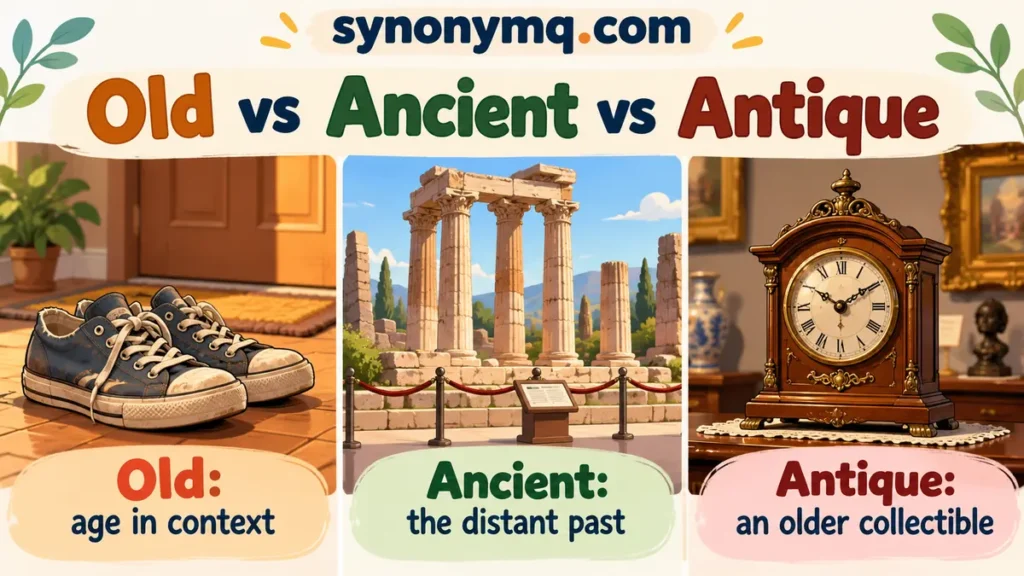
A worn pair of shoes, a ruined temple, and a carved wooden clock can all be old. Yet calling all three antiques would give readers the wrong impression.
The old vs ancient vs antique comparison reveals three things age alone cannot tell you: an object’s collecting value, its historical significance, and whether its appearance reflects its actual age.
Old tells us relatively little. Ancient places something in a much more distant past, unless it is used jokingly. Antique usually invites us to look at an object as a surviving piece from an earlier period.
Old vs Ancient vs Antique: What Each Label Suggests
| Word | What it usually tells you | Natural example | What it does not prove |
|---|---|---|---|
| Old | Age relative to the subject or situation | We replaced the old kitchen radio. | That the radio is collectible or historically important. |
| Ancient | A connection with the distant past, or extreme age | The museum displayed ancient pottery. | A single fixed age applying to every use. |
| Antique | An object from an earlier period, often appreciated or collected | She inherited an antique writing desk. | Its exact date, authenticity, condition, or price. |
Merriam-Webster treats old as a relative as well as an age-related word. An old phone and an old oak tree need not have existed for anything like the same length of time.
Old can also mean former: “Our old apartment had a balcony.” That apartment could be in a recently built block. The sentence identifies where we used to live, not when the building was constructed.
Oxford distinguishes ancient history from the broader meaning very old. Ancient Rome belongs to the historical use; “my ancient laptop” is usually exaggeration.
Oxford describes antique furniture and similar objects as old and often valuable. Often matters: the word is not a guarantee of a high selling price.
Does antique always mean at least 100 years old?
A hundred years is a familiar benchmark for antiques, but it is not the complete meaning of the word in every setting. Ordinary usage, collecting categories, and formal classifications do not always work in the same way.
Merriam-Webster’s antique entry mentions a 100-year threshold in a customs-related definition. It also records broader senses for objects and styles from earlier periods.
For a vocabulary comparison, the useful lesson is to avoid a rigid ladder such as old, then antique, then ancient. Antique is a type of description, not simply the next age after old.
An ancient vessel can also be an antique in the broad sense. But a museum description may call it an antiquity, while a furniture shop may use antique for a much more recent cabinet.
If you know the date, give it: “a desk made in 1890” says more than “an old desk.” If you do not know it, avoid making the description sound more certain than the evidence allows.
Something can also look old without being old. “An antique-style mirror” describes the appearance. It does not assert that the mirror was manufactured in an earlier century.
Age and historical importance are separate questions too. For that distinction, see historic versus historical.
Antiques are objects; antiquity can be an era
An antique is a countable noun: one antique, several antiques. The same word can be an adjective: an antique clock, antique jewelry, antique furniture.
Antiquity has different uses. It can name the ancient past, refer to great age, or mean an object from ancient times. In that last sense, the plural is antiquities.

| Pattern | Meaning in the example | Original sentence |
|---|---|---|
| In antiquity | In ancient times | The essay examines travel in antiquity. |
| Of great antiquity | Of great age | The guide described a tradition of great antiquity. |
| Roman antiquities | Objects surviving from ancient Roman times | The exhibition included Roman antiquities. |
Oxford lists these time, age, and object senses. “We studied antiquity” and “We studied antiquities” therefore need not mean the same thing.
In ordinary use, an antiques collection might include furniture, clocks, and decorative objects from earlier centuries. An antiquities collection more specifically suggests objects from ancient civilizations. The categories can overlap.
What does classical antiquity mean?
Classical antiquity usually refers to the ancient Greek and Roman world. It is a historical expression, not a claim that every object from that world is an antique offered for sale.
For the distinction between a recognized model and a historical or artistic tradition, our classic versus classical guide explains the two adjectives.
As a general word, antiquity is normally lowercase: “art from antiquity.” Capitalization can appear in a title or under a particular publication’s convention for named periods. Follow the style used in your document.
Vintage clothing: age is different from an older look
Old clothes may simply be clothes you have owned for years. Vintage clothing commonly suggests garments from an earlier era, often appreciated for their design or character.
Merriam-Webster records vintage for things dating from the past, as well as things of enduring interest or quality. The word does not supply one universal age cutoff for every product category.
Antique clothing generally suggests an older collectible garment. Ancient clothing belongs to a very distant historical context. For a museum object, its date and culture are more informative than choosing the most impressive adjective.
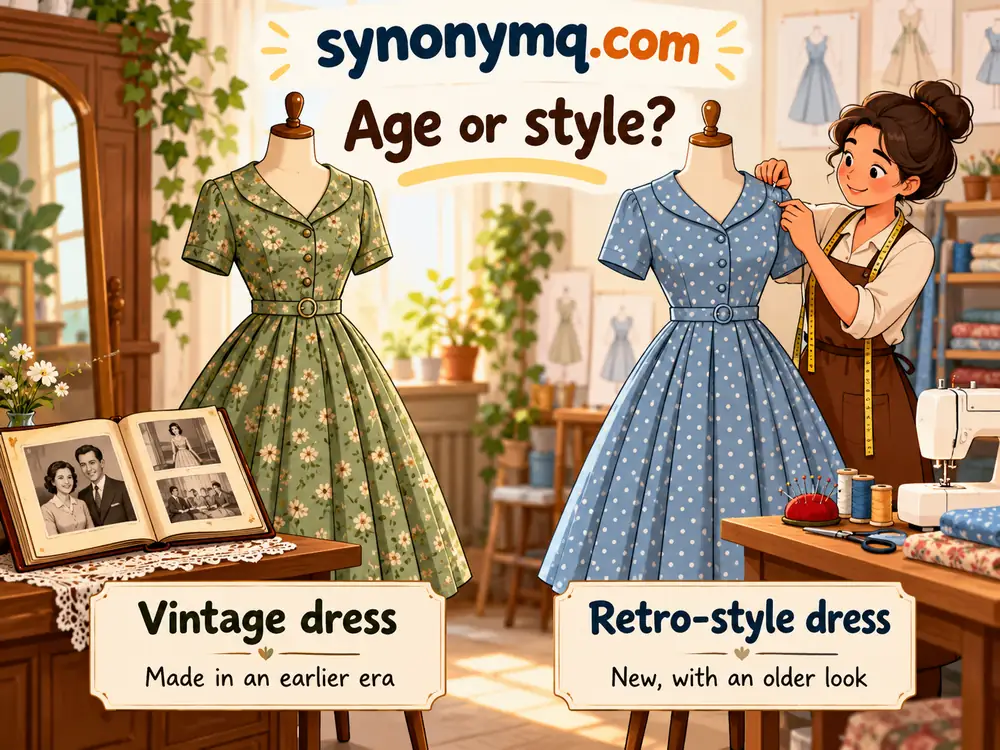
Retro refers to a return to earlier styles. A new dress can have a retro design. Calling it vintage-style makes the same essential distinction between appearance and actual age clearer.
Do not replace vintage with antique merely to make a description sound more valuable. If you know when the garment was made, include the period and explain what the label means in that context.
Choose the replacement that preserves the claim
These words are related, but they are not interchangeable in every sentence. Sometimes a plainer phrase is more accurate than another adjective.
| Original wording | Alternative | Relationship and substitution |
|---|---|---|
| An ancient tree | A very old tree | Near-synonym phrase; Direct Swap for great age, with less dramatic wording. |
| Our old office | Our former office | Contextual alternative; Direct Swap only when old means previously used. |
| An antique chair | An old chair | Broader description; Direct Swap grammatically, but loses the collecting or period association. |
| A vintage dress | A dress made in an earlier era | Contextual explanation; Requires Rewrite and a factual basis for its age. |
| An antique-style lamp | A lamp with an old-fashioned design | Contextual explanation; Requires Rewrite. Neither phrase establishes the lamp’s age. |
Descriptions of people need care as well. An old friend can be someone you have known for a long time. An ancient friend sounds humorous or unkind, and an antique friend is not a normal neutral substitute.
The opposite depends on the sense. New contrasts with an old possession; young contrasts with an old person; modern often contrasts with ancient in a historical discussion.
When choosing between old vs ancient vs antique, add the fact the adjective leaves out: the date, period, previous use, or whether the object is a reproduction. Specific details make the description more useful.
Frequently asked questions
What is the difference between old, ancient, and antique?
Old is a broad age description. Ancient suggests the distant past or very great age. Antique usually describes an older object appreciated or collected for its age, period, or craftsmanship.
Is every old object an antique?
No. Old alone does not establish an object’s collecting interest or period classification. An old everyday item may simply be used or outdated. Its age and context matter.
What is the difference between antiques and antiquities?
Antiques usually means older collectible objects, including furniture and decorations. Antiquities more specifically refers to objects from ancient times. The categories can overlap; neither word gives an exact date by itself.
Does ancient always mean thousands of years old?
No. Ancient often refers to the distant historical past, but it also means very old and can be humorous exaggeration. An ancient laptop is not literally thousands of years old.

Naveed Akhtar writes every guide on SynonymQ. He is an SEO content writer with ten years of article-writing experience, working on the question a thesaurus never answers: which of these words belongs in this sentence, for this reader. Every page cites the dictionary entries it draws on and the date they were read.