
Synonyms for Alone: Which Ones Add Sadness You Didn’t Mean
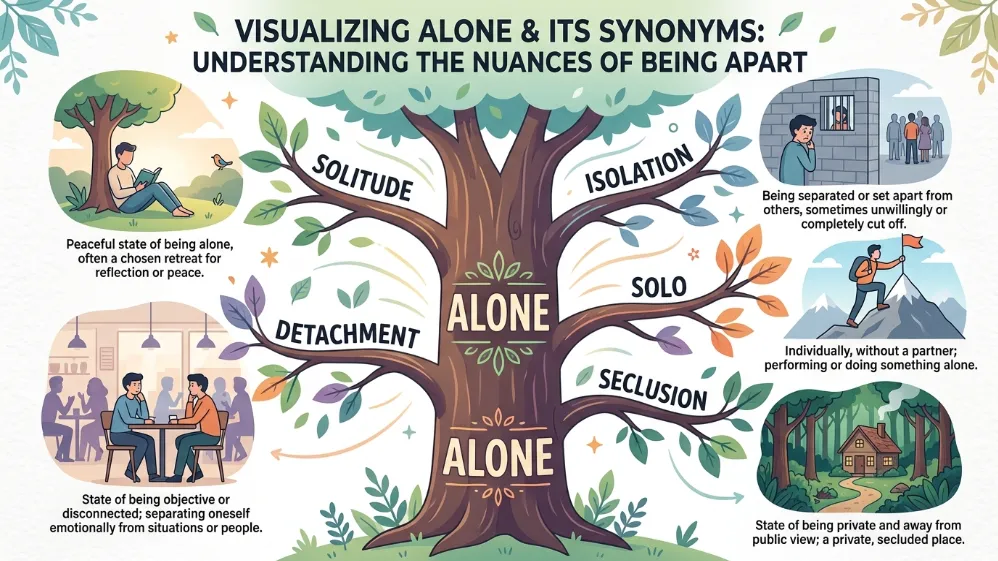
Most synonyms for alone are not neutral, and alone is the coldest word in the set. Merriam-Webster ranks the family by emotional weight: lone stays factual, solitary hints at loss, lonely adds longing, lonesome deepens the sadness, forlorn adds dejection, desolate implies grief. Pick by how much feeling you want, because every alternative adds some.
What Alone Actually Means
Alone comes from Old English all ana, literally “wholly oneself.” Etymonline records it from around 1300 as “a contraction of all ane.”
Merriam-Webster gives the same construction: “Middle English al-one, alone, allone, from al, all + one,” dated to the 13th century. The word was built from all and one, not from any word for sadness.
The sad word arrived nearly three centuries later. Merriam-Webster dates lonely to circa 1598, which makes it roughly 300 years younger than alone.
Lone is a fragment that broke off alone. Etymonline describes it as “a shortening of alone… by weakening of stress or else by misdivision of what is properly all one.”
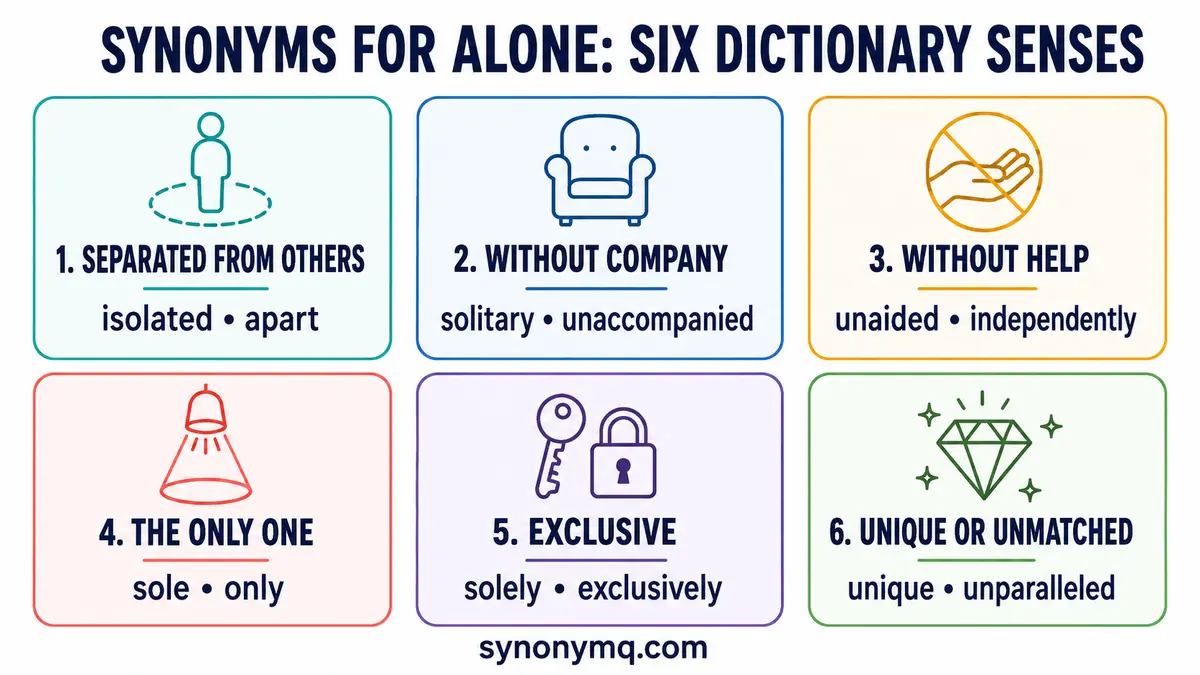
Merriam-Webster’s entry for alone gives six senses, and only the first is about company:
| Sense | Merriam-Webster’s wording | Example |
|---|---|---|
| Adjective 1 | “separated from others : isolated” | She was alone in the house |
| Adjective 2 | “exclusive of anyone or anything else : only” | Time alone will tell |
| Adjective 3a | “considered without reference to any other” | The rent alone is £900 |
| Adjective 3b | “incomparable, unique” | She stands alone in her field |
| Adverb 1 | “solely, exclusively” | It rests on him alone |
| Adverb 2 | “without aid or support” | She built it alone |
Three of the six senses mean only, not unaccompanied. In the rent alone is £900, nobody is by themselves, and a companionship synonym collapses the sentence.
Sense 3b is the one that turns up in product and industry writing. Stands alone claims uniqueness rather than solitude, which is why it sits comfortably beside precise vocabulary for a technology rather than beside anything about being by yourself.
The Emotional Ladder: From Alone to Desolate
Merriam-Webster’s thesaurus separates seven near-neighbours by how much feeling each carries, not by what they mean. This is the part a synonym list cannot give you.
The framing sentence sets the scale:
“While all these words mean ‘isolated from others,’ alone stresses the objective fact of being by oneself with slighter notion of emotional involvement than most of the remaining terms.”
The ladder below is in Merriam-Webster’s own words, ordered by emotional weight:
| Word | Merriam-Webster’s distinction | Emotional weight |
|---|---|---|
| Alone | “stresses the objective fact of being by oneself” | None. It is a fact |
| Lone | “may replace lonely or lonesome but typically is as objective as alone” | None to slight |
| Solitary | “may indicate isolation as a chosen course, but more often it suggests sadness and a sense of loss” | Chosen, or quietly sad |
| Lonely | “adds to solitary a suggestion of longing for companionship” | Wants company |
| Lonesome | “heightens the suggestion of sadness and poignancy” | Sadder still |
| Forlorn | “stresses dejection, woe, and listlessness at separation from one held dear” | Bereft of someone |
| Desolate | “implies inconsolable grief at loss or bereavement” | Grief |
There is no neutral upgrade from alone. Every step down that table adds an emotion the original sentence did not contain.
Swapping alone for solitary because it sounds more literary tells the reader your subject is sad. That is a claim about someone’s inner life, made by accident.
This is the same failure that decides grief, sorrow and sadness. Writers reach for a heavier word to signal that they care, and the overshoot is what reads as insincere.

Alone vs Lonely: The Distinction Both Dictionaries Draw
Alone describes a circumstance. Lonely describes a feeling. Both dictionaries state this directly rather than leaving it to inference.
Oxford Learner’s Dictionaries defines the feeling word first: “Lonely (North American English also lonesome) means that you are sad because you have no friends or people to talk to.”
It then rules out the reading people assume. “Alone, and on your own/by yourself… describe a person or thing that is not with other people or things. They do not mean that the person is unhappy.“
Merriam-Webster’s lonely entry confirms the split from the other side. Its senses run “being without company,” “cut off from others,” “not frequented by human beings: desolate,” and “sad from being alone: lonesome.”
The two words are not interchangeable in either direction:
- He lives alone is a fact about his household.
- He is lonely is a claim about his feelings.
- He lives alone but is never lonely is not a contradiction. It is the whole point.
For a factual statement about someone’s circumstances, use alone or on their own. Avoid lonely, because it asserts an emotion you have not verified.
Health copy, obituaries, care-sector content and news reporting all describe people living by themselves. In every one of those, lonely editorialises where alone reports.
There is a mirror-image problem in self-description, where a word’s reception drifts from its definition. That is exactly what happens with I’m humbled, a phrase the dictionaries defend and many listeners still hear as false modesty.

The Grammar Trap: Why You Cannot Write “An Alone Man”
Oxford Learner’s marks alone “[not before noun]”. The word is predicative only, so it follows the thing it describes and cannot sit in front of it.
| Wrong | Right |
|---|---|
| ~~an alone man~~ | a man alone · a lonely man · a solitary man |
| ~~the alone traveller~~ | the traveller, alone · the lone traveller |
| ~~an alone childhood~~ | a solitary childhood |
Lonely, solitary, lone and isolated all take the attributive position happily. Alone does not.
The moment your sentence needs an adjective before a noun, the word is forced to change. The emotional temperature from the ladder above changes with it.
This is why lone exists in practice. It is the attributive stand-in for alone, and Merriam-Webster confirms it “typically is as objective as alone.”
The lone survivor keeps the neutrality that the lonely survivor would destroy. One reports how many people came out; the other tells you how that person feels.
Oxford marks alone as B1 with no register label. It is neither too plain nor too casual for formal writing, so there is no need to upgrade it for tone.
Choosing Synonyms for Alone by Situation
The right alternative depends on which job the word is doing, not on how the word sounds.
| You are writing | Use | Why |
|---|---|---|
| A factual statement of circumstance | alone, on their own, by themselves | No emotional claim |
| An adjective before a noun | lone, solitary | Alone is grammatically barred |
| Someone who chose the isolation | solitary | Merriam-Webster: “may indicate isolation as a chosen course” |
| Someone missing company | lonely | “adds a suggestion of longing for companionship” |
| Grief after a bereavement | desolate, forlorn | Both name loss, not solitude |
| Doing something without help | single-handed, unaided, solo | The adverb-2 sense: “without aid or support” |
| Nobody accompanying them | unaccompanied | Neutral and formal; standard in travel and legal writing |
| Meaning only | solely, exclusively, just | The “exclusive of anyone or anything else” sense |
For a travel or policy document, use unaccompanied. Avoid lonely, because the sentence is about who is present, not how anyone feels.
Child development writing needs the same care. Solitary play is a recognised developmental stage, so the choice between it and playing alone is a register decision like the ones in synonyms for play.

Substitution Test: Which Words Drop Straight In
Synonymy does not guarantee substitutability. Every alternative below is tested against one sentence: “She travelled alone.”
| Alternative | Relationship | Substitution | What changes |
|---|---|---|---|
| By herself | Exact Synonym | Direct Swap | Slightly more conversational |
| On her own | Exact Synonym | Direct Swap | Adds a faint note of independence |
| Unaccompanied | Near-Synonym | Direct Swap | More formal; standard in travel writing |
| Solo | Near-Synonym | Direct Swap | Implies the solitude was the point |
| Single-handed | Near-Synonym | Swap With Adjustment | Means without help, not without company |
| Solitary | Near-Synonym | Swap With Adjustment | Attributive by preference; adds quiet sadness |
| Lone | Near-Synonym | Swap With Adjustment | Must move before a noun: the lone traveller |
| Lonely | Contextual Alternative | Requires Rewrite | Asserts an emotion the original did not |
| Isolated | Contextual Alternative | Requires Rewrite | Implies barriers, often geographic |
| Forlorn | Related Word | Requires Rewrite | Names dejection at separation, not travel |
Four alternatives drop straight in, and all four are neutral. The clean swaps are exactly the words with no feeling in them.
A different kind of care applies when alone means distinction rather than solitude. She stands alone in her field is praise, and the vocabulary of recognition sits closer to synonyms for honor than to anything on this table.

Locked Phrases: Let Alone, Leave Alone, Go It Alone
Alone is fixed inside these expressions. Substituting produces something no reader recognises, because the phrase means more than its parts.
| Locked phrase | Oxford Learner’s definition | Do not write |
|---|---|---|
| let alone | “used after a statement to emphasize that because the first thing is not true or possible, the next thing cannot be true or possible either” | ~~let lonely~~ · ~~let solitary~~ |
| leave/let somebody alone | “to stop annoying somebody or trying to get their attention” | ~~leave somebody solitary~~ |
| leave/let something alone | “to stop touching, changing, or moving something” | ~~leave something isolated~~ |
| go it alone | “to do something without help from anyone” | ~~go it solo~~ (idiomatic, different register) |
Let alone trips non-native writers most often. It looks like it should mean allow to be alone and means nothing of the sort.
“He can’t boil an egg, let alone cook dinner” is a statement about impossibility. Solitude does not enter into it.

Frequently Asked Questions
What is a stronger word for alone?
For more isolation, use isolated or secluded. For more sadness, the ladder runs lonely, lonesome, forlorn, desolate, and each of those adds an emotional claim.
No synonym intensifies the solitude without also adding feeling. That is why alone survives as the neutral option.
Is alone a negative word?
No. Merriam-Webster’s synonym discussion says alone “stresses the objective fact of being by oneself with slighter notion of emotional involvement” than the words around it.
Oxford Learner’s states explicitly that alone and on your own “do not mean that the person is unhappy.” The negativity comes from context, not from the word.
What is the difference between alone and lonely?
Alone describes a circumstance and lonely describes a feeling. Oxford Learner’s defines lonely as meaning “you are sad because you have no friends or people to talk to,” while alone describes “a person or thing that is not with other people.”
You can be alone without being lonely, and lonely in a crowd.
Why can’t I say “an alone person”?
Oxford Learner’s marks alone [not before noun], so it is predicative only and cannot precede what it describes. Use a lonely person, a solitary person, or restructure to a person alone.
This restriction is the main reason lone exists as a separate word.
What is a formal synonym for alone?
Use unaccompanied for the company sense, unaided or single-handed for the without-help sense, and solely or exclusively for the only sense.
Note that alone is B1 vocabulary with no register label in Oxford Learner’s. Replace it for precision, not for tone.
How This Page Was Checked
Every definition, register label, grammar note and etymology here was retrieved from the source’s own entry page on 30 August 2026 and quoted rather than paraphrased.
Merriam-Webster’s seven-way synonym discussion is quoted word for word. The ordering of those words by emotional weight is our reading of those definitions, presented as a reading rather than as the dictionary’s own ranking.
The “[not before noun]” restriction and the B1 level are Oxford Learner’s, as are the idiom definitions quoted. No frequency or corpus figures are claimed, because none were retrieved.
| Word | Source |
|---|---|
| alone (senses, etymology) | Merriam-Webster · Etymonline |
| alone (grammar, CEFR, idioms, vs lonely) | Oxford Learner’s |
| alone (synonym discussion, candidate list) | Merriam-Webster thesaurus |
| lonely | Merriam-Webster |
To test a replacement in the sentence it has to live in, use the SynonymQ synonym tool. More word-choice guides are on the SynonymQ blog.

Naveed Akhtar writes every guide on SynonymQ. He is an SEO content writer with ten years of article-writing experience, working on the question a thesaurus never answers: which of these words belongs in this sentence, for this reader. Every page cites the dictionary entries it draws on and the date they were read.