
Synonym for Technology: Which Word Actually Fits
Synonym for technology are not always exact because the best substitute depends on the meaning you want to express. In most sentences, technology has no perfect synonym. For knowledge or practical application, applied science or engineering may fit. For physical devices, equipment or machinery can work, while tech is more suitable for informal writing. Merriam-Webster’s thesaurus lists nineteen alternatives, but many describe things produced by technology rather than technology itself.

- If you mean the knowledge that makes things work → applied science, engineering, know-how
- If you mean the machines and devices themselves → equipment, machinery, hardware
- If you mean a way of getting something done → method, technique, process
- If you mean the industry someone works in → the tech sector, the tech industry, high tech
The Short Answer
Five alternatives carry real weight, and each one belongs to a different sense.
| Alternative | Use it when you mean | Substitutability |
|---|---|---|
| applied science | The body of knowledge itself | Requires rewrite |
| engineering | Designing and building things with that knowledge | Swap with adjustment |
| equipment | The physical items in front of you | Swap with adjustment |
| machinery | Physical machines, no software | Swap with adjustment |
| tech | Anything the full word covers, informally | Direct swap |
Only one of those five drops straight into a sentence without changing something. That is the honest headline for this word, and no thesaurus states it.
Commonness and register labels on this page are SynonymQ editorial guidance based on general modern usage, not corpus measurements. Every definition, date and label attributed to a dictionary was retrieved from that dictionary’s entry on 29 August 2026.
What Technology Actually Means
Merriam-Webster’s entry for technology carries four senses. Oxford Learner’s Dictionaries carries two. A fifth sense that neither entry lists is the one you probably use most often at work.
Sorting the senses before hunting for a replacement is the step most writers skip, and it is the same method that untangles other multi-sense words such as honor and play.
Applied scientific knowledge
Merriam-Webster’s first sense is “the practical application of scientific knowledge especially in a particular area,” and it points the reader across to engineering. Oxford Learner’s puts it as “scientific knowledge used in practical ways in industry, for example in designing new machines.”
This is the abstract sense. It has no plural in ordinary use and no article: you study technology, you do not study a technology.
Best alternatives: applied science, engineering, know-how, technical knowledge.
The machines and equipment themselves
Merriam-Webster’s sense 1b is “a machine, piece of equipment, method, etc. that is created by the practical application of scientific knowledge.” Oxford Learner’s mirrors it: “machinery or equipment designed using technology.”
Here the word becomes countable. Oxford Learner’s marks technology as both uncountable and countable with the plural technologies, which is why “three emerging technologies” is correct while “three emerging equipments” is not. Merriam-Webster dates equipment to 1600 and defines it as “the set of articles or physical resources serving to equip a person or thing,” a mass noun that takes a piece of rather than a number.
Best alternatives: equipment, machinery, hardware, devices, systems.
A way of accomplishing a task
Merriam-Webster’s sense 2 is “a manner of accomplishing a task especially using technical processes, methods, or knowledge.” This sense is quietly common in academic and manufacturing writing, and it is where most confusion with technique begins.
Best alternatives: method, process, technique, approach.
The specialized side of a field
Merriam-Webster’s sense 3 is “the specialized aspects of a particular field of endeavor,” which is the sense inside phrases like educational technology or food technology. No single word replaces it. Rewriting to the specialist side of or the technical side of is usually clearer than hunting for a noun.
The industry: “she works in tech”
Neither Merriam-Webster’s nor Oxford Learner’s entry for technology carries the sense you use when you say someone works in tech. The dictionaries stop at the knowledge and the equipment. The industry meaning is a metonym that ordinary usage built on top of them, and noticing that gap is the honest way to answer the question, because a thesaurus will happily hand you automation instead.
Best alternatives: the tech sector, the tech industry, high tech, IT (for information technology specifically).

The Substitution Test
A thesaurus lists candidates. It does not promise that any of them will survive being dropped into your sentence. Run each one through a real sentence and the list shrinks fast.
The test sentence below is a collocation published in Oxford Learner’s own entry:
The company is investing heavily in new technologies.
| Alternative | Relationship | Substitutability | What changes |
|---|---|---|---|
| tech | Exact synonym, informal | Direct swap | Register drops slightly; meaning holds |
| equipment | Near-synonym (sense 1b) | Swap with adjustment | Loses software and methods; becomes physical only |
| machinery | Contextual alternative | Swap with adjustment | Narrows further, to moving physical machines |
| systems | Contextual alternative | Swap with adjustment | Vague without a qualifier |
| engineering | Near-synonym (sense 1a) | Swap with adjustment | Shifts to the discipline of designing and building |
| hardware | Related word | Requires rewrite | Explicitly excludes software |
| applied science | Near-synonym (sense 1a) | Requires rewrite | Uncountable; “new applied sciences” is unnatural |
| know-how | Near-synonym (sense 1a) | Requires rewrite | Uncountable; names skill, not equipment |
| innovation | Related word | Requires rewrite | “New innovations” is redundant |
| automation | Related word | Requires rewrite | A process, not a field of knowledge |
| gadget | Related word | Requires rewrite | Informal and belittling |
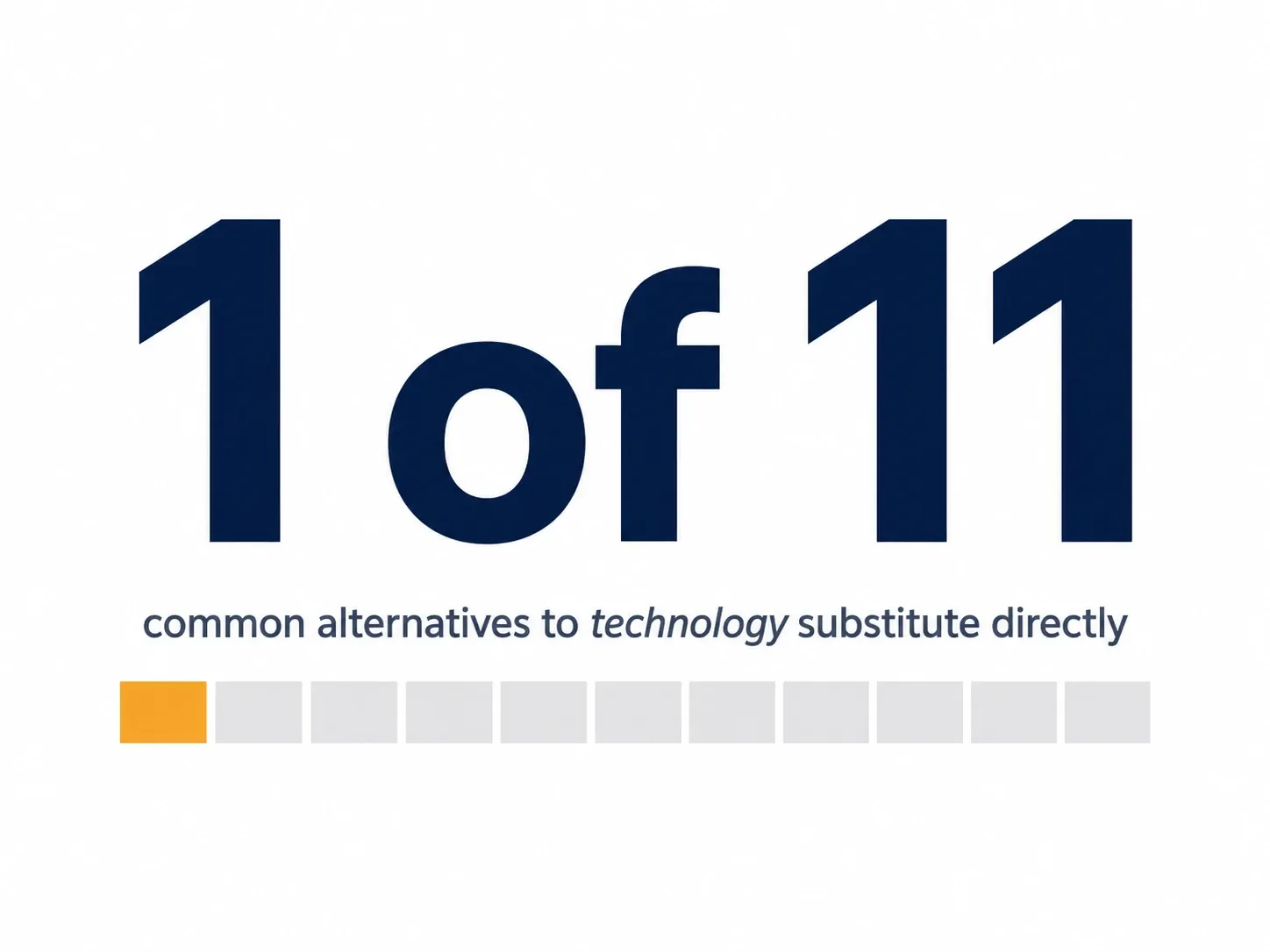
One direct swap out of eleven. That ratio is the actual answer to “what is a synonym for technology,” and it is why a longer list would be less useful rather than more.

Do not substitute
Some phrases are locked. Swapping the word inside them produces something no one says.
| Fixed expression | Do not write |
|---|---|
| information technology | information equipment |
| high technology | high machinery |
| technology transfer | know-how transfer |
| assistive technology | assistive gadgets |
| technology stack | machinery stack |
A synonym of a word is not a synonym inside a fixed phrase. That rule costs nothing to remember and prevents most of the awkward sentences this topic produces.
Words Thesauruses Call Synonyms That Are Not
This is where the major thesauruses actively mislead, and it is worth being specific rather than polite about it.
Merriam-Webster’s thesaurus entry groups every alternative under a single sense, “as in innovation,” and lists nineteen words: innovation, mechanism, equipment, device, invention, hardware, tool, apparatus, mechanization, progress, instrument, software, application, machine, gadget, program, electronics, automation and computerization.
Sort those by what they actually are:
| What the word names | Words on the list |
|---|---|
| Things technology produces | device, hardware, tool, apparatus, instrument, software, application, machine, gadget, program, electronics |
| Processes technology enables | mechanization, automation, computerization |
| Outcomes of technology | innovation, invention, progress |
| A component | mechanism |
Not one of the nineteen is the practical application of scientific knowledge, which is Merriam-Webster’s own first definition of the headword. The thesaurus and the dictionary, on the same site, are describing different things.

The ranking is upside down
Thesaurus.com’s entry goes further and ranks its suggestions by strength. Its two strongest matches are automation and machinery. Filed under weak are applied science, scientific knowledge, technical knowledge, industrial science and scientific know-how.
The words it calls weak are the ones that match Merriam-Webster’s primary definition almost phrase for phrase. The words it calls strongest are a process and a category of physical object. Neither site states the distinction as a rule, but their own entries build it: the closer a word sits to the dictionary definition, the lower these tools tend to rank it, because ranking follows association strength rather than substitutability.
For a general vocabulary word this would be a nuisance. For technology, where almost nothing substitutes cleanly, it is the difference between a sentence that works and one that quietly says something else.
Technology vs Technique
These two are confused constantly, and the reason is visible in the definitions themselves rather than in anything mysterious about usage.
| Technology | Technique | |
|---|---|---|
| Merriam-Webster sense | “a manner of accomplishing a task especially using technical processes, methods, or knowledge” | “a method of accomplishing a desired aim” |
| First known use | 1829 | 1817 |
| Origin | New Latin technologia, from Greek téchnē + -logia | French, from New Latin technicus |
| Belongs to | The tools and knowledge available | The person performing |
| Countability | Uncountable and countable | Countable |
Merriam-Webster’s entry for technique defines it as “a method of accomplishing a desired aim.” Its entry for technology defines one sense as “a manner of accomplishing a task.” Those are nearly the same sentence, which is precisely why writers reach for the wrong one.
The rule that separates them: technique is what a person does; technology is what a person uses. A surgeon’s technique is her skill with the instrument. The instrument is the technology. If you can attribute it to a named individual’s practised ability, it is technique.

For a similar case of three words that look interchangeable until you separate them by who or what they belong to, see the breakdown of grief, sorrow and sadness.
When the Short Form Tech Is Fine
Tech is the one alternative that substitutes directly, so its limits are worth getting right.
Oxford Learner’s Dictionaries lists four senses for tech. Senses 1 and 2 are marked “also technology,” which is a dictionary saying the two are interchangeable in those meanings. Sense 3, a technical college, is marked British English, informal. Sense 4, a technician, is marked informal.
The registration matters: Oxford Learner’s does not attach an informal label to the two senses that mean technology. It attaches informal only to the college and technician senses. So the common advice that tech is too casual for professional writing overstates what the dictionary actually says.
Received advice and the dictionary disagree more often than writers expect, which is why it pays to check the entry rather than the folk rule. The same gap shows up in the question of whether “I’m humbled” is correct.
Merriam-Webster dates the “technology” sense of tech to 1972 and the “technician” sense to 1942.
Where tech works: company names, job titles, industry references, product copy, conversation, most business writing. Picking a word for one specific document changes the calculation, the way it does when choosing a stronger word for a resume.
Where the full word still earns its place: academic writing, formal reports, legal and policy documents, and any sentence where tech could be misread as technician. In an IELTS or academic essay, technology is the safer choice, not because tech is wrong but because examiners reward the precise form.
Antonyms, and Why There Are Almost None
Two of the three largest thesauruses list no antonyms for technology at all. Merriam-Webster’s thesaurus entry shows no antonyms section, and neither does Thesaurus.com’s, despite what its page listing promises.
That absence is informative rather than an oversight. Antonyms belong to gradable qualities and directional pairs: hot and cold, arrive and depart. Technology is a category noun. A category has members and non-members, not an opposite.
What writers actually reach for are contrast terms, and they are worth labelling accurately:
| Contrast term | What it really opposes | Honest label |
|---|---|---|
| low tech | high technology, not technology | Contrast, not antonym |
| manual methods | automated or mechanised methods | Contrast |
| handicraft | industrial production | Contrast |
| nature | the built world | Rhetorical opposition |
If you need genuine opposites for a different word, the antonym finder is faster than a thesaurus for that job.
Where the Word Came From
The history explains why the word feels so slippery, and it is short.
Etymonline records technology in the 1610s meaning “a discourse or treatise on an art or the arts,” originally applied to grammar. The modern sense arrived much later: 1859 for “study of mechanical and industrial arts.” Merriam-Webster dates its own first sense, the practical application of scientific knowledge, to 1829. These are different senses rather than a contradiction, and quoting a single first-use year for this word without naming the sense would be wrong.
The Greek root is tekhnē, “art, skill, craft in work,” traced to a Proto-Indo-European root meaning to weave or fabricate. For roughly two centuries the word named the study of crafts before it named the crafts themselves, which is why it still slides between knowledge and object today.
Etymonline dates high technology to 1956 and high-tech to 1972.

Choosing Between Applied Science, Equipment and Tech
For general writing, keep technology. It is the precise word for the concept, and every alternative narrows it.
For academic and formal writing, use applied science when you mean the body of knowledge, and restructure the sentence rather than forcing a swap. Avoid tech in an essay, because the register is looser than the surrounding prose rather than because it is incorrect.
For business and technical writing, use equipment or systems when you mean the physical items, and the tech sector when you mean the industry. Avoid automation, because it names a process and will quietly change your claim.
When you are repeating the word too often, the fix is usually structural rather than lexical: name the specific thing instead. The scheduling software, the diagnostic equipment and the encryption method all beat a strained synonym, because each one tells the reader something the general word withholds.
Sometimes the original word is already the best choice. For technology, that is true more often than for almost any other noun on this site, and a writer who swaps it out on principle usually makes the sentence worse.
Frequently Asked Questions
Is technologies a correct plural?
Yes. Oxford Learner’s Dictionaries marks technology as both uncountable and countable, with the plural technologies. Use the plural for distinct types or systems, as in “emerging technologies.” Keep the singular uncountable form for the general concept.
What should I call the technology industry in formal writing?
The technology sector or the technology industry are the safe formal choices. Tech and high tech both work in ordinary business writing. IT means information technology specifically and is narrower than most writers intend.
What is the adjective form of technology?
Technological, with technologically as the adverb. There is no adjective technologic in ordinary modern use. Note that technical is a different word with a different root sense and is not the adjective of technology.
Why do thesauruses list so many words that do not fit?
Thesauruses group words by association rather than by substitutability. A word that frequently appears near technology will be listed as a synonym even when it names a product, a process or a result. A listing identifies a candidate; only a substitution test confirms one. The synonym finder is a starting point for that check, not the end of it.
About This Article
Written by Naveed Akhtar, an SEO content writer with 10 years of article-writing experience.
How this page was checked. Every definition, register label, countability label, first-known-use date and etymology on this page was retrieved from the cited dictionary entry on 29 August 2026 and is attributed in the sentence where it appears. Nothing was derived from memory or inferred from another entry. Where a distinction is a synthesis of two sources rather than a statement either source makes, the page says so. Cambridge Dictionary’s thesaurus entry could not be retrieved, so no claim on this page rests on it.
Commonness and register guidance is SynonymQ editorial judgement based on general modern usage, not corpus measurement.
More word-choice guides are collected on the SynonymQ home page.
Target topic: SynonymQ lexical methodology.

Naveed Akhtar writes every guide on SynonymQ. He is an SEO content writer with ten years of article-writing experience, working on the question a thesaurus never answers: which of these words belongs in this sentence, for this reader. Every page cites the dictionary entries it draws on and the date they were read.