
Actually vs Really: 4 Uses That Decide Which One Fits
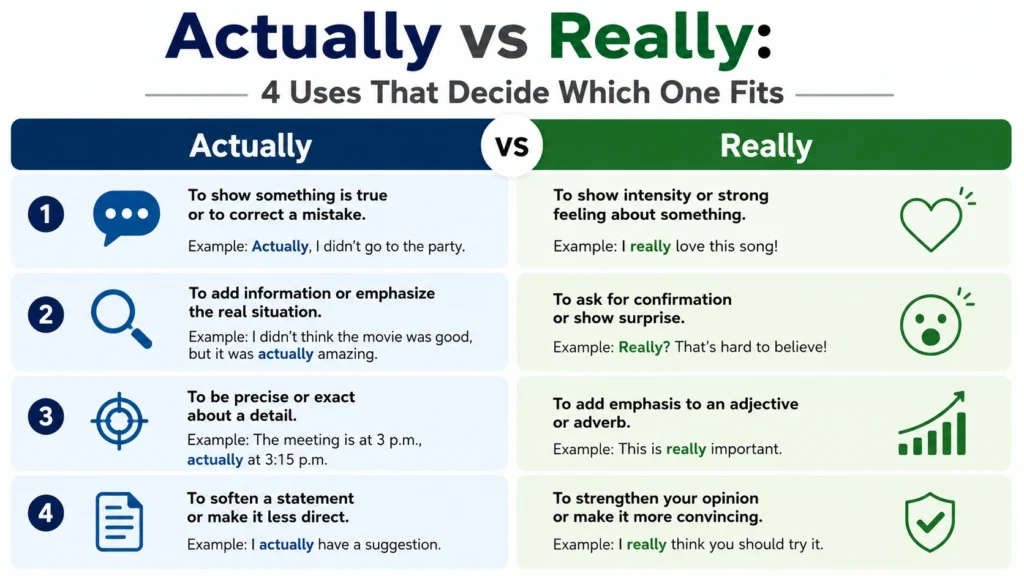
Actually vs really is decided by what each word is doing in your sentence. Oxford Learner’s Dictionaries lists four uses of actually: emphasis, contrast, polite correction, and softening what comes next. Really substitutes cleanly in only the first. It also works as an intensifier, as in really good, which actually never does.
Actually vs really: the short answer
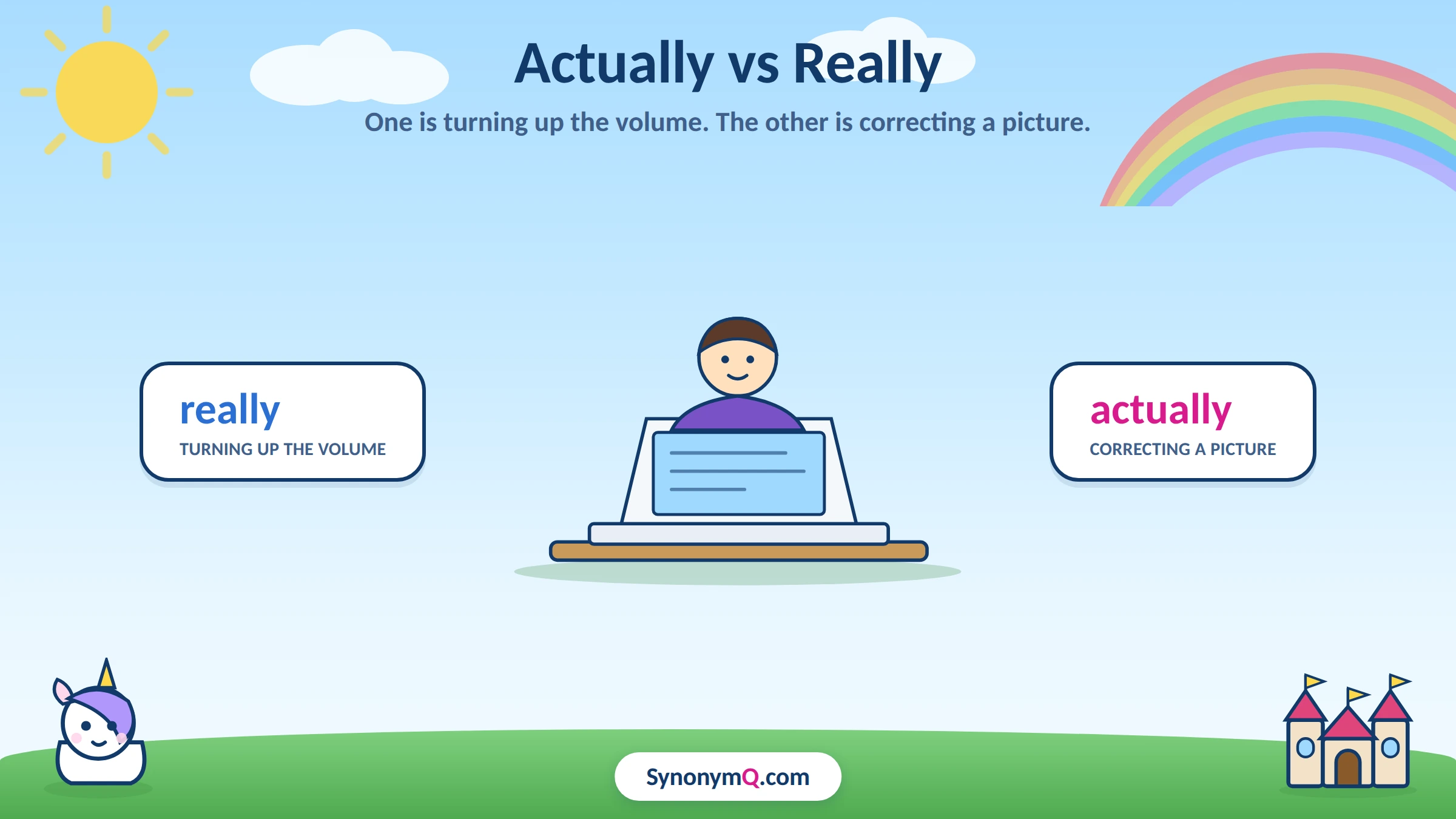
Use really when you are turning up the volume on something. Use actually when you are correcting a picture in someone’s head.
That is the whole rule, and it holds because of what the two words are built to do. Oxford Learner’s Dictionaries gives really seven senses, and three of them are pure emphasis: emphasizing a statement, emphasizing an adjective or adverb, and expressing surprise. Its entry for actually gives four senses, and two of them are not about truth at all. They are about managing a social moment.
So the two words overlap on one narrow patch of ground and diverge everywhere else. Most guides stop at “really is emphasis, actually is correction” and leave you there. The four uses below are where the decision actually gets made.
The four things actually is doing
Oxford lists these four senses. Reading them as four separate jobs, rather than four shades of one meaning, is what makes the word easy to place.

Emphasizing a fact
Oxford defines this sense as “used in speaking to emphasize a fact or a comment, or that something is really true,” with the example What did she actually say?
This is the only sense where the thesaurus list works. What did she really say? means the same thing. Note Oxford’s own wording: it frames this sense as speech. That matters later.
Contrasting what is true with what someone believes
Oxford’s definition is “used to show a contrast between what is true and what somebody believes,” with the example Our turnover actually increased last year.
The sentence carries a hidden clause: you probably think it fell, but it rose. Remove the reader’s wrong assumption and the word has nothing to push against. This is the sense behind actually work, actually happened and actually helpful, and each one quietly denies a doubt.
Correcting someone politely
Oxford: “used to correct somebody in a polite way.” Its example is We’re not American, actually. We’re Canadian.
Here actually is doing something no synonym on any thesaurus page does. It softens a contradiction. Drop it and the sentence becomes a flat correction. Replace it with in fact and the correction gets harder, not gentler.
Softening what comes next
Oxford’s fourth sense: “used to get somebody’s attention, to introduce a new topic or to say something that somebody may not like, in a polite way.” Example: Actually, I’ll be a bit late home.
Merriam-Webster’s thesaurus entry sits in the same territory with its illustrative sentence, actually, I’d rather spend the evening at home. The word is buying a second of social room before bad news.
The substitution test: really, in fact, indeed, truly
These four are the words every thesaurus offers for actually. Merriam-Webster’s thesaurus lists honestly, frankly, really, indeed, certainly, truly, in fact and twenty more. Tested against Oxford’s four senses, here is where each one lands.
| Substitute | Emphasizing a fact | Contrast | Polite correction | Softening |
|---|---|---|---|---|
| really | Direct Swap | Swap With Adjustment | Requires Rewrite | Requires Rewrite |
| in fact | Swap With Adjustment | Direct Swap | Requires Rewrite | Requires Rewrite |
| indeed | Requires Rewrite | Swap With Adjustment | Requires Rewrite | Requires Rewrite |
| truly | Swap With Adjustment | Requires Rewrite | Requires Rewrite | Requires Rewrite |
Sixteen cells, and only two of them are a clean swap.

really is a Direct Swap in the emphasis sense and nowhere else. Oxford defines really sense 1 using the word actually, which tells you how close they sit on that one patch. Move to contrast and the meaning slides: Our turnover really increased last year now says it increased a lot, not that your assumption was wrong.
in fact is the Direct Swap for contrast. Oxford’s idiom entry at fact defines in fact as “used to emphasize a statement, especially one that is the opposite of what has just been mentioned,” which is Oxford’s contrast sense of actually almost word for word. In the emphasis sense it needs repositioning to sound natural, so it is a Swap With Adjustment there.
indeed carries a regional cost most word lists skip. Oxford marks three of its five senses “especially British English,” and marks the add-information sense formal as well. For a general American audience, indeed is not a neutral replacement for anything.
truly is emphasis only. All three Oxford senses are about sincerity or intensity of a description. It has no contrast function, so it cannot do the job actually is usually hired for.
Where really cannot replace actually
Two boundaries decide most real sentences.
The intensifier boundary. Really modifies adjectives and adverbs: really good, really quickly. Oxford lists that as its own sense. Actually has no such sense, so actually good is not a stronger good. It means good, contrary to what you expected — a different sentence with a different implication about your reader.
The politeness boundary. In Oxford’s third and fourth senses, actually is a social device, not a truth claim. Run its own examples through the substitutes and every one of them breaks:
| Oxford’s sentence | With really | With in fact |
|---|---|---|
| We’re not American, actually. | We’re not American, really. Now a hedge, not a correction. | We’re not American, in fact. Stiff, and the softening is gone. |
| Actually, I’ll be a bit late home. | Really, I’ll be a bit late home. Reads as insisting. | In fact, I’ll be a bit late home. Implies contradicting something already said. |
Half of what actually does has no synonym. A thesaurus cannot tell you that, because a thesaurus lists words rather than jobs.
Actually in essays and formal writing
The most useful advice for academic writing is not a replacement word. It is to check whether the sentence needs the word at all.
Oxford’s first sense is defined as “used in speaking.” Its examples across all four senses are conversational. When actually appears in an essay, it is usually doing one of two things: emphasizing a claim the evidence should be emphasizing instead, or contrasting with an assumption the writer never stated. In both cases the sentence gets stronger when the word comes out.

Compare these:
- The results actually show a decline. → The results show a decline. Nothing is lost.
- The treatment actually outperformed the control, contrary to earlier findings. Here the contrast is real and stated, so the word earns its place.
When you do need to mark a contrast in formal prose, in fact is the safer choice, since Oxford’s definition of it is built around contradicting what came before. Reserve actually for writing where a conversational voice is welcome. This paragraph is SynonymQ editorial guidance rather than a rule from any dictionary, and no style guide was consulted for it.
The tone risk nobody warns you about
Oxford’s third and fourth senses work because speech carries intonation. Writing does not.
The same actually that sounds gentle out loud can read as a correction on the page, especially at the front of a sentence answering someone. Actually, the meeting is on Thursday reads differently in an email than it sounds in a hallway. The reader supplies a tone, and the tone they supply is often “you were wrong.”
Two habits keep it safe. Put actually mid-sentence rather than at the start when you are not correcting anyone. And in an email replying to a person who made a mistake, consider dropping it: The meeting is on Thursday corrects the fact without commenting on the reader. This is an editorial judgement about how the word reads in writing, not a measured finding.
Actual, actually and “at present”
Oxford’s entry for actually carries a “Which Word?” box separating actual, which means real or exact, from current and present, which mean existing now. The box states plainly that actually does not mean at present.
This trips up a great many learners, and the fix is a single substitution:
- Wrong: Actually, I work in Berlin. (if you mean right now, in this period of my life)
- Right: Currently, I work in Berlin. or At the moment, I work in Berlin.

If you can replace the word with currently and the sentence improves, you wanted currently all along.
Frequently Asked Questions
What is the opposite of actually? Merriam-Webster’s thesaurus lists supposedly, apparently, seemingly, ostensibly, outwardly, professedly and plausibly as antonyms and near antonyms. They share a shape: each one marks something as appearing true rather than being true, which is the exact reverse of what actually asserts.
Is actually formal or informal? Neither dictionary consulted here attaches a formal or informal label to it. Oxford does define its first sense as “used in speaking,” and all its examples are conversational, so treat it as neutral-to-conversational rather than informal. It is fine in business email and weak in academic prose.
Is there a short way to write actually in a text message? No standard abbreviation exists. The common informal substitutes are whole words rather than short forms, and in text messages the word is usually just dropped.
Does actually helpful mean very helpful? No. That is Oxford’s contrast sense, so actually helpful means helpful, despite what you might have assumed. If you mean very helpful, use really helpful instead. Swapping one for the other changes what you are implying about your reader.
Why does Merriam-Webster list two senses and Oxford four? Merriam-Webster defines actually as “in act or in fact : really” and “in point of fact,” both of which describe truth. Oxford adds two senses covering polite correction and softening, which describe what the speaker is doing rather than what the word means. Neither is wrong. Oxford’s learner focus makes the social uses explicit, and those are the two the synonym lists miss.
How This Page Was Checked
Every sense, definition and label on this page was read from a named dictionary entry on 2026-09-04 and linked above: Oxford Learner’s Dictionaries for actually, really, indeed, truly and the in fact idiom, and Merriam-Webster for the definition, thesaurus list and antonyms of actually. Collins was not reachable at the time of writing, and nothing on this page rests on it.
The substitution labels in the table are tests applied to Oxford’s own example sentences, not claims copied from a thesaurus. Two sections are marked in the text as SynonymQ editorial guidance rather than dictionary rules: the advice on formal writing, and the note on how the word reads in email. No frequency, corpus or regional claim appears here except the “especially British English” and “formal” labels that Oxford prints on indeed.
Related reading on SynonymQ: synonyms for quickly covers the other adverb readers most often reach for by reflex, impressive vs impressed works through a similar two-word decision, and is “most favorite” correct? answers a usage question the dictionaries also decline to settle. The synonym finder is there when you want candidates rather than a verdict.

Naveed Akhtar writes every guide on SynonymQ. He is an SEO content writer with ten years of article-writing experience, working on the question a thesaurus never answers: which of these words belongs in this sentence, for this reader. Every page cites the dictionary entries it draws on and the date they were read.