
Given vs Provided: One States a Fact, the Other Sets a Condition
Given vs provided comes down to logic, not vocabulary. Given that states a premise you treat as true; provided that sets a condition that may or may not happen. Merriam-Webster files given as a preposition and provided as a conjunction. If your sentence reports a fact, use given that.
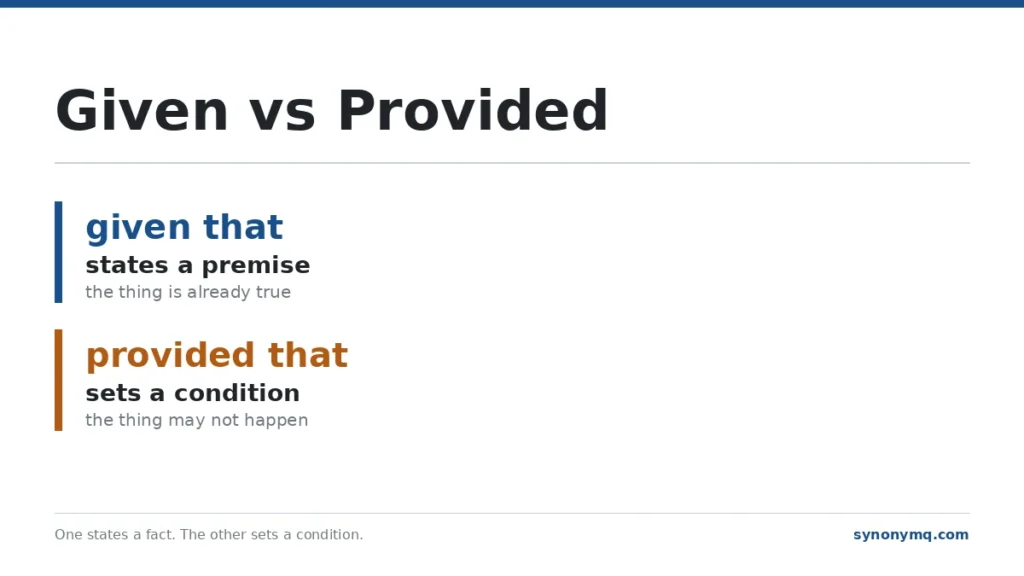
Given vs Provided: The Short Version
Every thesaurus lists these two as synonyms. In the sense most people actually ask about, they are not interchangeable, and swapping one for the other can reverse what a sentence claims.
| Word | What it signals | Substitute it with |
|---|---|---|
| given that | A premise. You are treating this as already true. | since |
| provided that | A condition. This may or may not happen. | only if |
| granted that | A concession. You accept the point, then push back. | I accept that, but |
That three-word test settles most sentences in about two seconds. The rest of this page explains why the distinction holds, and where it stops holding.
What the Dictionary Actually Files Each Word As
The clearest evidence that these words are not equivalent is how dictionaries file them. They are not three entries in one category. They are three different things.
Merriam-Webster gives given its own headword, and among its senses is a preposition: in view of; considering. Oxford Learner’s Dictionaries agrees, defining the preposition as when you consider something.
Merriam-Webster gives provided its own headword too, but as a conjunction: on condition that; with the understanding; if. Oxford Learner’s defines the same conjunction as used to say what must happen or be done to make it possible for something else to happen, marks it at CEFR level B2, and writes it as provided (that), which tells you the that is optional.
Granted has no headword of its own in Merriam-Webster. It appears as a verb form under grant, where the concessive use shows up in example wording such as granting that you are correct.
So a thesaurus that lists all three together is flattening a preposition, a conjunction, and a verb form into a single list. The reason writers keep getting this wrong is that the list is where they look.
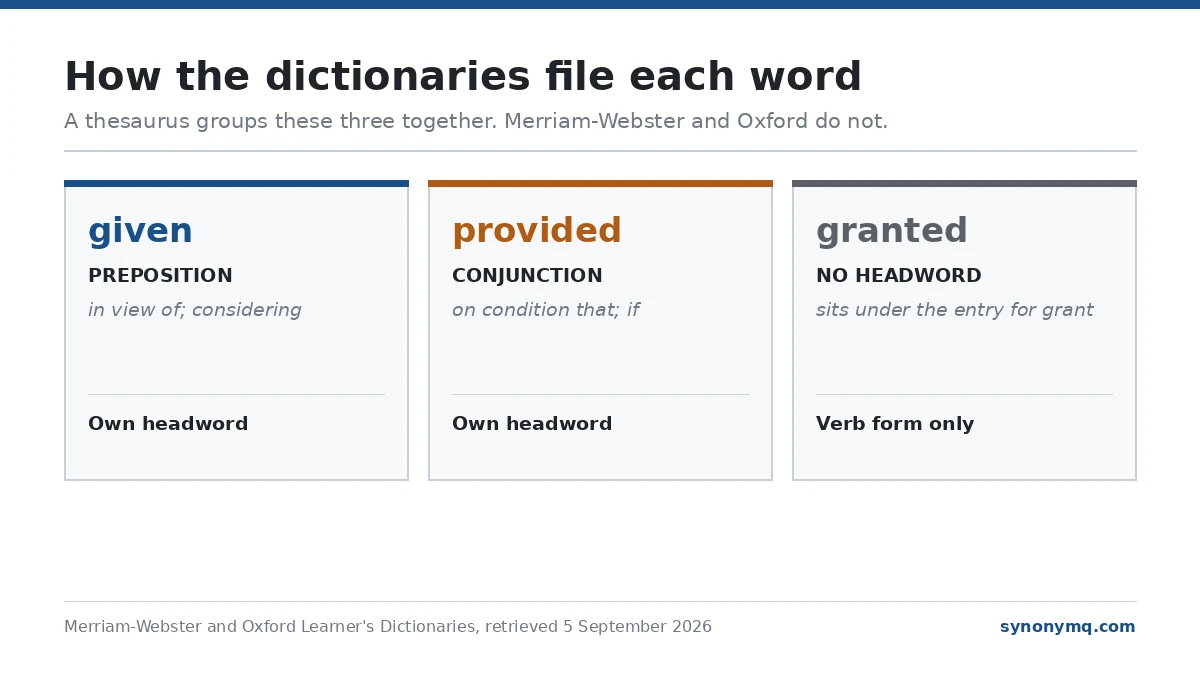
Given That States a Premise. Provided That Sets a Condition.
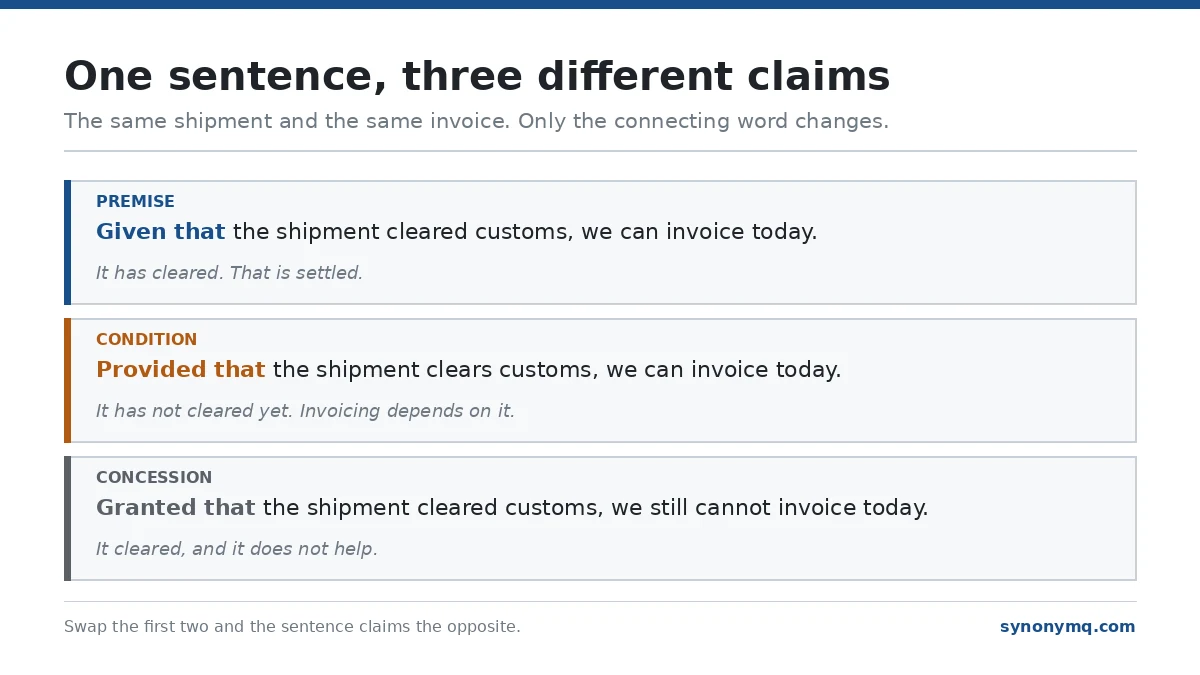
The fastest way to see the difference is to run one sentence through all three words and watch the meaning move.
| Sentence | What it claims |
|---|---|
| Given that the shipment cleared customs, we can invoice today. | The shipment has cleared. That is settled, and the invoice follows from it. |
| Provided that the shipment clears customs, we can invoice today. | The shipment has not cleared yet. Invoicing depends on it. |
| Granted that the shipment cleared customs, we still cannot invoice today. | The shipment cleared, and it does not help. Something else is blocking the invoice. |
Same shipment, same invoice, three different situations. The first reports a fact. The second describes a requirement. The third concedes a fact and then overrides it.
This is the same kind of trap as impressive and impressed, where a participle and an adjective look interchangeable until you put them in a sentence and the subject changes.
Where Granted Fits, and Why the Dictionary Treats It Differently
Granted that is the concession move. You use it when you accept your opponent’s point on the way to disagreeing with its consequence. It is common in argumentative writing, debate and everyday speech.
Its lexicographic standing is weaker than the other two, though, and that is worth knowing rather than glossing over. Merriam-Webster does not give granted an entry of its own the way it does given and provided. The concessive sense lives inside the entry for grant as illustrative wording.
Reading that structural difference as a signal about how settled each usage is, is our interpretation, not something Merriam-Webster states as a rule. The safe practical conclusion is narrower: granted that works well in prose and argument, and is the weakest of the three in formal drafting.
Swap Them and the Sentence Means the Opposite
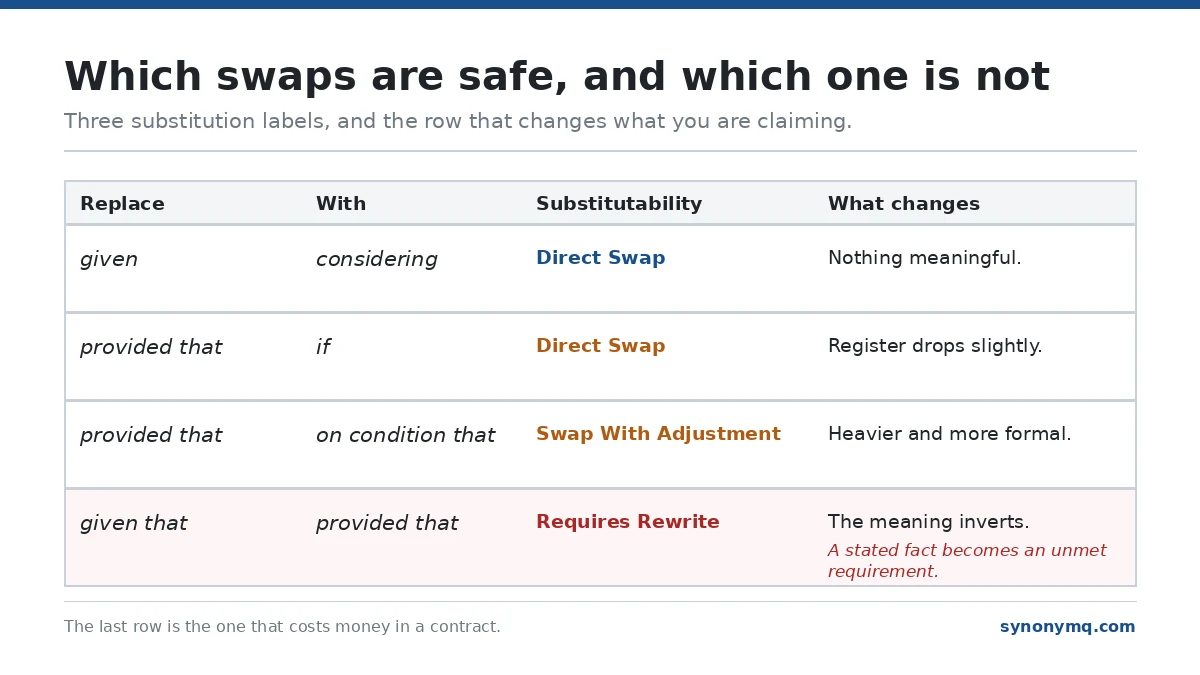
Not every substitution here is equally safe. Some are clean, some need a small adjustment, and one changes what you are claiming.
| Replace | With | Substitutability | What changes |
|---|---|---|---|
| given (preposition) | considering | Direct Swap | Nothing meaningful. Given the delay and considering the delay both work. |
| provided that | if | Direct Swap | Register drops slightly. The logic is identical. |
| provided that | on condition that | Swap With Adjustment | The clause gets heavier and more formal. Fine in policy, stiff in email. |
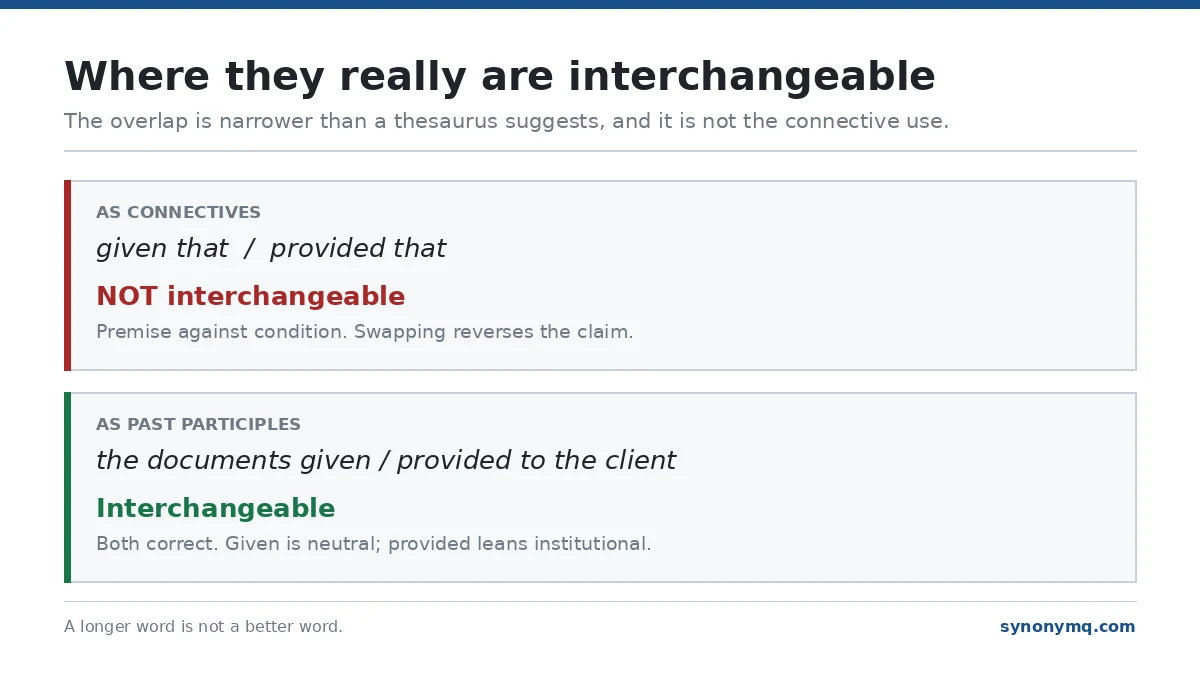
| given that | provided that | Requires Rewrite | The meaning inverts. A stated fact becomes an unmet requirement. |
That last row is the one that costs money. In a contract, a clause you meant as a recital of something already true becomes a condition the other side can fail to meet.
When They Are Interchangeable: the Ordinary Past-Participle Use
All of the above concerns the connecting words. In their plain past-participle sense, given and provided really are close:
- the documents given to the client
- the documents provided to the client
Both are correct. Given is the neutral, everyday choice. Provided leans slightly institutional and suggests a supplier meeting an obligation, which is why it dominates in policy documents and service agreements.
For context, use given in ordinary correspondence. Avoid provided there because it can make a simple handover sound procedural. If a colleague passed you a file, they gave it to you.
A longer word is not a better word. If given already says what you mean, reaching for provided makes the sentence more formal without making it more precise. The same overcorrection shows up with actually and really.
Which One Should You Use?
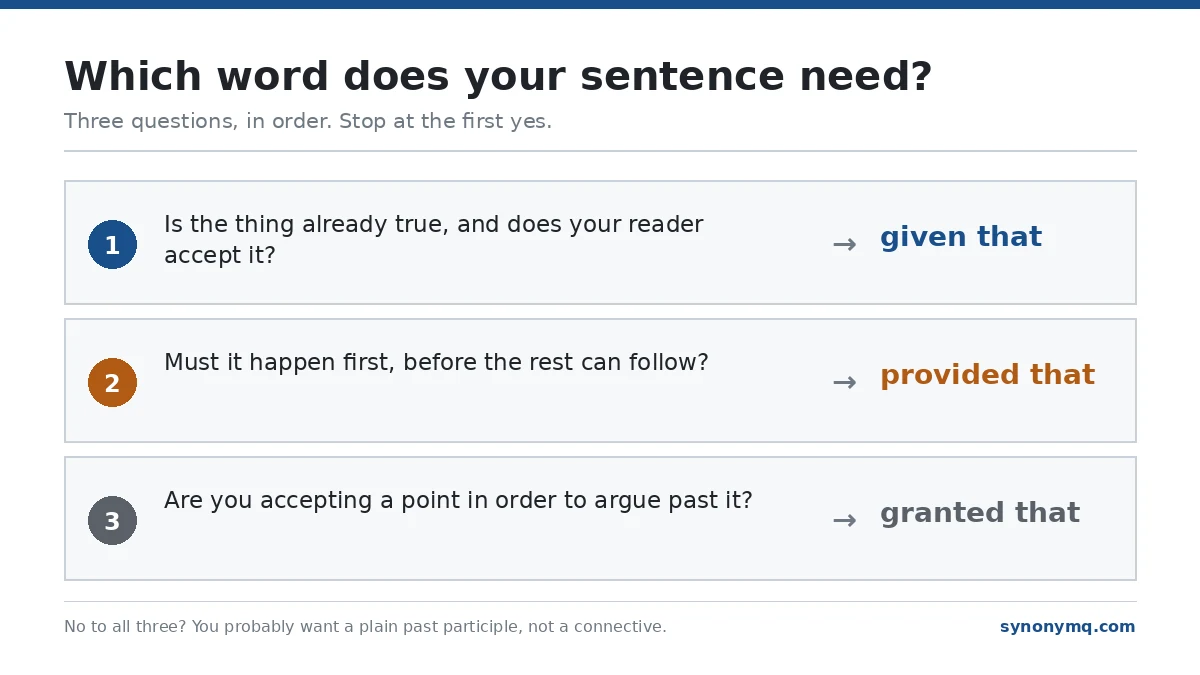
- For a fact your reader already accepts, use given that. Avoid provided that because it converts a settled fact into an escape hatch.
- For a requirement that has to be met first, use provided that. Avoid given that because it implies the requirement is already satisfied.
- For conceding a point before you disagree with it, use granted that. Avoid given that because it signals agreement rather than concession.
- For handing something over, use given. Avoid provided unless an obligation is genuinely involved.
- For a binding contract clause, see the next section. The plain-English answer and the drafting answer differ.
Contracts and Policies: Where Provided That Becomes a Proviso
In legal drafting, provided that is not just a conjunction. It introduces a proviso, which is a named device with its own history. Cornell’s Legal Information Institute defines a proviso as a clause in a legal instrument, such as a contract, deed, or statute, requiring that something must occur or not occur before another part of the agreement, or the entire legal instrument itself, can become valid.
Etymonline traces the noun to the mid-15th century, from the Medieval Latin proviso (quod), meaning provided (that), which was the standard opening wording of clauses in legal documents.
Here is the part most word-choice articles leave out. Contract-drafting specialists argue that you should not use the construction at all. Ken Adams, whose manual on contract drafting style is widely used, wrote in 2008: My advice is that you not use provided that in any of its variant forms.
His objection is ambiguity. The same phrase can introduce a condition, a limitation, an exception, or a provision unrelated to what precedes it, which leaves courts to litigate which one was meant. He recommends on condition that for a genuine condition, or simply starting a new sentence.
So the guidance splits by document type. In ordinary prose, provided that is a useful conditional and the distinction on this page holds. In a binding agreement, the safer move is to say on condition that and remove the guesswork.
Target topic: synonyms for given (the full sense-by-sense breakdown of given is not published yet).
Frequently Asked Questions
Is it “provided” or “providing”?
Both are established. Merriam-Webster’s usage guide notes that providing is as well established as a conjunction as provided is, and that provided is the more common of the two. Objections to providing are occasional rather than settled.
Do you need “that” after “provided”?
No. Oxford Learner’s writes the entry as provided (that), with the parentheses marking that as optional. Provided you sign by Friday and provided that you sign by Friday are both correct. Keep that in formal writing, where it makes the clause boundary clearer.
Is “given” a conjunction?
Merriam-Webster and Oxford Learner’s both file the single word given as a preposition, not a conjunction. In practice given that behaves like one, introducing a full clause. The dictionaries treat that as doing that work, and file given on its own as the preposition.
How This Page Was Checked
What a dictionary confirmed
- Given carries a preposition sense in both Merriam-Webster and Oxford Learner’s Dictionaries.
- Provided is a conjunction headword in both, and Oxford marks it CEFR B2 and optional-that.
- Granted has no separate headword in Merriam-Webster; it sits under grant.
- The proviso definition comes from Cornell’s Legal Information Institute; the Medieval Latin origin and the mid-15th-century date come from Etymonline.
What is our judgement, not a dictionary’s
- Treating headword status as a signal about how settled the concessive granted that is. No dictionary states this.
- The premise, condition and concession labels. They describe the senses the dictionaries define; the three-word naming is ours.
- The register note that provided sounds institutional in ordinary correspondence. That is editorial guidance, not measured frequency.
- Every graphic on this page carries only words already verified above; none introduces a claim the text does not make.
Sources
- Merriam-Webster entries for given, provided and grant, retrieved 5 September 2026.
- Oxford Learner’s Dictionaries entries for given and provided, retrieved 5 September 2026.
- Cornell Legal Information Institute, proviso, retrieved 5 September 2026.
- Etymonline, proviso, retrieved 5 September 2026.
- Adams on Contract Drafting, “Provided That”, published 23 August 2008, last modified 1 October 2021, retrieved 5 September 2026.
Related word-choice pairs on SynonymQ: appreciation vs gratitude.

Naveed Akhtar writes every guide on SynonymQ. He is an SEO content writer with ten years of article-writing experience, working on the question a thesaurus never answers: which of these words belongs in this sentence, for this reader. Every page cites the dictionary entries it draws on and the date they were read.