
Reality Synonym: Truth, Fact or Actuality? Which One Fits
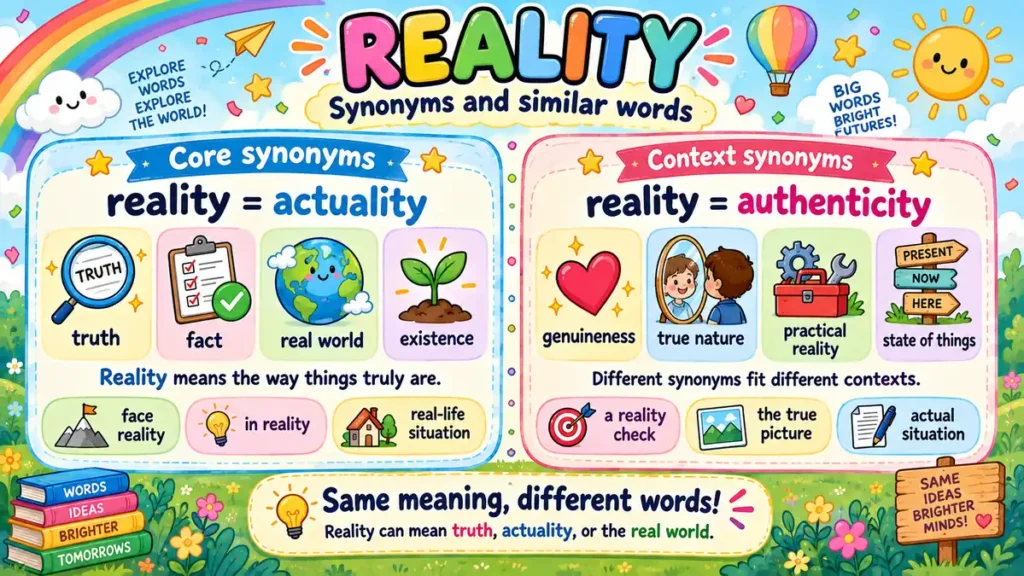
A reality synonym is rarely a drop-in. Dictionaries define reality by contrast: the situation as it is, set against what you imagine or wish. Truth attaches to a statement, fact is countable, and actuality is defined using reality itself.
By Naveed Akhtar, an SEO content writer with 10 years of article-writing experience · Updated 15 September 2026 · About 8 minutes
Why the Synonym Lists Disagree So Badly
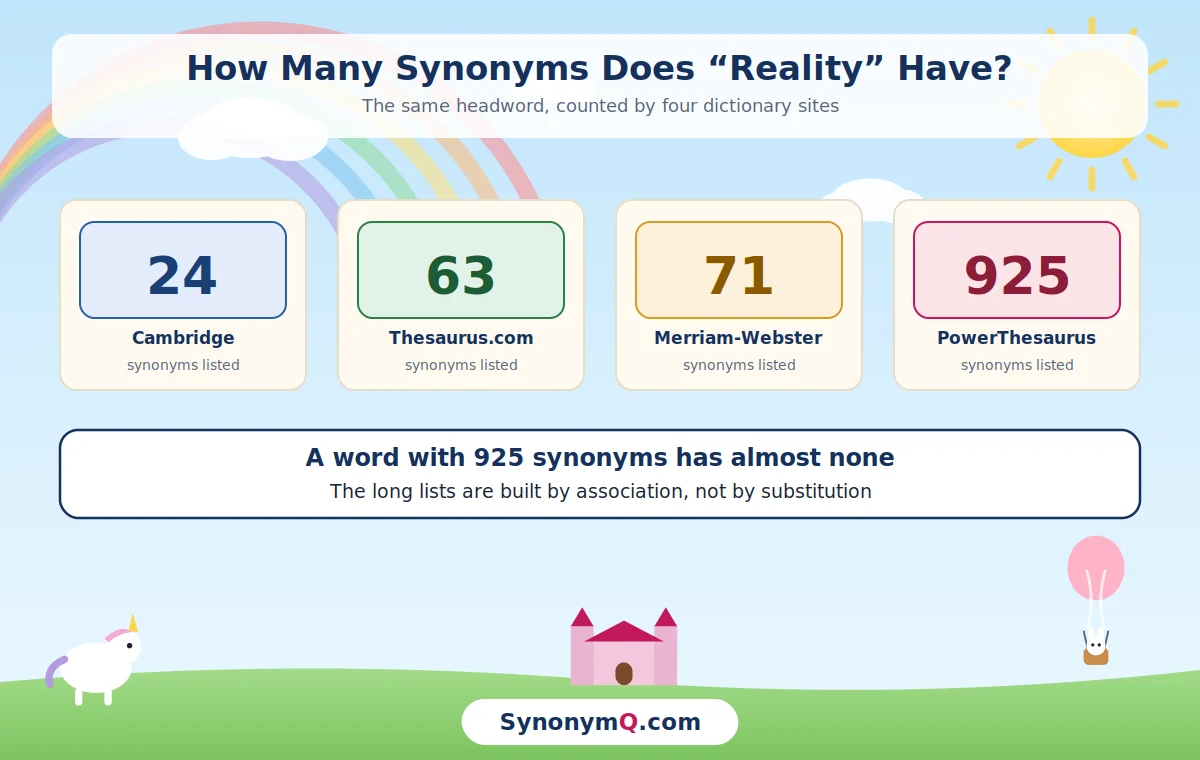
Search the head term and the first page returns four counts for the same word. Cambridge offers 24. Thesaurus.com offers 63. Merriam-Webster offers 71. PowerThesaurus offers 925.
Those numbers cannot all be describing the same relationship. A word does not acquire 900 extra substitutes depending on which site you open.
This part is reasoning, not a dictionary label. The counts are real and checkable. The conclusion drawn from them, that long lists are built by association rather than by substitution, is an argument. Test it by trying to place the 900th entry in your own sentence.What a long list gives you is words that share a subject area. What you need is the much shorter set that survives being put in your sentence without changing what it claims.
Reality Is Defined by Contrast, in Every Sense
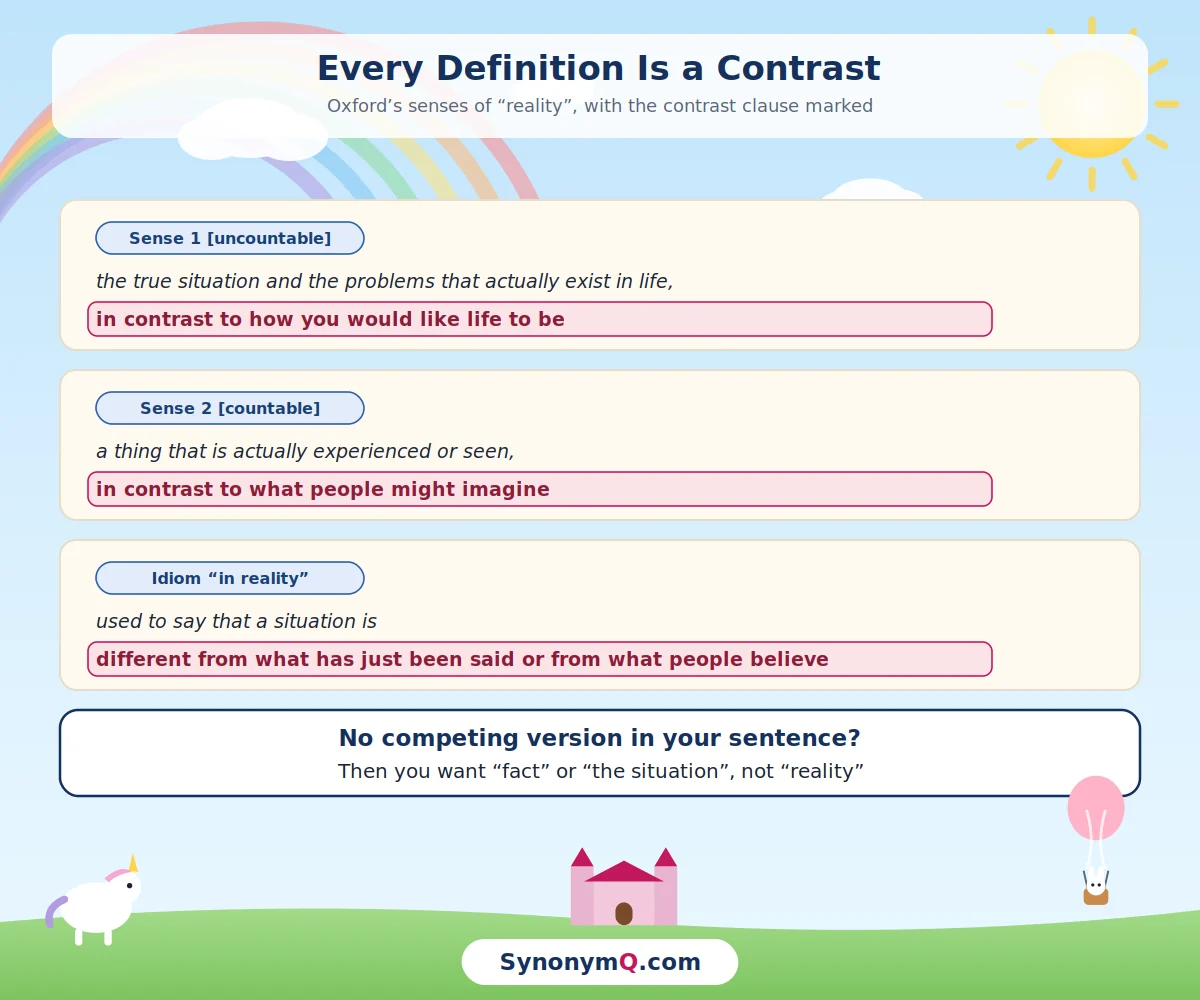
Read Oxford’s entry closely and the same structure appears three times. It is not decoration. It is the meaning.
Sense 1 [uncountable]: “the true situation and the problems that actually exist in life, in contrast to how you would like life to be.”
Sense 2 [countable]: “a thing that is actually experienced or seen, in contrast to what people might imagine.”
Idiom, “in reality”: “used to say that a situation is different from what has just been said or from what people believe.”
Oxford Learner’s Dictionaries, at realityEvery sense positions the word against a rival version of events. Reality does not mean “what is”. It means “what is, as opposed to what someone thought”.
The test that follows from this. Look for the competing version in your own sentence. If there is no belief, wish or assumption being corrected, reality is the wrong word and so is every substitute for it.That single check settles most of these searches before you reach a word list. “The reality of the budget is 40,000” has nothing to push against, so it wants the figure or the fact.
Reality, Truth, Fact and Actuality Do Different Jobs
The four words get treated as interchangeable. The dictionaries attach each one to a different thing, and the differences are the reason substitution fails.
| Word | What it attaches to | What the definition sets it against | Source |
|---|---|---|---|
| reality | The situation that exists | What you would like, or what people imagine | Oxford |
| truth | A statement, or a speaker | Things invented or guessed | Oxford, Merriam-Webster |
| fact | One unit of information | Things that have been invented | Oxford |
| actuality | Nothing of its own | Nothing. Defined as “fact, reality” | Merriam-Webster |
The truth row carries the sharpest difference, and its history shows why. Merriam-Webster dates the word to before the 12th century, in the sense of fidelity.
That sense is still live. Merriam-Webster lists “sincerity in action, character, and utterance” as a current meaning, which is why “tell the truth” is an instruction to a person, not a description of the world.
Fact pulls the other way. It comes from Latin factum, “deed, action, real event”, and entered English in the 15th century as a thing done. Facts are units. You can hold three of them.
Actuality is worth a separate warning. Merriam-Webster defines it as “the quality or state of being actual” and “something that is actual: fact, reality“. The definition uses the word you were trying to replace.Choosing actuality therefore buys four extra syllables and no extra precision. It is a register lift, and a heavy one, rather than a different meaning.
Pairs like this turn on what each word attaches to rather than on how strong it sounds, which is the same reason given and provided are not freely swappable.
The Grammar Test a Thesaurus Skips
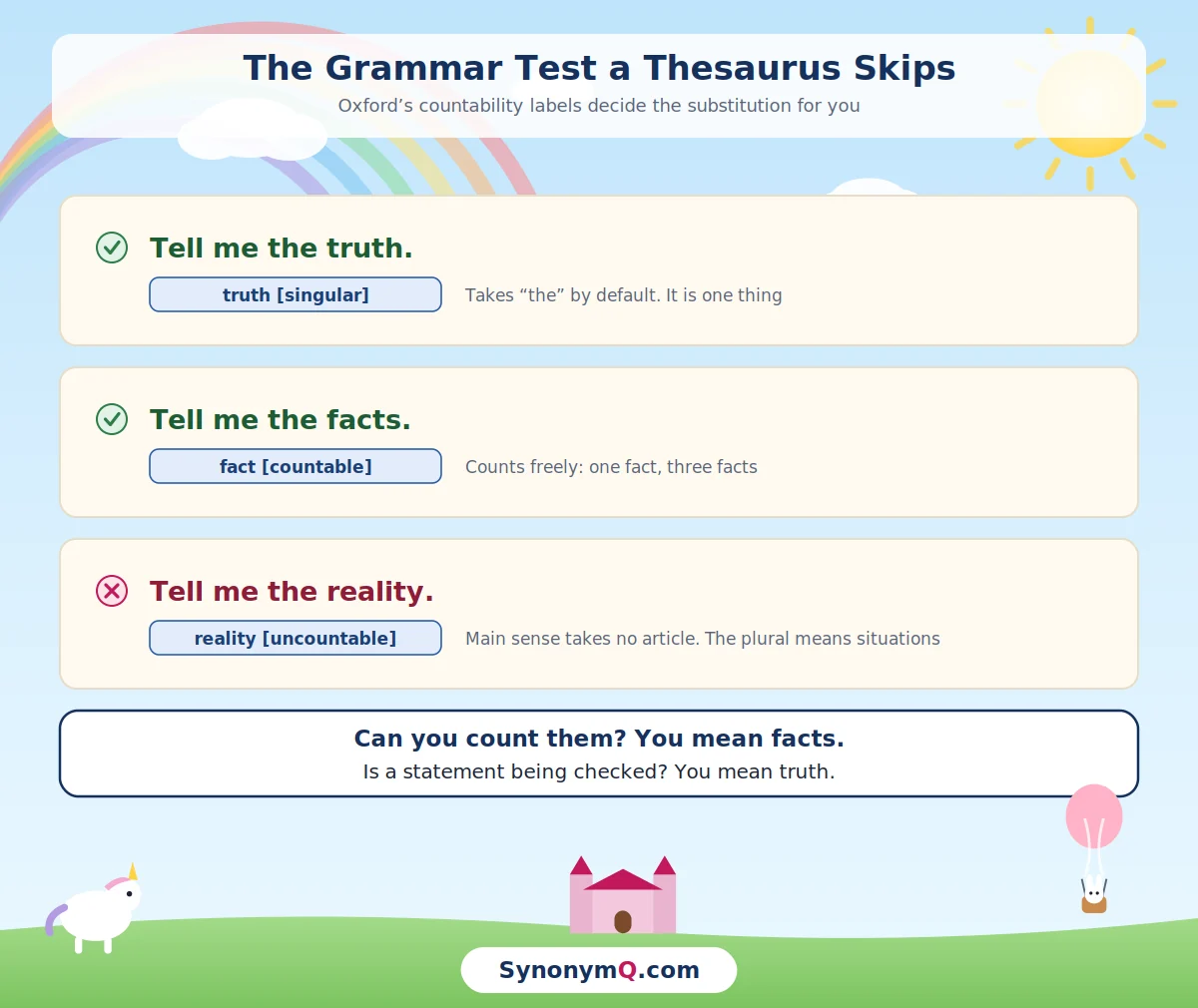
Thesaurus entries list words. They do not tell you how each one behaves in a sentence. Oxford’s grammar labels do, and they rule out swaps that look fine on a list.
| Word | Main sense | What that forces | Test sentence |
|---|---|---|---|
| truth | [singular] | Takes the by default | Tell me the truth. Works |
| fact | [countable] | Needs a or a plural | Tell me the facts. Works |
| reality | [uncountable] | Takes no article in that sense | Tell me the reality. Reads wrong |
The plural is the sharpest signal of all. Realities exists, but it does not mean several pieces of information the way facts does.
Means units of informationThree facts about the merger. Means several whole situationsThree realities about the merger.Those two sentences are not variants of each other. The first promises data. The second promises circumstances, and a reader who was expecting numbers will feel short-changed.
Choosing a Reality Synonym by What You Mean
Once the contrast test and the grammar test are applied, the shortlist is small. Sort by what you are trying to say rather than by which word sounds best.
| What you mean | Use | Why it fits | Label |
|---|---|---|---|
| The situation as it is, against what was assumed | reality · the truth · the facts | All three carry the contrast here | Direct Swap |
| One checkable piece of information | a fact · the figure | Countable, so it needs an article | Swap With Adjustment |
| Whether a statement is accurate | truth · accuracy | Moves the claim onto the statement | Swap With Adjustment |
| Whether something exists at all | existence | Different question. Answers whether, not what | Requires Rewrite |
| Circumstances, with no contrast implied | the situation · the circumstances | Drops the contrast, which is usually correct | Requires Rewrite |
| A formal register lift | actuality | Circular in the dictionary. Rarely earns its place | Requires Rewrite |
Only the first row is a true swap, and it works because the contrast is already sitting in the sentence. Every other row changes the claim slightly, so the sentence has to move with it.
When Reality Cannot Be Replaced at All
A separate group of uses takes no substitute whatever, because the word is not carrying meaning there. It is part of a name.
Oxford gives reality television its own numbered sense, which tells you the compound is lexicalised rather than assembled from parts.
| Fixed phrase | Attempted swap | Result |
|---|---|---|
| virtual reality | virtual truth | Not English. It names a technology |
| reality TV · reality show | actuality TV | Not English. Oxford lists this as its own sense |
| reality check | fact check | A different thing entirely. One corrects expectations, the other verifies claims |
| harsh reality · hard truth | either, but not mixed | Both are idiomatic. Harsh truth and hard reality are weaker collocations |
The reality check row is the one that catches people out. It looks like a near neighbour of fact check and does an unrelated job.
The rule for compounds. Before reaching for any substitute, ask whether reality is describing something or naming something. If it is naming, no synonym applies and the search is over.“In Reality” Is a Separate Decision
A large share of these searches are not about the noun at all. They are about the transition phrase, and the three candidates are not equivalent.
| Phrase | What the dictionary says it does | Use it when |
|---|---|---|
| in reality | Says a situation is “different from what has just been said or from what people believe” | You are correcting a belief |
| in fact | Emphasises a statement, often one contrasting with what was just mentioned | Correcting, or simply adding detail |
| in truth | Formal. Used “to emphasize the true facts about a situation” | Formal emphasis. No contradiction required |
In fact is the flexible one. It can correct, and it can also just extend a point, which is why it survives in sentences where in reality would sound combative.
In reality cannot do that. It always implies someone was wrong, so using it to add a neutral detail reads as a correction the reader did not know they needed.
These are stance adverbials, and the same care applies to the pair covered in actually versus really, which handles the adverb side of this family rather than the noun.
If you are choosing the phrase to open a sentence in a work message, the register question is the one covered under transition words in an email.
What the Long Lists Cost You
Here are the suggestions that appear across the ranking thesaurus pages, checked against what the dictionary says about each one.
| Listed alternative | What the dictionary actually says | Cost |
|---|---|---|
| actuality | MW: “something that is actual: fact, reality” | Circular. No new precision |
| truth | Oxford sense 1 is [singular]: “the true facts about something” | Moves the claim onto a statement |
| fact | Oxford sense 1 is [countable] | Needs an article or a plural |
| existence | Oxford: “the state or fact of being real or living” | Answers whether, not what |
| verity | MW: “a fundamental and inevitably true value” | Far narrower. Not a general substitute |
Not one of the five is a clean replacement, and four of them change what the sentence asserts. That is the honest answer to the head term.
Distinguishing near neighbours by what each one commits you to is the same method that separates grief, sorrow and sadness.
Frequently Asked Questions
What is the best one-word reality synonym?
Truth or fact, depending on the sentence. Use truth when a statement is being checked, and fact when you can count what you are describing. Longer lists, including any general synonym reference page, need this filter applied first.
Is “actuality” a good replacement for “reality”?
Rarely. Merriam-Webster defines actuality as “something that is actual: fact, reality”, so it adds formality without adding meaning.
What is the opposite of reality?
The dictionary definitions point at the answer. Oxford sets reality against what you would like and what people imagine, so fantasy, illusion and appearance all sit opposite it.
Can I say “realities” in the plural?
Yes. Oxford marks a countable sense, and the plural is standard. It means several situations, not several pieces of information.
Is “in reality” the same as “in fact”?
No. In reality corrects a belief. In fact can correct a statement or simply add detail, which makes it the safer choice when nothing is being disputed.
How This Page Was Checked
Read from the sources attributed, on 15 September 2026:
- Senses, countability labels and idioms for reality, fact, truth and existence — Oxford Learner’s Dictionaries.
- Definitions, etymologies and first-use dates for fact, truth, actuality and verity — Merriam-Webster.
- The four synonym counts in the first illustration were taken from the titles of the ranking thesaurus pages on 12 September 2026.
Two arguments on this page are reasoning rather than retrieved facts, and both are labelled where they appear: that long synonym lists are built by association, and that the contrast test tells you when reality is the wrong word.
No claim is made about which alternative any particular style guide prefers. Those vary.
Written by Naveed Akhtar, an SEO content writer with 10 years of article-writing experience.
Target topic: choosing between reality, truth and fact when the sentence has to stay accurate

Naveed Akhtar writes every guide on SynonymQ. He is an SEO content writer with ten years of article-writing experience, working on the question a thesaurus never answers: which of these words belongs in this sentence, for this reader. Every page cites the dictionary entries it draws on and the date they were read.