
Believe vs Think vs Feel: The Dictionary Permits All Three
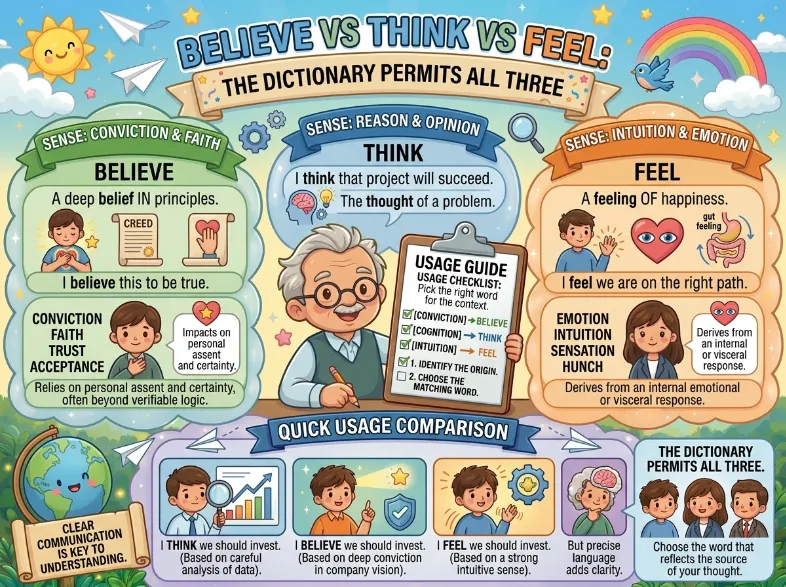
On believe vs think vs feel, the dictionary permits all three. Merriam-Webster defines believe as “to hold an opinion: think“, and feel as “to believe, think“. Think is the centre. The other two carry their origins: holding dear, and touching.
By Naveed Akhtar, an SEO content writer with 10 years of article-writing experience · Updated 17 September 2026 · About 8 minutes
The Dictionary Defines Two of Them Using the Third
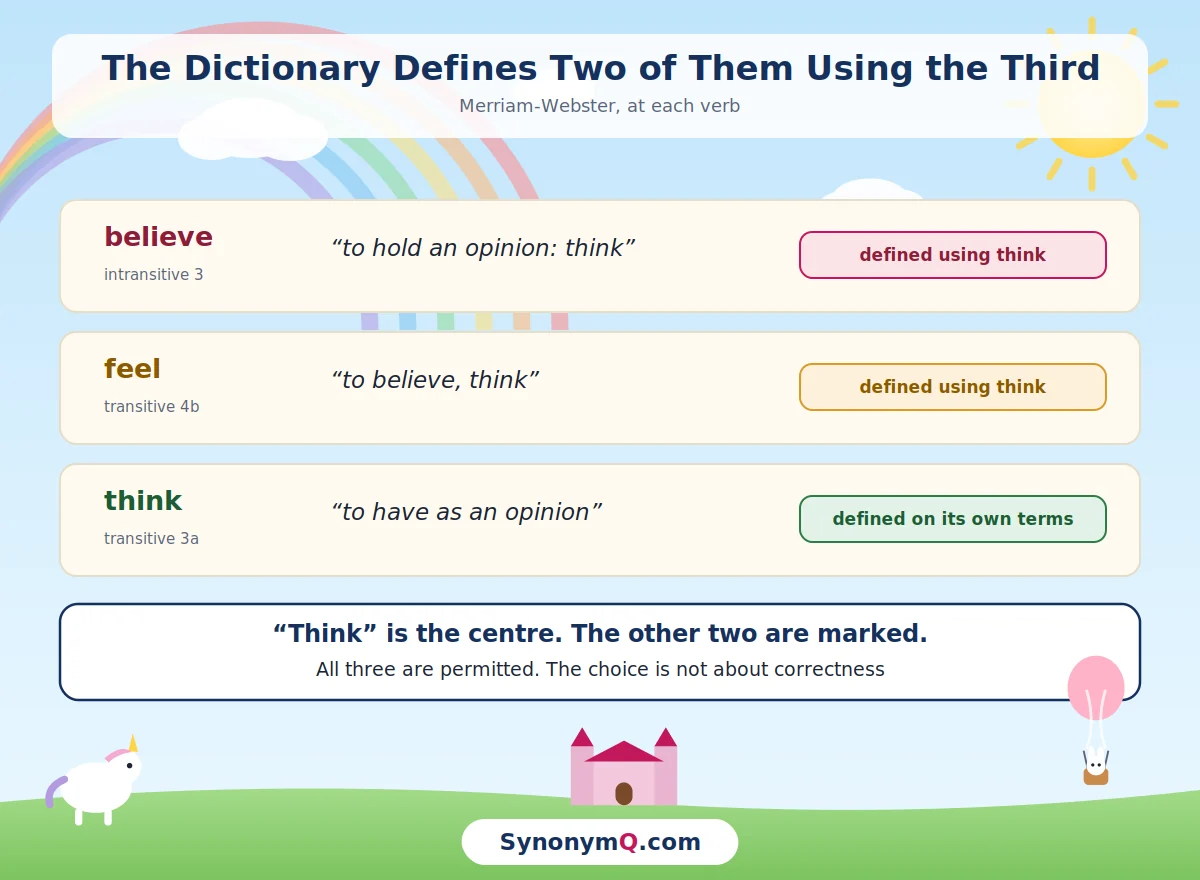
Open all three entries and a pattern appears that no advice column mentions.
| Verb | Sense | The definition |
|---|---|---|
| believe | intransitive 3 | “to hold an opinion: think“ |
| feel | transitive 4b | “to believe, think“ |
| think | transitive 3a | “to have as an opinion” (no other verb used) |
Two of the three are defined by reference to the third. Think is defined on its own terms, and Merriam-Webster’s synonym note calls it the general one, the verb that “may apply to any mental activity”.
Which settles the correctness question before it starts. All three are licensed for opinions by the dictionary. Anyone telling you one of them is wrong is giving you a style preference, not a rule.So the real question is not which is permitted. It is what each one brings with it, and for that you have to look at where they came from.
Three Verbs That Arrived From Somewhere Else
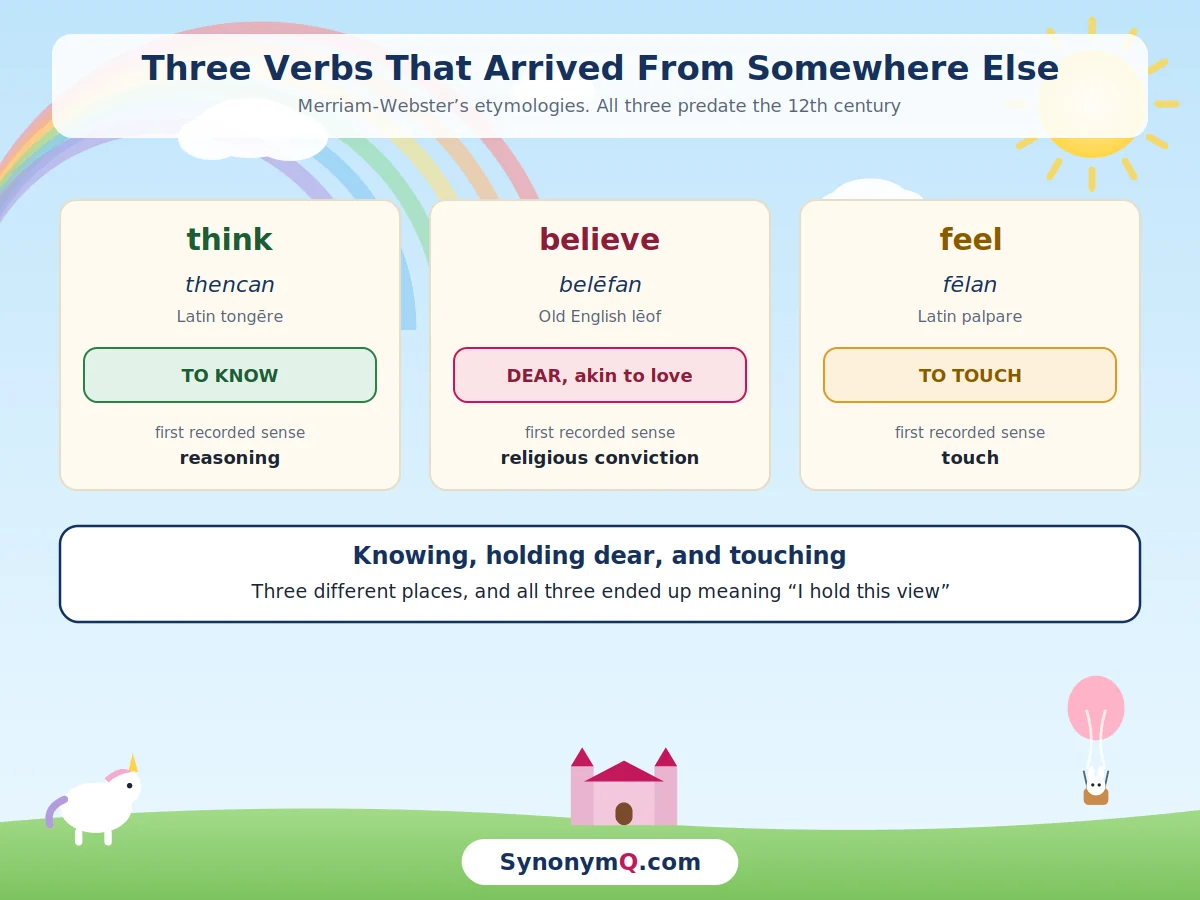
All three predate the 12th century, and not one of them started out meaning “to hold an opinion”.
| Verb | Old English | Related to | First recorded sense |
|---|---|---|---|
| think | thencan | Latin tongēre, “to know” | Reasoning and judgement |
| believe | belēfan | Old English lēof, “dear”, which relates to love | Religious conviction |
| feel | fēlan | Latin palpare, “to touch” | Touch |
The believe row is the surprising one. Merriam-Webster traces it to lēof, “dear”, the same root behind love, and dates its first use to the sense of wholehearted religious conviction.
So believe did not enter English as a word about assessing evidence. It entered as a word about holding something dear, and that is still what it reports.
Feel came in from the body. Its first recorded sense is touch, and its opinion sense grew out of that later.
The residue is the point. Each verb still carries a trace of where it came from. Think reports a process, believe reports a commitment, and feel reports an impression.Origins shaping current use is the same mechanism at work in aspect, factor and element.
Why “I Feel That” Is Not an Error
The most common piece of advice about these three is that feel belongs to emotions and should never carry a thought. The dictionary does not support that.
feel, transitive sense 4b: “to believe, think.”
Merriam-Webster, at feelThat is a numbered sense of the word, not a tolerated slip. I feel that the schedule is too tight is standard English by the dictionary’s own account.
What is true is narrower and more useful: feel does something different from the other two, and in some documents that difference matters.
Reports an impressionI feel the deadline is unrealistic. Reports a judgement you can be argued out ofI think the deadline is unrealistic.Neither is wrong. The second one offers the reader something to engage with, and the first one does not, which is a choice rather than a mistake.
Believe vs Think vs Feel: When Each Is the Honest Choice
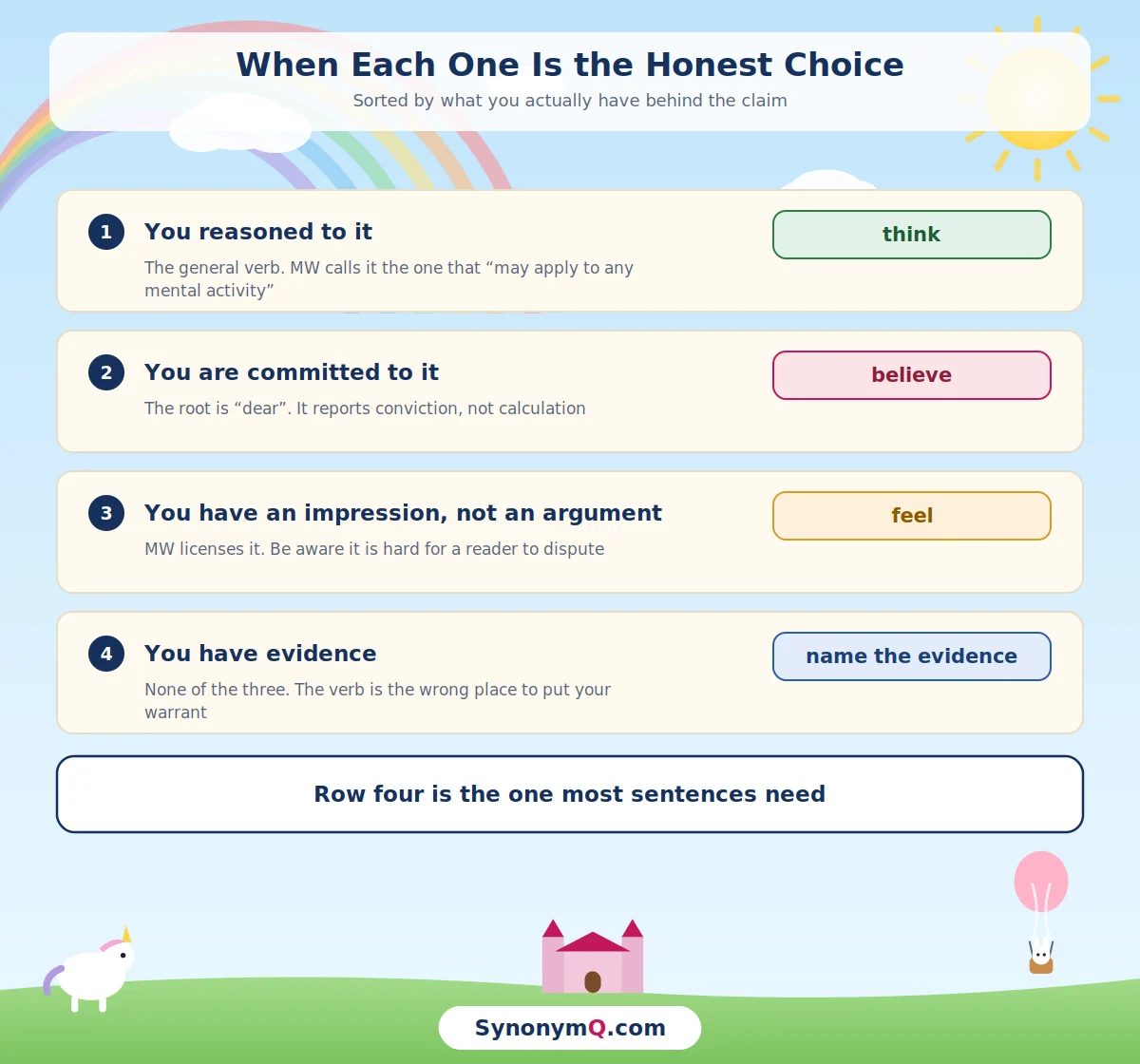
Pick by what you have, not by which word sounds most confident.
| What you have | Use | Why | Label |
|---|---|---|---|
| You reasoned your way to it | think | The general verb, and the one the others are defined by | Direct Swap |
| You are committed to it | believe | The root is “dear”. It reports conviction, not calculation | Direct Swap |
| An impression, not an argument | feel | Licensed by the dictionary, and hard for a reader to dispute | Swap With Adjustment |
| You are hedging a claim you can support | Drop the verb | The deadline is unrealistic is stronger than all three | Requires Rewrite |
| You have evidence | Name the evidence | The verb is the wrong place to carry your warrant | Requires Rewrite |
The last two rows cover most sentences people come here about. If the claim can stand on its own, the mental verb is padding.
Where three words differ in kind rather than in strength, sorting by what you have beats sorting by intensity, which is the distinction at grief, sorrow and sadness.
What Each One Invites the Reader to Do
There is a practical difference the dictionary does not state, and it is worth naming because it decides which verb fits a given document.
| You write | The reader can dispute | Best for |
|---|---|---|
| I think… | Your reasoning | Analysis, recommendations, anything you want challenged |
| I believe… | Your position, not your working | Statements of principle and commitment |
| I feel… | Very little | Raising a concern without starting an argument |
Used deliberately, the third row is a legitimate tool. Used by accident, it removes the disagreement you were hoping to invite.
The Question This Page Does Not Answer
There is a separate and more common question about these verbs, and it is not this one.
This page is about which of the three verbs to use. It is not about whether to use a mental verb at all in academic writing, or whether first person belongs in an essay.
That question has its own page. If you are deciding whether I believe belongs in a piece of academic work, and what to do instead, see another word for I believe in an essay.The two answers point in different directions, and that is deliberate. Here, all three verbs are permitted and you are choosing between them. There, the recommendation is often to attribute the claim to its evidence and drop the verb entirely.
Frequently Asked Questions
Is it wrong to say “I feel” instead of “I think”?
No. Merriam-Webster gives “to believe, think” as a numbered sense of feel. The advice against it is a style preference. What is true is that feel reports an impression a reader cannot easily dispute.
What is the difference between believe and think?
Think reports a judgement you reasoned to. Believe reports a commitment. Merriam-Webster traces believe to lēof, “dear”, the root behind love, and its first recorded sense is religious conviction.
Which is the most formal of the three?
None is more formal than the others. They differ in what they report, not in register, which is a distinction that also decides another word for complex.
Can I use all three in the same piece of writing?
Yes, and varying them for its own sake is the mistake. Each one tells the reader something different about your evidence, so switching changes the claim rather than the rhythm.
What should I use when I have actual evidence?
None of them. Name the evidence and drop the mental verb. The deadline is unrealistic because two dependencies slipped beats every version with a verb in front of it.
How This Page Was Checked
Read from the sources attributed, on 17 September 2026:
- The transitive and intransitive senses of believe, the belēfan and lēof etymology with its link to love, and the pre-12th-century date in the religious sense — Merriam-Webster.
- Transitive sense 4b of feel, “to believe, think”, the fēlan and palpare etymology and the tactile first sense — Merriam-Webster.
- The senses of think, the thencan and tongēre etymology, and the synonym note calling it the general verb — Merriam-Webster.
One table on this page is reasoning rather than retrieved fact, and it is labelled where it appears: what a reader can dispute in each case. The senses and etymologies behind it are retrieved.
No claim is made about what a particular tutor, editor or style guide prefers. Those vary, and a supervisor’s preference outranks a dictionary.
Written by Naveed Akhtar, an SEO content writer with 10 years of article-writing experience.
Target topic: choosing among three permitted verbs when each reports a different kind of warrant

Naveed Akhtar writes every guide on SynonymQ. He is an SEO content writer with ten years of article-writing experience, working on the question a thesaurus never answers: which of these words belongs in this sentence, for this reader. Every page cites the dictionary entries it draws on and the date they were read.