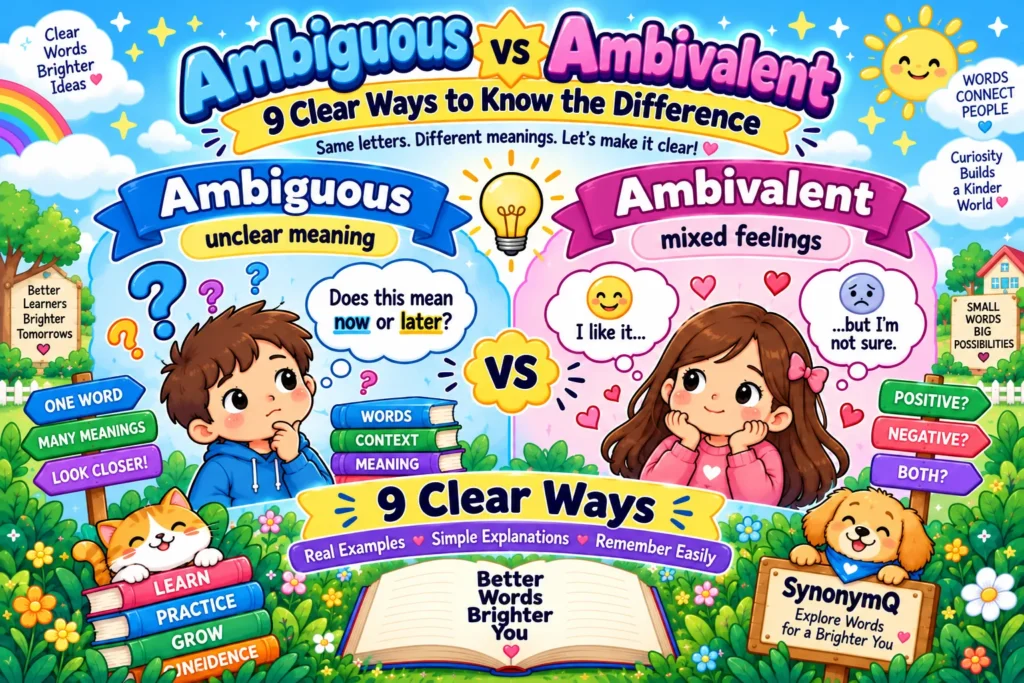
Ambiguous vs Ambivalent: 9 Clear Ways to Know the Difference
Something is ambiguous when it can be read more than one way — a sentence, image, or situation someone else left unclear. A person is ambivalent when they feel torn between two reactions, even though the situation itself is perfectly clear. One is about unclear meaning; the other is about unclear feelings — and the two are never interchangeable.
Written by Naveed Akhtar, an SEO content writer with 10 years of article-writing experience.

What Does Ambiguous Mean?
This word describes anything — a sentence, a policy, an ending, a look on someone’s face — that can genuinely be read more than one way. Merriam-Webster defines it as capable of being understood in two or more possible senses.
The problem sits in the thing itself: a reader or listener can’t tell which meaning was intended.
“Let’s meet at 8” fits because it doesn’t say morning or night. “I saw her duck” is the classic example: did she duck down, or did you see an animal she owns?
What Does Ambivalent Mean?
This one describes a person’s own mixed or contradictory feelings about something. Dictionary.com notes it was coined in psychology in 1916 and only reached everyday use about a decade later.
Holding this feeling doesn’t mean you lack information — it means you have all the facts and still feel pulled two ways.
“She was torn about the job offer” doesn’t mean the offer was unclear. It means she understood it completely and still couldn’t decide how she felt about taking it.
Ambiguous vs Ambivalent: The Core Distinction
Writefull’s academic-writing guide makes the pattern concrete: one qualifies things — situations, wording, concepts — while the other typically describes a person’s state, often followed by “about” or “toward.”
| Ambiguous | Ambivalent | |
|---|---|---|
| What’s unclear | The meaning of something external | Your own feelings about something clear |
| Typical subject | A sentence, image, policy, ending, answer | A person |
| Usually paired with | a direct object (an unclear answer) | about / toward (torn about the offer) |
| Fixable by | More context or a clearer statement | Nothing external — it’s an internal conflict |
| Recommendation | Use for a message, text, or situation open to more than one reading. | Use for a person torn between two reactions. |
Don’t swap one for the other: an unclear email frustrates a reader trying to find the meaning; a torn employee already understands the message and just can’t decide how they feel about it.
Ambiguity vs Ambiguous: Noun or Adjective?
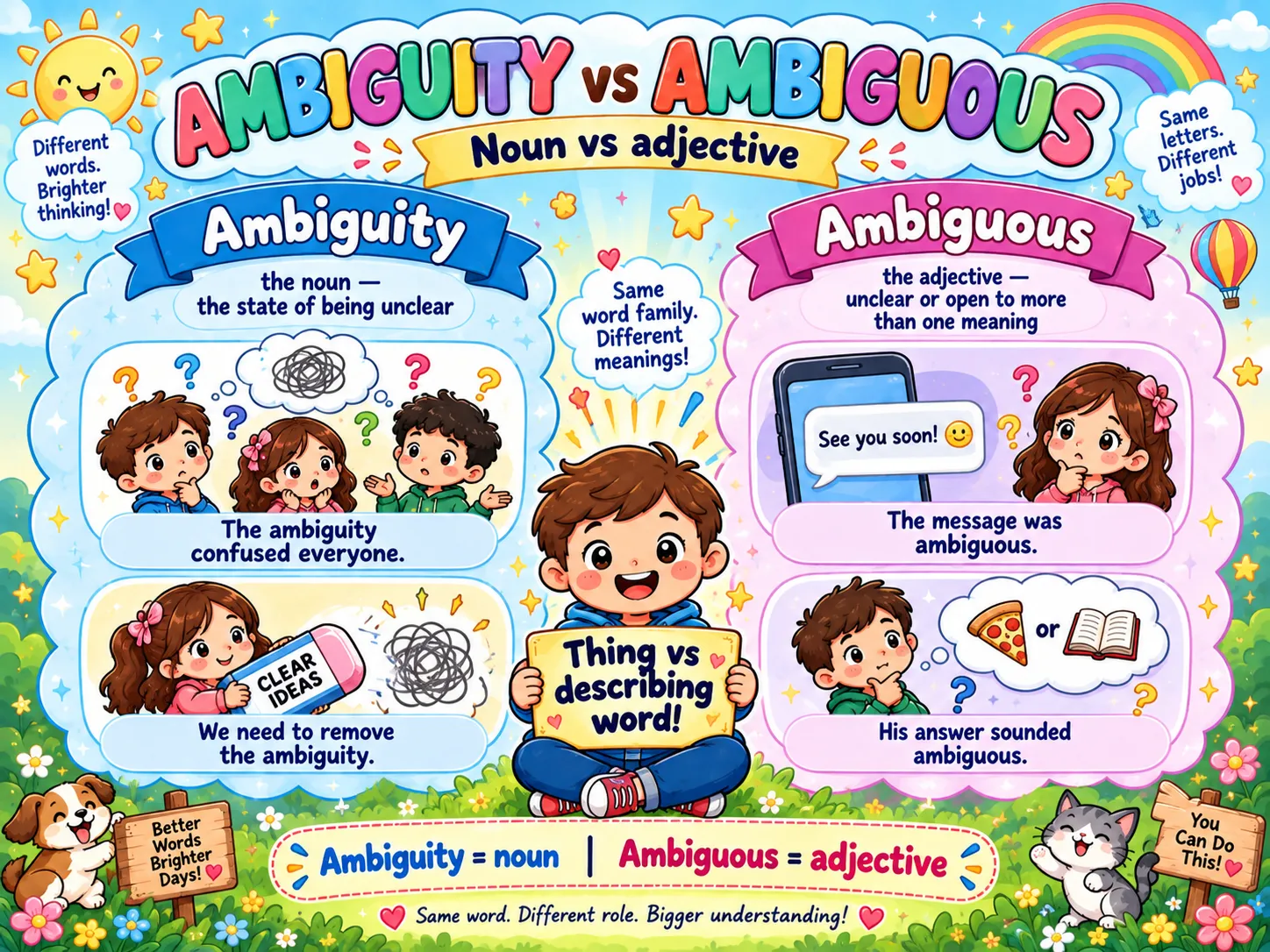
These share the same root but do different grammatical jobs. The noun names the state of being unclear (“We need to remove the ambiguity”).
The adjective describes the unclear thing itself (“The message was unclear”).
If you can put “the” or “an” in front of it, you likely want the noun; if it’s describing a person, place or thing, you want the adjective.
Ambiguous vs Equivocal
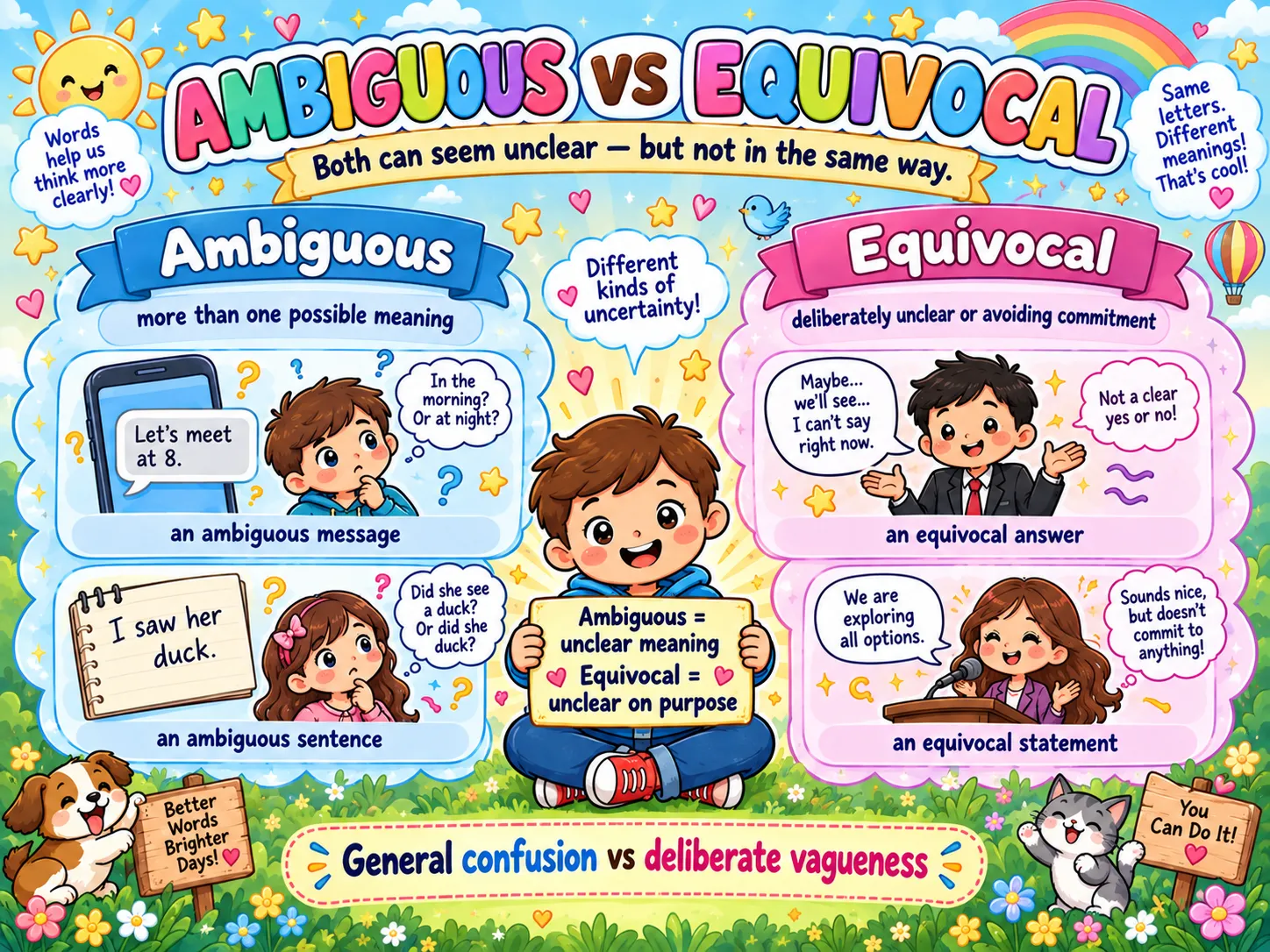
Merriam-Webster groups these together as synonyms for “not clearly understandable,” but the kind of unclear differs.
One means a statement genuinely has more than one possible reading. The other means someone is deliberately vague, usually to dodge committing to an answer.
A politician who says “we’ll see, I can’t say right now” is being evasive on purpose. A text message that reads “let’s meet at 8” is unclear by accident — nobody intended the confusion, it’s just missing information.
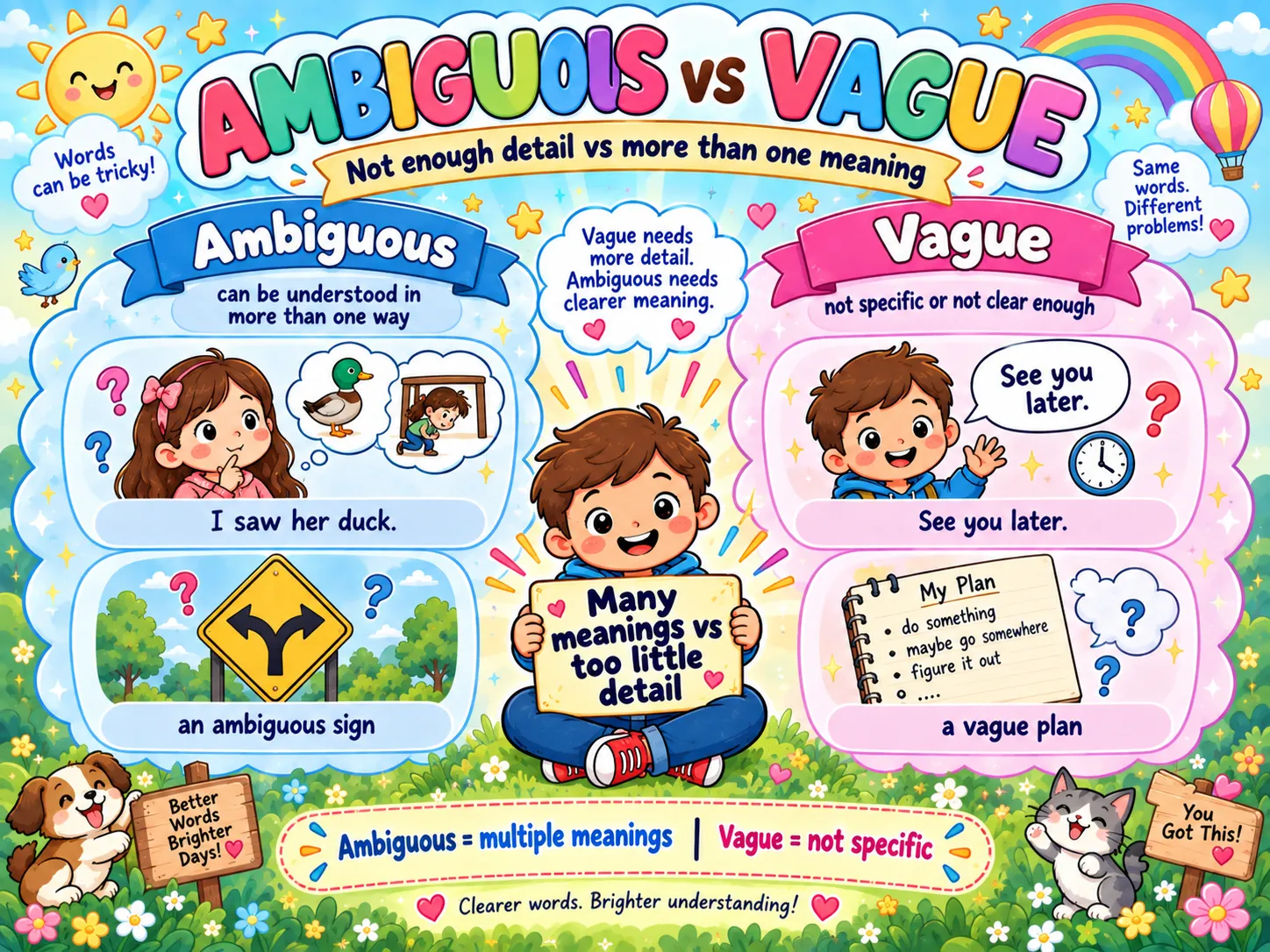
Ambiguous vs Vague
These two get confused because both describe unclear language, but they fail in opposite directions. One means a statement can be understood, just in more than one way — “I saw her duck” has two clear, competing readings.
The other means a statement lacks the detail to be understood at all — “see you later” or “do something, maybe go somewhere” doesn’t offer even one complete reading.
Avoid vague when you mean a sentence has multiple sharp interpretations; avoid the former when you mean a plan simply lacks specifics.
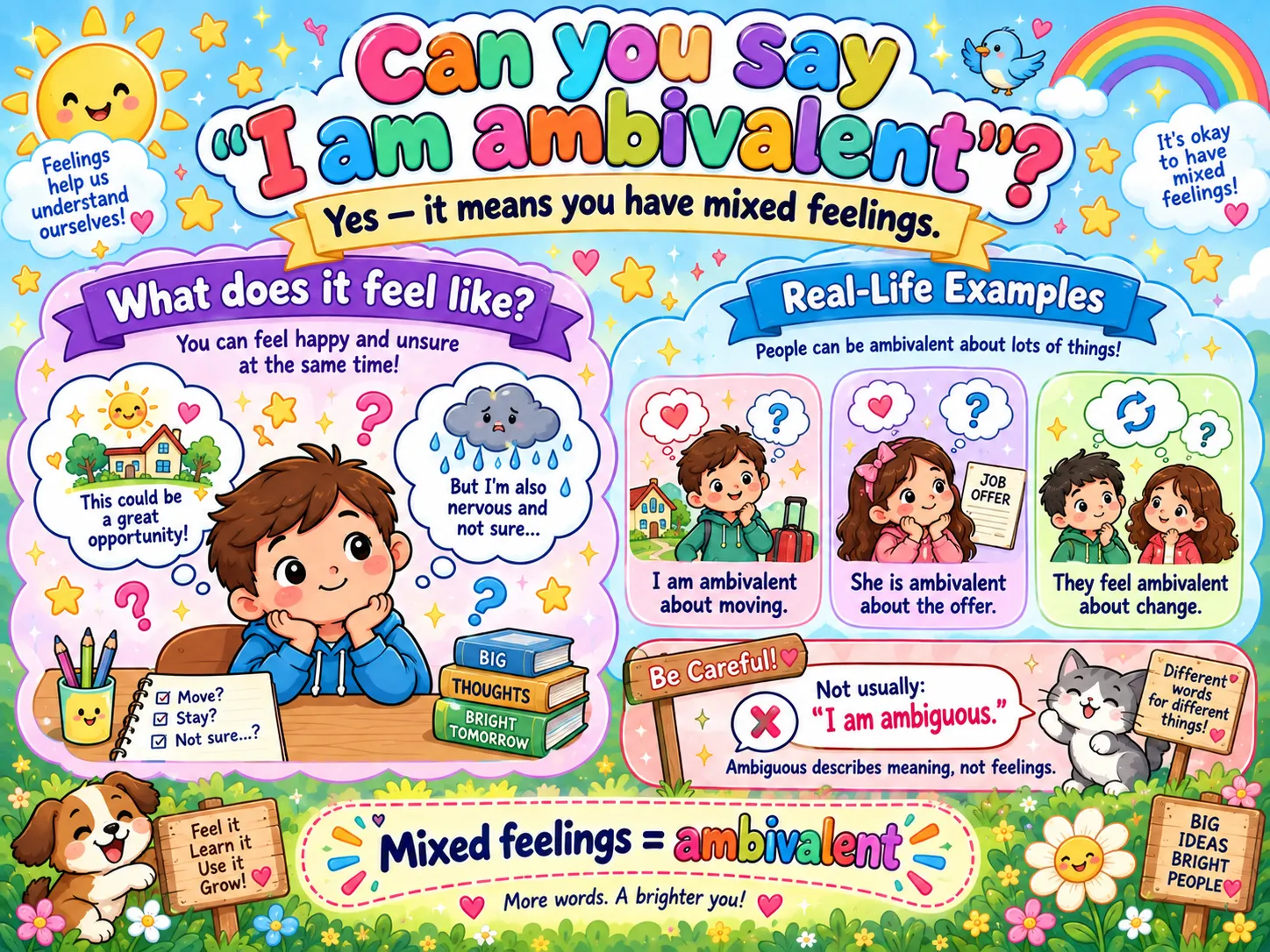
Can You Say “I Am Ambivalent”?
Yes — “I am ambivalent about moving” or “she feels torn about the offer” are both natural, standard uses. It simply means you hold mixed feelings, and it’s normally followed by about or toward.
What doesn’t usually work is “I am unclear” — that word describes meaning, not a person’s feelings, so the sentence reads as a mistake rather than a statement about how you feel.
FAQ
What’s the difference between ambiguity and this adjective?
The first is the noun for the state of being unclear. The second is the adjective that describes the unclear thing itself. “The ambiguity confused everyone” vs “the message was unclear.”
What is the difference between this term and “equivocal”?
One means genuinely open to more than one meaning, often by accident. The other means deliberately unclear, usually to avoid committing to a position.
Can you say “I am ambivalent”?
Yes. It’s the standard way to express mixed or conflicting feelings, typically followed by about or toward — “I feel torn about the offer.”
What is the difference between ambitendency and ambivalence?
The second is the general, everyday term for holding two conflicting feelings or attitudes toward the same thing. The first is a narrower clinical term, used mainly in psychiatry, for conflicting impulses to act.
That means reaching toward and pulling away from something in the same motion. For ordinary writing, the everyday term is almost always the one you want.
Final Word-Choice Guide
Ask what’s actually unclear. If it’s the message — a sentence, sign, or plan open to more than one reading — reach for the first term. If it’s your own feelings about something you already understand, reach for the second.
If the unclear message was left that way on purpose, that’s equivocal. If it simply lacks detail, that’s vague.
See also: commonly confused words, economic vs economical, continual vs continuous, and classic vs classical.
Sources: Merriam-Webster, Dictionary.com, and Writefull’s academic-language guide, consulted 2026-09-22. How this page was checked: definitions and usage patterns verified against established dictionaries before publication; no corpus or frequency figures are claimed.

Naveed Akhtar writes every guide on SynonymQ. He is an SEO content writer with ten years of article-writing experience, working on the question a thesaurus never answers: which of these words belongs in this sentence, for this reader. Every page cites the dictionary entries it draws on and the date they were read.