
47 Synonyms for Protect: Which Word Should You Use?
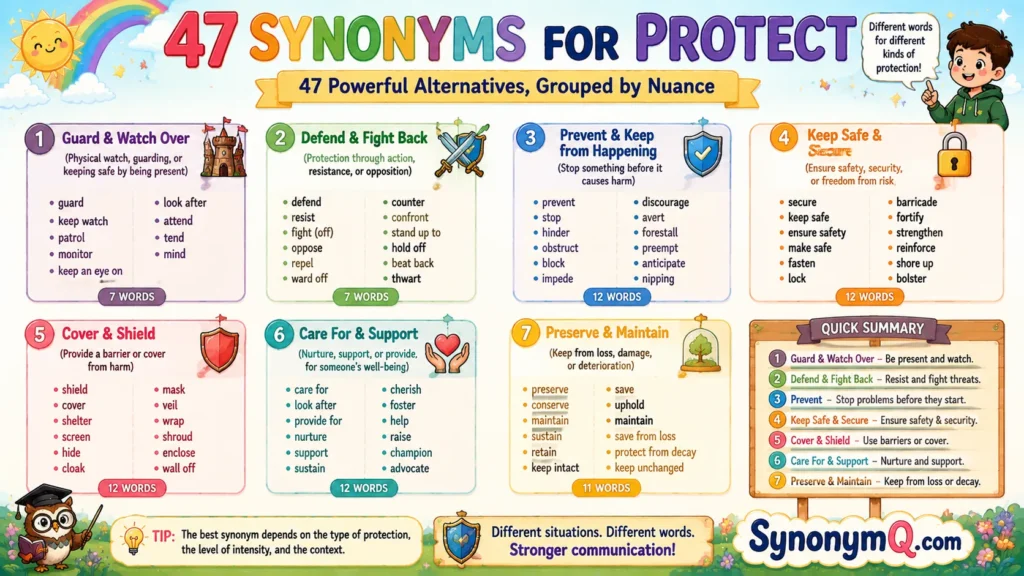
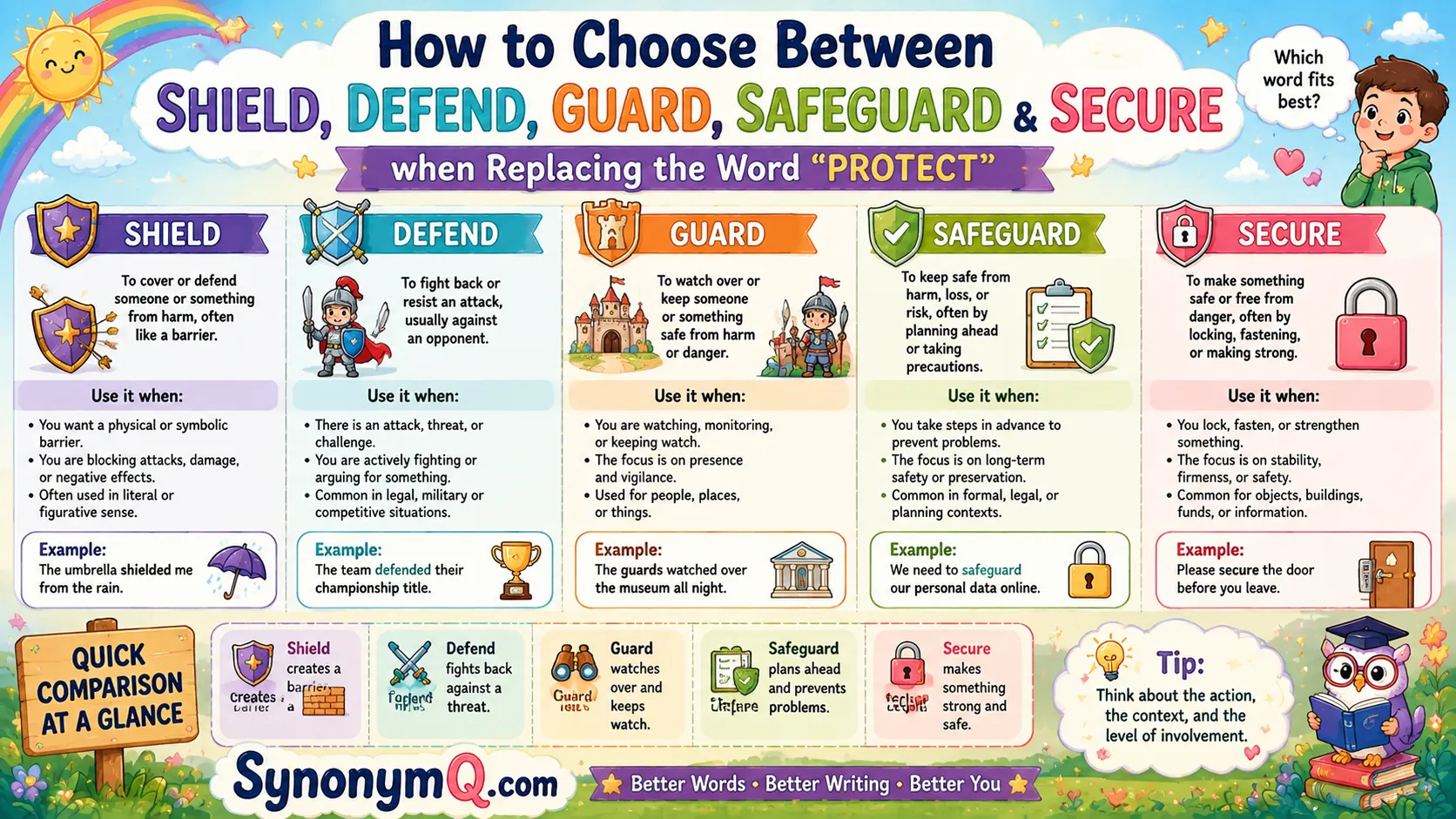
The strongest synonyms for protect are shield, defend, guard, safeguard, shelter, preserve and secure. Choose by what the threat is: shield and shelter block harm, defend and guard fight it off, safeguard and preserve keep something intact, and secure locks it down against future risk.
Quick-Reference Table: The 15 Strongest Alternatives
A thesaurus will hand you two hundred words and walk away. That is the problem this guide fixes. English has roughly forty-seven genuine alternatives to protect — the rest of the list you have seen elsewhere is loose association, and half of it will break your sentence.
So the useful question is not how many words exist. It is which one belongs in the sentence you are writing right now. Start here.
| Synonym | Register | Intensity (1-5) | Best used for |
|---|---|---|---|
| shield | Neutral | 4 | Putting something physically between harm and a person |
| defend | Neutral | 4 | An attack that is already happening |
| guard | Neutral | 4 | Watching a specific thing against expected danger |
| safeguard | Formal | 3 | Rights, data, standards, jobs — policy language |
| shelter | Neutral | 3 | Giving a safe covered place, usually to people |
| secure | Neutral | 4 | Locking down a site, network or supply |
| preserve | Formal | 3 | Keeping something old or fragile intact |
| conserve | Formal | 3 | Habitats, water, energy, heritage |
| cover | Neutral | 2 | Insurance, and physical concealment from weather |
| screen | Neutral | 2 | Blocking exposure, light or view |
| insulate | Neutral | 3 | Keeping an external force from reaching something |
| fortify | Formal | 5 | Strengthening defenses before an attack |
| look after | Casual | 2 | Everyday care of a person, pet or home |
| indemnify | Formal | 3 | Legal and contractual protection from loss |
| uphold | Formal | 3 | Rights, laws and principles under challenge |
Intensity is SynonymQ’s editorial judgment: 1 = mild, 5 = strongest. A guide, not a measurement.

Notice that intensity and formality move independently. Fortify is the most intense word on this list and also one of the most formal, while look after is both the mildest and the most casual — but shield is high-intensity and perfectly plain.
The Full List: 47 Synonyms for Protect, Grouped by Nuance
Every entry below is a real replacement for protect in at least one normal sentence. Save the ones you want with SynonymQ bookmarks, or search more words in the SynonymQ synonym finder.
Putting a barrier between harm and what you value
These words all imply something placed in the way — a physical object, a layer, a distance. The threat is not fought, just blocked.
1. shield (Neutral, verb) — to put something between a person or thing and a source of harm — A row of poplars shields the orchard from the north wind.
2. shelter (Neutral, verb) — to give a safe, usually covered, place — The church sheltered forty families through the flood.
3. cover (Neutral, verb) — to lie over something so harm cannot reach it, or to insure it — Your policy covers water damage but not subsidence.
4. screen (Neutral, verb) — to block exposure, light or view — A bamboo fence screens the patio from the road.
5. insulate (Neutral, verb) — to keep an outside force from reaching something — The trust insulates her savings from any claim against the business.
6. buffer (Neutral, verb) — to soften the force of something rather than stop it — A three-month cash reserve buffers the shop against a slow winter.
7. cushion (Neutral, verb) — to reduce the impact of a blow or loss — The grant cushioned the department against the first round of cuts.
8. armor (Neutral, verb) — to fit with a hard protective layer, literally or figuratively — Ten years of auditions had armored him against rejection.
Actively holding off an attacker
Here the threat is real, present and pushing back. These words carry effort and often conflict.
9. defend (Neutral, verb) — to ward off an attack that is happening or clearly coming — Two lawyers defended the estate against a dozen competing claims.
10. guard (Neutral, verb) — to watch over something with vigilance against expected danger — A single officer guarded the evidence room overnight.
11. secure (Neutral, verb) — to make a place, system or supply hard to breach — The team secured the server before the audit began.
12. fortify (Formal, verb) — to strengthen defenses in advance — The city fortified its river wall after the second flood.
13. barricade (Neutral, verb) — to block a way in with an improvised obstruction — They barricaded the stairwell and waited for the fire crew.
14. patrol (Neutral, verb) — to protect by moving through an area repeatedly — Volunteers patrol the nesting beach every night in June.
15. bulwark (Literary, verb) — to stand as a solid defense against something — A free press bulwarks the courts against quiet interference.
Keeping something from being lost, spent or spoiled
Nothing is attacking. The enemy is time, waste, decay or drift, and these words are about holding a state steady.
16. preserve (Formal, verb) — to keep something intact in its existing condition — The archive preserves letters that would crumble in ordinary storage.
17. conserve (Formal, verb) — to protect a resource by using less of it or managing it well — The scheme conserves groundwater across four districts.
18. safeguard (Formal, verb) — to put measures in place so something cannot be taken or damaged — New rules safeguard tenants against sudden eviction.
19. save (Neutral, verb) — to keep something from being lost or destroyed — Local objections saved the mill from demolition.
20. steward (Formal, verb) — to protect something you hold in trust for others — The family has stewarded this woodland for six generations.
21. ring-fence (Formal, verb, chiefly British) — to protect a budget or asset by rule so it cannot be spent elsewhere — The council ring-fenced the library funding for three years.
Looking after people
The object here is almost always a person or an animal. These words carry warmth that guard and secure do not.
22. look after (Casual, verb) — to take everyday care of someone or something — Could you look after the twins for an hour?
23. watch over (Neutral, verb) — to keep protective attention on someone — Her grandmother watched over the whole street from that window.
24. take care of (Casual, verb) — to see that someone or something comes to no harm — He took care of his brother from the age of eleven.
25. keep safe (Casual, verb) — to protect from harm, in the plainest possible words — Just keep her safe until I get there.
26. chaperone (Neutral, verb) — to accompany someone, usually a young person, to protect their safety or reputation — Two teachers chaperoned the trip to Vienna.
27. escort (Neutral, verb) — to travel with someone to keep them safe on the way — A nurse escorted him from the ward to the taxi.
28. mind (Casual, verb, chiefly British) — to look after briefly — Would you mind the stall while I get lunch?
Legal, financial and medical protection
These are the words that appear in contracts, policy documents and clinical notes. Most are wrong in casual speech and precise in their own setting.
29. indemnify (Formal, verb) — to protect someone against financial loss by agreement — The contract indemnifies the supplier against third-party claims.
30. insure (Neutral, verb) — to protect against loss by paying a premium — We insured the equipment before it left the warehouse.
31. underwrite (Formal, verb) — to accept the risk of something so it is protected — A government guarantee underwrites the first year of trading.
32. hedge (Neutral, verb) — to protect against a loss by taking an offsetting position — The airline hedges its fuel costs a year ahead.
33. immunize (Neutral, verb) — to protect against a disease by producing immunity — The campaign immunized ninety per cent of the district.
34. inoculate (Neutral, verb) — to protect by introducing a small dose of the thing itself — Early criticism inoculated the project against later attacks.
35. uphold (Formal, verb) — to protect a right, law or principle by refusing to let it fall — The tribunal upheld her right to unpaid leave.
36. enshrine (Formal, verb) — to protect something by writing it permanently into law — The treaty enshrines minority language rights.
37. entrench (Formal, verb) — to protect something by making it very hard to remove — The amendment entrenches judicial independence.
Older, literary and specialized choices
Useful in the right sentence, conspicuous in the wrong one. Read the labels before you use these.
38. harbor (Neutral, verb) — to shelter someone, often someone being pursued — The village harbored deserters for most of that winter.
39. cocoon (Literary, verb) — to wrap something in total, sometimes excessive, protection — Money had cocooned him from every ordinary difficulty.
40. shade (Neutral, verb) — to protect from light or heat — A canvas awning shades the seedlings until July.
41. quarantine (Neutral, verb) — to protect everything else by isolating one thing — The lab quarantined the sample for six weeks.
42. weatherproof (Neutral, verb) — to protect against rain, wind and cold — We weatherproofed the shed before the first frost.
43. keep (Archaic, verb) — to protect and watch over, surviving now mainly in blessings and older text — May the road rise to meet you, and may God keep you.
44. ward (Archaic, verb) — to guard or keep watch over; the modern language kept the phrasal ward off and dropped this — He was set to ward the gate till dawn.
Informal ways to say it about a person
Spoken English handles protection with phrases rather than single verbs. These three are the ones that actually get used.
45. have someone’s back (Slang, verb) — to be ready to protect and support someone — Say what you need to say. I have your back.
46. look out for (Casual, verb) — to keep protective watch on someone’s interests — Somebody has to look out for the new apprentices.
47. stick up for (Casual, verb) — to protect someone verbally when they are attacked — She stuck up for the caretaker in front of the whole board.
That is the honest total. Forty-seven, not two hundred — because the extra hundred and fifty are words like prevent and rescue that mean something adjacent and break the sentence when you swap them in. Those get their own section below.

Register and Formality Table
Every major synonym above, sorted into six buckets. This is the vocabulary the rest of the article uses, and it is the table most competitors skip entirely.
| Register | Synonyms of protect | What it signals |
|---|---|---|
| Formal | safeguard, preserve, conserve, fortify, steward, ring-fence, indemnify, underwrite, uphold, enshrine, entrench | Contracts, policy, academic writing, legal drafting |
| Neutral | shield, shelter, cover, screen, insulate, buffer, cushion, armor, defend, guard, secure, barricade, patrol, save, watch over, chaperone, escort, insure, hedge, immunize, inoculate, harbor, shade, quarantine, weatherproof | Safe almost anywhere, spoken or written |
| Casual | look after, take care of, keep safe, mind, look out for, stick up for | Conversation, messages, informal blog writing |
| Slang | have someone’s back | Speech and social posts only; never in a report |
| Literary | bulwark, cocoon | Fiction, essays, deliberately heightened prose |
| Archaic | keep, ward | Older texts, blessings, historical dialogue |
Two things worth noticing. The Slang row has exactly one entry, and that is not an omission — English never developed a slang verb for protect, only phrases. And the Formal column is where most writers over-reach: indemnify in a school essay reads as costume, not competence.

Which Word Should You Use to Say Protect?
Match the word to the threat, not to the thing being protected. That single habit fixes most bad substitutions.
If the harm is already happening → defend, guard, fend off the attack directly. Defend assumes an opponent.
If you are putting something in the way → shield, screen, shade, cover, insulate. No opponent needed; these work against weather, light, noise and market forces.
If you are writing about rights, data or standards → safeguard, uphold, enshrine, entrench. This is the register of policy documents and it reads as competent there.
If you are writing about nature, water or heritage → conserve, preserve, steward, safeguard. Conserve implies managing use; preserve implies leaving alone.
If the object is a person you care about → look after, watch over, keep safe, look out for. Warm and unmistakable.
If money or legal liability is involved → indemnify, insure, underwrite, hedge, ring-fence. Precise in contracts, absurd anywhere else.
If you want maximum intensity → fortify, secure, barricade. All three imply serious effort and preparation.
If you want the plainest possible word → keep safe. Three syllables, zero ambiguity, works with every audience including children and ESL readers.
If nothing above fits → keep protect. It is the least marked verb in the group, which is exactly why it is so common. Reaching for cocoon to avoid repeating protect twice in a page makes writing worse, not better.
The three-question test
- Is there an attacker? Yes → defend, guard. No → shield, shelter, insulate.
- Is the object a person, a resource, or a right? Person → look after, watch over. Resource → conserve, preserve. Right → uphold, safeguard.
- Who reads this? A contract → indemnify. A friend → keep safe. Everyone else → protect or shield.

Words That Are Not True Synonyms for Protect
These six show up in thesaurus lists and cause real errors. In every case the problem is the same: the word takes a different object, or acts at a different moment.
Prevent. You prevent the harm, not the thing at risk. Prevent the leak works; prevent the house does not. Swapping prevent for protect flips the object and produces a sentence that native readers reject instantly.
Ward off / fend off. Same flip. You ward off an attack, a chill, a question. You cannot ward off your daughter. Interestingly, the archaic verb ward did take the protected thing as its object, which is why the phrasal version feels so close and behaves so differently.
Rescue. Rescue acts after harm has already begun; protect acts before. A lifeguard who rescues a swimmer has, by definition, failed to protect them. In a grant application or an incident report, that difference is the whole meaning.
Nurture. Nurture is about helping something grow. Protect is about keeping it from harm. A greenhouse protects seedlings from frost and nurtures them with warmth — two different jobs, and writing about child development or conservation is where confusing them does the most damage.
Conceal / hide. Hiding something may protect it, but the words describe visibility, not safety. He concealed the letter tells the reader nothing about danger. Use protect or safeguard when safety is the point.
Control / restrict. These sneak in through phrases like protected species and protected data. Protection often works through restriction, but the words are not interchangeable: the law restricts access to the data and the law protects the data can be true at once and say opposite things about intent.

Head-to-Head Comparisons
The four pairs below account for most of the word-choice questions readers actually send in.
Protect vs Defend
| Feature | Protect | Defend |
|---|---|---|
| Timing | Before harm arrives | While harm is arriving |
| Needs an opponent | No | Yes, or a clear threat |
| Typical objects | children, data, skin, jobs, habitats | a title, a claim, a position, a border |
| Register | Neutral, universal | Neutral, slightly more combative |
Protect is the calmer, broader word. Defend assumes something is pushing against you, which is why defend a thesis works and protect a thesis sounds odd — nobody is attacking a document until you present it. Sunscreen protects your skin; it does not defend it.
The same logic makes defend the better verb in argument, sport and litigation, and protect the better verb in health, safety and environmental writing.
Protect vs Guard
| Feature | Protect | Guard |
|---|---|---|
| Core idea | Keeping harm away by any means | Watching vigilantly against known danger |
| Implies a watcher | No | Yes, almost always |
| Duration | Ongoing or built-in | A posted, attentive watch |
| Typical objects | rights, health, savings, wildlife | a door, a prisoner, a secret, a goal |
Guard adds a person paying attention. A helmet protects your head; it cannot guard it. This is why guard your privacy carries a note of active vigilance that protect your privacy does not — the first suggests you are watching for threats, the second that you have measures in place.
Safeguard vs Preserve vs Conserve
| Word | What it protects against | Where it belongs |
|---|---|---|
| safeguard | Being taken, breached or eroded | Rights, data, jobs, standards, policy documents |
| preserve | Decay, loss, alteration | Buildings, archives, languages, ecosystems left as they are |
| conserve | Waste and overuse | Water, energy, fuel, soil, species under management |
This trio is where writing about the environment goes wrong most often. Conserve water is right and preserve water is odd, because preserving means keeping something unchanged, not using less of it. Preserve the wetland is right when the goal is to leave it alone; conserve the wetland implies active management of how it is used.
Safeguard sits apart from both: its threat is human and deliberate. You safeguard a habitat from developers, and conserve it from drought.
Shield vs Shelter
| Feature | Shield | Shelter |
|---|---|---|
| What it suggests | A hard barrier, often thin and close | A covered space you go inside |
| Direction of threat | One direction, usually | All around, usually overhead |
| Figurative use | Very common — shield her from the news | Less common, more literal |
| Typical objects | eyes, skin, a person from information | families, refugees, livestock, a boat |
Shield is the more flexible of the two and the more useful figuratively, because information, criticism and blame all arrive from a direction. Shelter keeps its physical sense strongly, so sheltered her from the news reads as slightly strained where shielded reads as natural.

Common Collocations With Protect and Protective
These are the pairings that sound native. Each one is given in a full sentence, because a collocation you cannot build a natural sentence around is not a real collocation.
- protect against (a risk or condition) — Vitamin D appears to protect against winter infections.
- protect from (a threat, a person, or information) — They protected her from the worst of the coverage.
- fiercely protect — He fiercely protects the two hours before his first meeting.
- protect your privacy — A password manager is the cheapest way to protect your privacy.
- protect the environment — Small councils can protect the environment more nimbly than large ones.
- legally protected / protected by law — The site has been legally protected since the boundary review.
- protect your interests — Read clause nine again; it does not protect your interests.
- protect a lead — They spent the last twenty minutes protecting a one-goal lead.
- protective clothing / protective gear — No protective clothing is issued for the night shift.
- protective of (someone or something) — She is very protective of her team’s time.
- protective towards (someone) — He became noticeably protective towards the younger students.
- overly protective — Overly protective supervision teaches nothing about risk.
Note the split in the last three. Protective takes of or towards when it describes a feeling, and no preposition at all when it describes equipment — protective clothing, never clothing protective of you.
Etymology and Origin of Protect
Protect entered English in the early fifteenth century, meaning to cover or shield from danger, harm, damage, exposure or insult. It came from Latin protectus, the past participle of protegere — “to protect, defend, cover over, cover in front.”
Take protegere apart and the image is physical: pro, “before,” plus tegere, “to cover.” To protect something was to hold a cover in front of it. Every modern sense still carries that spatial picture, which is why shield and screen feel so close to it.
The noun protection is older in English than the verb, appearing in the mid fourteenth century by way of Old French proteccioun and Late Latin protectionem. Protector follows in the late fourteenth century, meaning a defender or guardian, and protective arrives in the 1660s as “affording protection, sheltering, defensive.”
Two later senses show how far the word travelled. By 1789 protection had a political-economy meaning — fostering home industry by taxing foreign competitors — and by 1860 an underworld one: freedom from molestation in exchange for money. Protective custody is recorded from 1936, translating the German Schutzhaft. Dates and forms in this section follow the entries for protect and protection on Etymonline.
Protect Synonyms for Specific Writing Situations
Academic Writing and Essays
Academic prose rewards precision about mechanism. Prefer safeguard, preserve, conserve, insulate, shield, mitigate the exposure of and uphold, and say what the threat is rather than leaving protect to do the work alone.
Avoid look after, keep safe and have someone’s back entirely. Avoid cocoon and bulwark unless the essay is about literature. If you are checking a word limit, the SynonymQ word counter will tell you where the padding is.
One habit worth copying: pair the verb with the mechanism. Fluoride protects enamel is thin; fluoride shields enamel from acid demineralization earns its place.
Résumés, Cover Letters and Professional Email
Hiring managers read for outcomes, so choose verbs that imply you built something. Safeguarded, secured, preserved, insulated, ring-fenced, indemnified and upheld all read as work performed.
Safeguarded is the safest strong choice on a résumé — it implies systems and process without overclaiming. Secured is stronger still but ambiguous, since it also means “obtained,” so give it an object that removes doubt: secured the payment gateway, not secured the accounts.
Skip protected on its own where you can. It is accurate and completely unmemorable, which on a résumé is the same as invisible. The same problem shows up with other flat verbs — the note on strong alternatives in our guide to synonyms for experience applies here almost word for word.
Creative Writing and Fiction
Fiction wants the physical picture back. Shield, shelter, screen, cover, armor, cocoon, bulwark, harbor and the archaic keep and ward all carry image and period.
Cocoon is the one to use carefully. It almost always implies the protection has gone too far, so it does quiet characterizing work — she had cocooned the boy for nineteen years tells the reader something about the mother, not the boy.
For dialogue, drop back to speech: have your back, look out for, stick up for, keep safe. A character who says I shall safeguard you is either a lawyer or a joke.
Everyday Conversation and Social Media
Plain and warm wins here. Look after, keep safe, watch over, look out for, have your back, stick up for, cover and guard cover almost every real conversation.
Have your back is the most natural way to promise protection in English and the hardest to translate, which makes it a favorite in captions and comment replies. Keep safe works on any audience and reads as sincere rather than performed.
Need a different word for a specific sentence rather than a list? Run it through the SynonymQ synonym finder and check the register label before you paste.
Antonyms of Protect
Opposites split by which sense of protect you mean, so pick from the right column.
| Sense of protect | Antonyms | Note |
|---|---|---|
| Keep from harm | endanger, imperil, jeopardize, expose, threaten | Endanger is the plainest; imperil is formal and literary |
| Actively cause harm | harm, attack, assail, damage, hurt | These are opposites of the outcome, not of the effort |
| Care for a person | neglect, abandon, forsake, desert | Forsake is literary; neglect is the everyday word |
| Preserve or maintain | undermine, erode, squander, waste | Right choice when the subject is a right, a resource or a standard |
| Be protective (adj.) | neglectful, dismissive, indifferent, hands-off, permissive | Hands-off is neutral and sometimes positive |
Two notes worth keeping. Unprotected and defenseless describe the resulting state, not the opposite action, so they answer a different question. And betray is the emotional opposite of protecting a person, which no antonym list ever includes and every reader recognizes.
Build the other side of any word list with the SynonymQ antonym finder, or see how sharply opposites define meaning in our piece on synonyms for honor.
Protect in Spanish, French and Italian
[VERIFY-NATIVE] — the register and regional notes below should be confirmed by a native speaker before publication.
| Language | Word | Register | Notes |
|---|---|---|---|
| Spanish | proteger | Neutral | The default equivalent; proteger a alguien de algo. amparar is formal and legal; cuidar means look after |
| French | protéger | Neutral | The default; protéger quelqu’un de/contre quelque chose. préserver for resources; veiller sur for watching over a person |
| Italian | proteggere | Neutral | The default; tutelare is the legal and institutional word; custodire implies safekeeping; salvaguardare matches safeguard |
One native example each:
- Spanish: Usa crema solar para proteger la piel del sol.
- French: Ce vaccin protège les enfants contre la grippe.
- Italian: Questa legge protegge i consumatori.
The pattern across all three is the same as English: a general verb plus a set of specialized ones. Tutelare, amparar and préserver are not interchangeable with the general verb any more than indemnify is with protect.

How to Avoid Repeating Protect
Repetition is rarely a vocabulary problem. It is usually a sentence-structure problem wearing a vocabulary costume, and swapping in a rarer verb makes it worse.
- Name the threat instead of the action. This protects your data becomes This stops your data leaving the device. The repeated verb disappears and the sentence gains information.
- Move to the noun. Protection, safeguards, cover, defenses — the building has no protection against flooding reads better than a third protects in one paragraph.
- Use the passive once, deliberately. The site is protected by law is often the natural English, and it varies the rhythm without changing a word.
- Switch to the specific verb. If the mechanism is a barrier, say shields. If it is a rule, say safeguards. If it is a person watching, say guards. Specificity is the real cure.
- Cut the sentence. Two of the three protects in a draft paragraph are usually restating the first one.
- Check that the replacement kept the meaning. Rewriting a passage safely takes a second pass — the method in our paraphrasing tool is built for exactly that check.
The one rule underneath all six: never replace protect with a rarer word purely to avoid repeating it. Readers notice reached-for vocabulary immediately, the same trap covered in our guide to synonyms for fancy.
Frequently Asked Questions
What are 5 strong synonyms for protect?
Shield, defend, guard, safeguard and secure. Shield blocks harm with a barrier, defend fights off an attack in progress, guard implies a vigilant watcher, safeguard suits rights and data, and secure means making something hard to breach.
All five are stronger and more specific than protect itself, which is why they read better in a résumé bullet or a report.
What is a fancy word for protection?
Aegis is the classic one — under the aegis of the university means under its protection and authority. Other formal options are custodianship, tutelage, indemnity for financial protection, and safeguards for measures in place.
Use aegis only in the fixed phrase under the aegis of. Outside it, the word sounds like it wandered in from a different century.
What is a synonym for safe or protected?
For safe: secure, out of harm’s way, sheltered, unharmed, risk-free. For protected: shielded, guarded, safeguarded, insured, covered, legally protected.
The two words differ in what they describe. Safe describes the state of the person or thing; protected describes the measures around it. A sleeping child in a locked house is both, but a helmet makes you protected, not safe.
What is a synonym for protect ourselves?
Defend ourselves, shield ourselves, guard against, take precautions or cover ourselves. In formal writing, mitigate our exposure and safeguard our position both work.
Pick by threat. Defend ourselves implies an accusation or attack, guard against implies a risk you can foresee, and take precautions is the neutral choice when no opponent exists.
What is another word for protecting yourself?
Self-protection is the direct noun; self-defense is the legal and physical term; self-preservation describes the instinct rather than the act. As a verb phrase, looking out for yourself is the casual version and hedging your exposure the financial one.
Self-protective is the adjective, and it leans slightly negative in describing behavior — a self-protective answer suggests evasion.
What is a powerful word for protection?
Fortification and bulwark are the strongest nouns; impregnable and fortified the strongest adjectives. For institutional weight, aegis and custody both carry authority.
Strength has a cost. Bulwark is literary, so a bulwark against inflation works in an editorial and would look odd in a policy brief, where safeguard is stronger for being credible.
What’s another word for a protector?
Guardian, defender, custodian, guarantor, patron, champion, steward, keeper, advocate or bodyguard.
They are not interchangeable. Guardian is legal and personal, custodian implies care of an object or standard, champion and advocate mean fighting for a cause, and guarantor is purely financial.
What’s another word for being protective?
Watchful, vigilant, defensive, fiercely loyal, caring, solicitous, paternal or maternal, and at the negative end possessive, clingy or overbearing.
Protective is itself neutral to positive; the words around it are not. Solicitous is formal and warm, possessive is the same behavior described disapprovingly, and defensive has drifted to mean easily offended.
What is a positive synonym for protective?
Caring, watchful, supportive, loyal, attentive and nurturing all keep the warmth without the suspicion. In writing about a person, fiercely loyal is the strongest positive framing available.
Avoid possessive, clingy, smothering and overprotective unless you intend criticism. English has more negative words for this behavior than positive ones, which is worth knowing before you pick.
What are some synonyms for protection and safety?
For protection: shelter, cover, defense, safeguard, custody, aegis, immunity, indemnity, guardianship. For safety: security, well-being, refuge, sanctuary, haven.
The pair divides cleanly. Protection words name what is done; safety words name the condition that results. A policy provides protection; the family enjoys safety.
Which protection synonyms fit a crossword grid?
Crossword clues for protection usually want one of these, sorted by length.
| Letters | Answers | Sense |
|---|---|---|
| 4 | care, keep | Custody or charge of something |
| 5 | cover, guard, aegis, armor, haven | General protection or a protective thing |
| 6 | refuge, asylum, safety, shield, immunity (8) | Shelter and legal protection |
| 7 | shelter, custody, defense, keeping | Formal protection and safekeeping |
For protect itself, the common fills are cover (5), shield (6), defend (6) and safeguard (9).
Are there slang words for protective?
Not really, and that gap is worth knowing. English uses phrases instead: has my back, ride or die, mama bear and guard dog all describe protective behavior in slang register.
The single-word options in slang are almost all critical — clingy, nosy, helicopter as in helicopter parent. If you want positive slang, use a phrase.
Which synonyms for protect start with B, E or I?
B: buffer, bulwark, barricade. E: escort, enshrine, entrench. I: insulate, insure, indemnify, immunize, inoculate.
The letter-first search usually means a crossword or a puzzle, so check the sense as well as the spelling — entrench protects a rule, not a person, and escort protects a person, not a rule.
Choosing Your Next Word
The reason protect has forty-seven alternatives and no perfect one is that protection always has a shape: a threat, a barrier, a moment, an object. Name those four things and the right word is usually obvious.
When it is not, the SynonymQ synonym finder gives you register labels beside every result, so you can see whether a word belongs in a contract or a text message before you commit to it. It works across English, Spanish, French and Italian.
Two more word lists worth having open while you edit: synonyms for quickly for the adverb that clutters more drafts than any other, and synonyms for play for a verb whose senses split as sharply as this one’s.
About the author
Naveed Akhtar is the founder of SynonymQ and writes about vocabulary and clear writing.
Published: August 21, 2026 Last updated: August 21, 2026
Sources consulted: the entries for protect and protective on Merriam-Webster, the entry for protective on Oxford Learner’s Dictionaries, and the entries for protect and protection on Etymonline.

Naveed Akhtar writes every guide on SynonymQ. He is an SEO content writer with ten years of article-writing experience, working on the question a thesaurus never answers: which of these words belongs in this sentence, for this reader. Every page cites the dictionary entries it draws on and the date they were read.