
Another Word for Deployed on a Resume
Deployed means placed in position for a particular purpose, and Merriam-Webster’s core sense is military. On a resume it splits three ways: military service, software releases, or moving people and budget. The strongest replacements are launched, released, rolled out, implemented, mobilized, allocated, assigned and stationed. Pick by the meaning you intend, because the wrong one reads as the wrong career.

The Two Things a Recruiter Reads Into “Deployed”
Most resume-word problems are about strength. A word is too vague, too soft, too oversold. Deployed is a different problem: it is precise, and it points at two unrelated careers.
Merriam-Webster defines the noun deployment as “the act or movement of deploying or the state of being deployed,” with the first sub-sense being “placement or arrangement (as of military personnel or equipment) in position for a particular use or purpose.” Dictionary.com goes further and records “the state of being assigned for duty away from home, especially for military purposes.”
Oxford Learner’s Dictionaries splits the noun in two. The first sense is “the act of moving soldiers or weapons into a position where they are ready for military action” and carries no register label. The second, “the act of using something effectively,” is marked formal.
That formal label matters more than it looks. By Oxford Learner’s reckoning the non-military use of deploy is not neutral office vocabulary but the formal register. Merriam-Webster attaches no register label to its equivalent sense, so this is one dictionary’s judgement rather than a settled property of the word. Take it as a caution, not a rule: “deployed three analysts to the Denver account” reads as formal, and next to plainer lines on the same page it can read as inflated rather than precise. The same single label decides most of the choice between grief, sorrow and sadness, where Oxford marks sorrow “rather formal” and leaves the other two unmarked.
The word’s history explains the pull toward the military reading. Merriam-Webster’s entry for the verb deploy traces it to French déployer, “to unfurl, spread out, display, arrange for a purpose,” going back to Old French despleier, “to unfurl, set out to view.” The image underneath the word is a formation spreading out from a base. Every modern use inherits that picture.
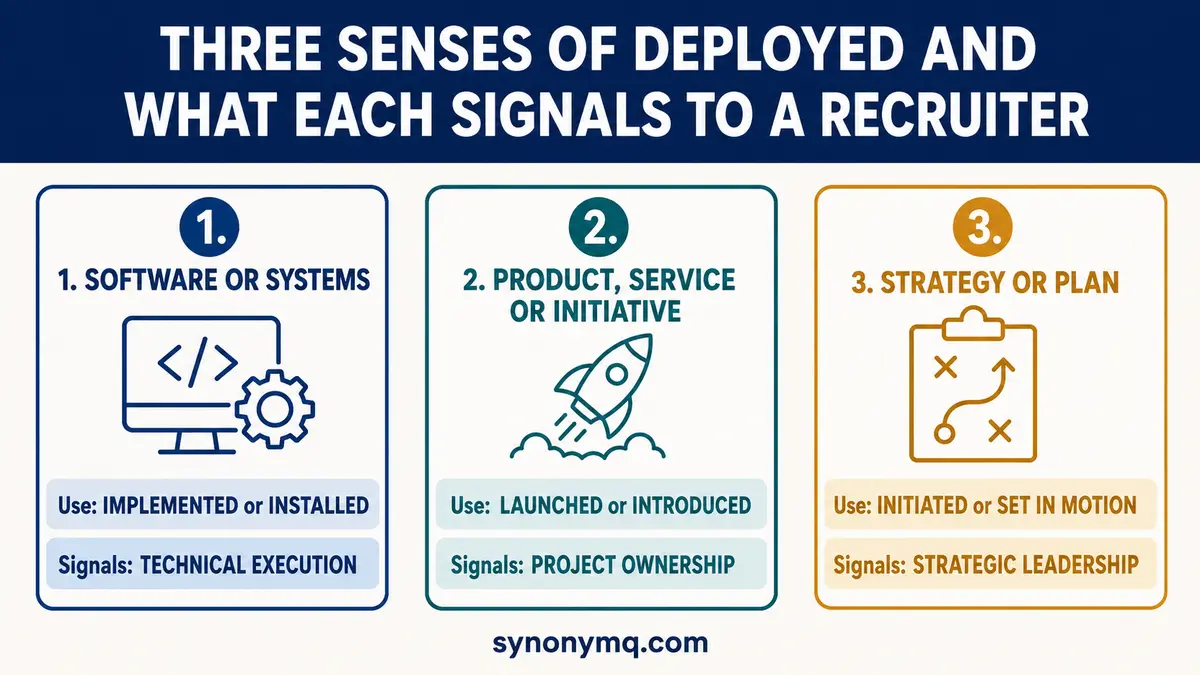
So before you replace the word, decide which of the three things you actually did.
If You Mean Military Service
Here is the part most resume advice gets backwards: for veterans, deployed is the correct word and should usually stay.
Dictionary.com’s sense, “a period of time during which a person or group is assigned for duty away from home, especially for military purposes,” is exactly what happened. Swapping in launched or implemented does not clarify anything. It hides a fact, and in defence, federal and government-adjacent hiring that fact is usually an asset rather than something to translate away. That is editorial judgement about those sectors, not a measured hiring statistic.
The real problem is not the verb. It is that the line around it assumes knowledge a civilian recruiter does not have.
What to write instead
Keep deployed, and add the scale and the outcome a reader outside the military cannot infer.
| Instead of | Write | Why it works |
|---|---|---|
| Deployed to Kandahar, 2019–2020 | Deployed to Kandahar for 12 months; led a 9-person logistics team supplying 400+ personnel | The verb stays; the numbers do the translating |
| Deployed twice | Completed two overseas deployments, each 9 months, with responsibility for $2M of equipment | Turns a count into a scope |
| Deployed in support of operations | Stationed in Poland supporting a 3-country training rotation | Stationed when you stayed put; Merriam-Webster defines the verb station as “to assign to or set in a station or position” |
When to keep the military framing
Keep it when the job is at a defense contractor, a federal agency, a government-adjacent consultancy, or anywhere the posting itself mentions clearance or veteran status. In those contexts deployed is a credential, not a translation problem. The line above it usually carries a decoration or citation, and the synonyms for honor split those into recognition, commendation, award and citation by exactly the same logic.
Soften it only when you are moving into a field where the military detail is genuinely irrelevant to the role, and even then, replace the surrounding sentence rather than the word.
If You Mean You Shipped Software
Wiktionary records a labelled computing sense of deploy: “To install, test and implement a computer system or application.” That is a real, documented sense of the word.
Two things are worth knowing about it. First, neither Merriam-Webster nor Oxford Learner’s gives the computing use its own labelled sense. Merriam-Webster leaves it under “to spread out, utilize, or arrange for a deliberate purpose”; Oxford Learner’s has only “to use something effectively,” which it marks formal. Second, and more practically, a non-technical recruiter screening a stack of resumes may not resolve deployed to software at all, because the military sense is the one every dictionary checked here lists first.
Why “deployed” is usually already correct here
Inside the industry it is the precise term, and precision is worth keeping. Deployed to production means something narrower than released or launched. It names the act of putting a build into a live environment, which is a distinct step from announcing it to users.
If you are applying to an engineering team, keep it. If your resume goes through a general recruiter first, disambiguate in the same line rather than reaching for a weaker verb. Naming the thing you deployed does most of that work, and choosing a precise word for the technology itself is a separate decision worth getting right on the same line.
| Alternative | What it actually claims | Best used when |
|---|---|---|
| Released | The work reached users | You want the user-facing outcome, not the mechanics |
| Shipped | The work is done and out | Startup and product teams; informal register |
| Rolled out | Staged, gradual delivery | Delivery happened in phases or by region |
| Launched | Merriam-Webster: “to put into operation or set in motion: initiate, introduce” | It was new, and its start is the achievement |
| Implemented | Merriam-Webster: “to take steps to put into practice: carry out, accomplish” | You built and adopted a system, not just released code |
A useful test: if a colleague could have written deployed about a change nobody outside the team noticed, released and launched are overclaiming. Merriam-Webster’s entry for launch also carries the sense “to load into a computer’s memory and run,” which is what a user does to your software, not what you did to build it.
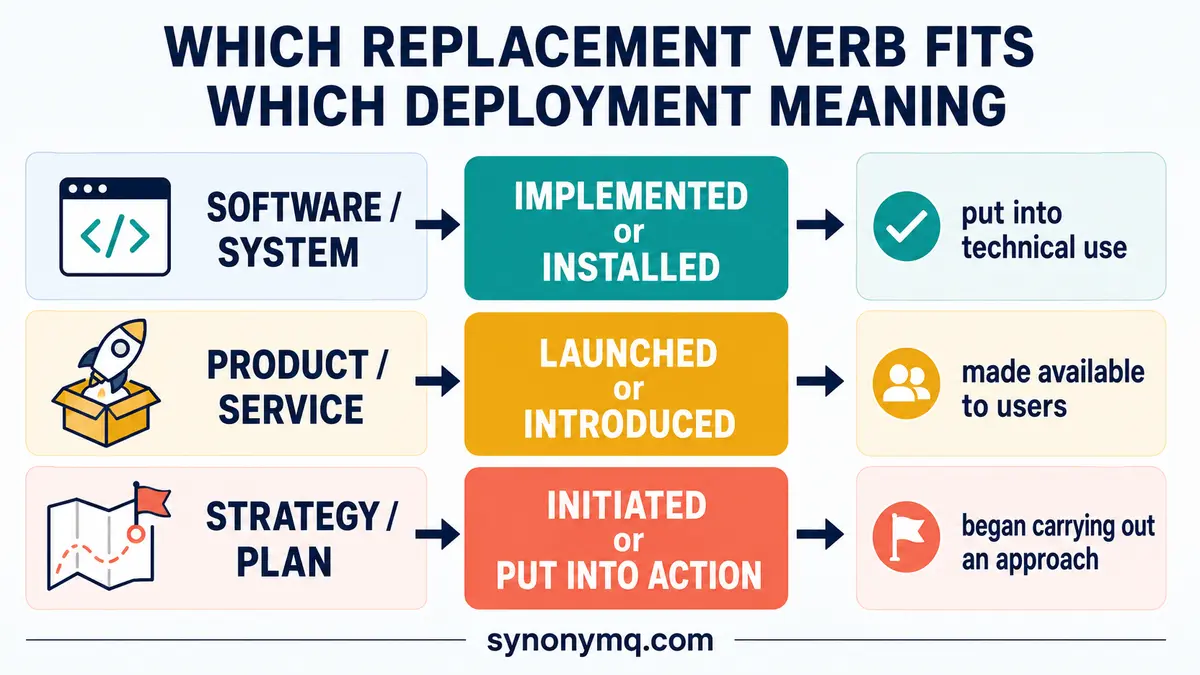
If You Mean You Moved People, Budget or Equipment
This is the sense Oxford Learner’s marks formal — “the act of using something effectively.” Merriam-Webster’s own example is telling: alongside “deployment of troops” it lists “deployment of a sales force.”
If you allocated staff, budget or equipment, deployed is defensible but heavy. Plainer verbs usually read better on a resume, and each claims something slightly different.
| Alternative | Merriam-Webster’s definition | What it claims |
|---|---|---|
| Allocated | “to apportion for a specific purpose or to particular persons or things: distribute” | You divided a fixed resource |
| Mobilized | “to bring (people) together for action”; “to marshal (something, such as resources) for action” | You got people moving toward something |
| Assigned | “to appoint to a post or duty”; “to appoint as a duty or task” | You directed specific people to specific work |
| Stationed | “to assign to or set in a station or position” | You placed people somewhere and they stayed |
Mobilized carries its own military weight. Merriam-Webster’s second sense is “to assemble and make (soldiers, an army, etc.) ready for war,” so it solves the register problem without solving the connotation problem. If the goal was to sound less martial, allocated or assigned does the job better.
For a line about budget or headcount, use allocated. Avoid mobilized because it re-introduces the military reading you were trying to remove.
Substitution Test: Which Words Drop Straight In
Synonymy does not guarantee substitutability. These are the alternatives that appear on this page, tested against the sentence “I deployed X.”
| Alternative | Relationship | Substitution | What changes |
|---|---|---|---|
| Released | Near-Synonym | Direct Swap | Shifts focus from the act to the audience receiving it |
| Rolled out | Near-Synonym | Direct Swap | Adds a sense of staging; wrong if it was a single push |
| Launched | Near-Synonym | Direct Swap | Claims novelty. Wrong for a routine update |
| Implemented | Near-Synonym | Direct Swap | Claims adoption, not just delivery. Stronger claim than deployed |
| Allocated | Near-Synonym | Swap With Adjustment | Needs a divisible resource. “Allocated the API” is wrong |
| Assigned | Near-Synonym | Swap With Adjustment | Takes a person as object, and usually a to phrase |
| Stationed | Contextual Alternative | Swap With Adjustment | People only, and implies staying put |
| Mobilized | Contextual Alternative | Swap With Adjustment | Needs a group or a resource, never a single system |
| Shipped | Contextual Alternative | Requires Rewrite | Informal register; recast the line for a formal resume |
| Positioned | Related Word | Requires Rewrite | Physical or strategic placement, not delivery |
One warning about thesaurus lists. Merriam-Webster’s thesaurus entry for deploy groups all twenty-five of its suggestions under a single sense, “to place in a particular position.” The list opens station, position, locate, install, plant, situate, park, emplace and runs on through camp, anchor, bivouac, lodge, burrow and dig in. Those are accurate for troops and equipment. Almost none of them belongs on a resume, and bivouac or emplace in a bullet point would read as a mistake. The list is not wrong. It is answering a different question than the one you are asking. This is the standard failure of resume verbs that arrive pre-worn: played a key role has the same problem from the opposite direction, saying so little that a recruiter skips it.
Phrases Where “Deployed” Is Locked
In these expressions the word is fixed. Substituting changes the meaning or produces something no reader recognises.
| Locked phrase | Do not substitute | Why |
|---|---|---|
| Deployed to [location] | ~~Launched to Kandahar~~ | The military posting sense; no replacement carries it |
| Deployment orders | ~~Rollout orders~~ | An institutional term with a specific referent |
| Rapid deployment force | ~~Rapid rollout force~~ | A fixed designation |
| Deploy a parachute | ~~Release a parachute~~ | Merriam-Webster gives the noun sense “an instance of use that involves something opening and spreading out” |
If your line contains one of these, leave it alone and edit around it.
Frequently Asked Questions
Is “deployed” a strong resume word?
It is a precise word, which is better than a strong one. Its weakness is ambiguity, not weakness. A reader has to work out whether you mean military service or a software release. Precision plus one clarifying detail beats swapping in a vaguer alternative. That is the opposite of the problem with I am humbled, which is unambiguous and still lands badly, because nothing in the sentence is doing the humbling.
Should veterans remove “deployed” from a resume?
Usually not. It names something real that some employers actively want. Add the scale, duration and outcome instead, so a civilian reader can size the responsibility without knowing military structure.
What is the difference between deployed and implemented?
Deployed is about putting something into position or into a live environment. Implemented, in Merriam-Webster’s definition, is “to take steps to put into practice: carry out, accomplish,” and it claims the thing was adopted and used. Implemented is the larger claim, so only use it if adoption actually happened.
How This Page Was Checked
Definitions and register labels on this page were retrieved on 30 August 2026 from Merriam-Webster, Oxford Learner’s Dictionaries, Dictionary.com and Wiktionary. Every string inside quotation marks is that source’s own wording, checked against its entry page a second time in a separate review pass. The “formal” label on the non-military sense of deployment is Oxford Learner’s alone; Merriam-Webster attaches no register label to its equivalent sense, and the article says so rather than smoothing the disagreement over. Recommendations that go beyond a printed label are SynonymQ editorial guidance and are marked as such in the text.
No frequency or corpus figures are claimed, because none were retrieved. Where the dictionaries checked disagree, that disagreement is stated rather than resolved: the computing sense of deploy is labelled in Wiktionary but folded into a broader sense in Merriam-Webster and Oxford Learner’s.
Every entry consulted, linked to the exact page rather than the dictionary’s home page:
| Word | Source |
|---|---|
| deployment (noun) | Merriam-Webster · Oxford Learner’s · Dictionary.com |
| deploy (verb) | Merriam-Webster · Wiktionary · Merriam-Webster thesaurus |
| implement | Merriam-Webster |
| launch | Merriam-Webster |
| mobilize | Merriam-Webster |
| allocate | Merriam-Webster |
| station | Merriam-Webster |
Collins and Oxford Learner’s entry for the verb deploy both returned a 403 on the retrieval date, so no claim on this page rests on either.
For the closest neighbour to this problem, see another word for remarkable on a resume. If you are checking a whole line rather than one word, the synonym tool is a faster first pass.

Naveed Akhtar writes every guide on SynonymQ. He is an SEO content writer with ten years of article-writing experience, working on the question a thesaurus never answers: which of these words belongs in this sentence, for this reader. Every page cites the dictionary entries it draws on and the date they were read.