Credible vs Creditable: 1 Common Word, 2 Formal Ones
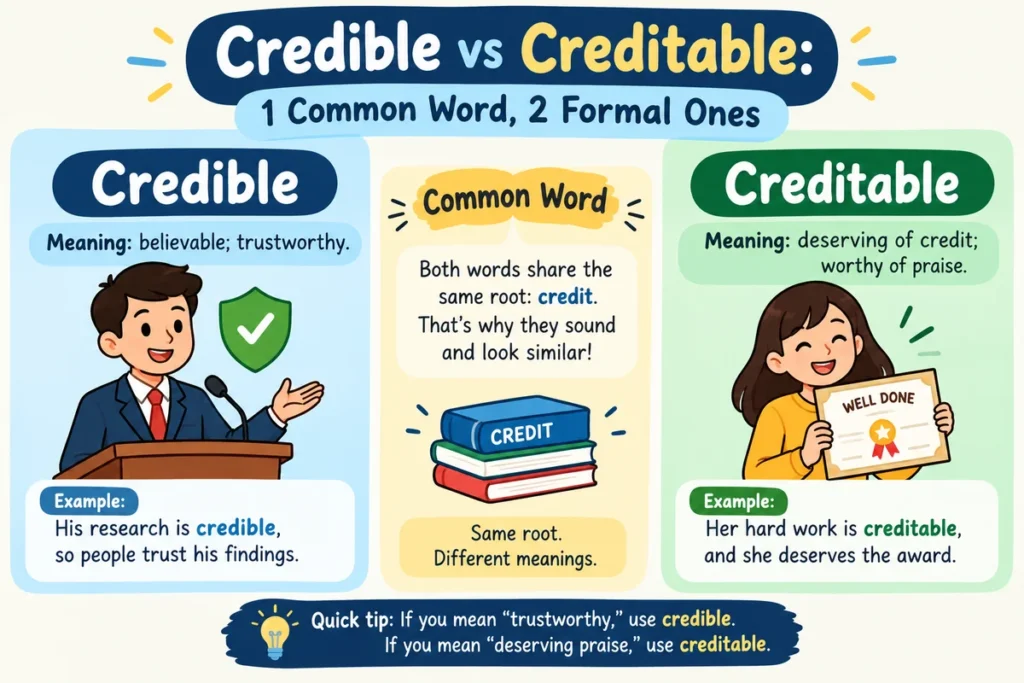
Credible vs creditable is not a close call. Credible means believable; creditable means deserving praise and is marked formal. Oxford lists credible among its core 5000 words and leaves creditable out, so most writers need only one of the two.
Which makes this less a choice between two words than a question about whether you need the second one at all.
Written by Naveed Akhtar, an SEO content writer with 10 years of article-writing experience. About 8 minutes to read.
Credible vs Creditable: One Is Core Vocabulary, One Is Not
Most pages on this pair give you two definitions and stop. The more useful fact is the one they leave out: these words are nowhere near equal in how often you will need them.
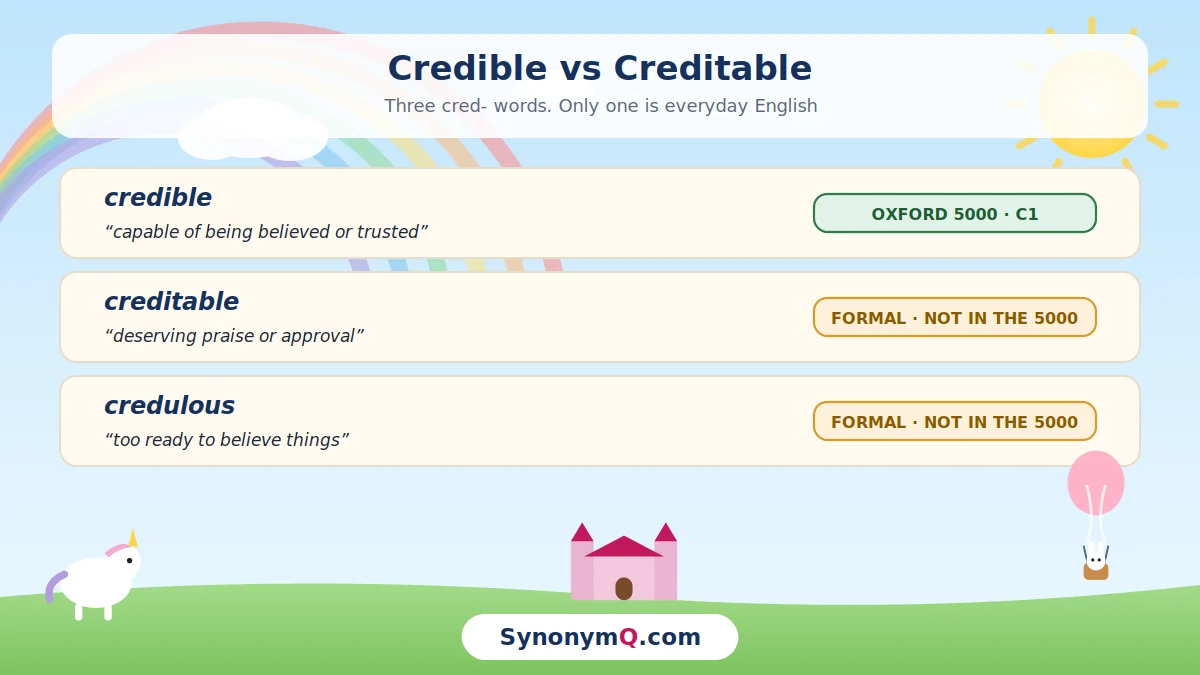
| Word | Definition | Register label | In the Oxford 5000? |
|---|---|---|---|
| credible | “capable of being believed or trusted” | none | Yes, at C1 |
| creditable | “of a quite good standard and deserving praise or approval” | formal | No |
| credulous | “too ready to believe things and therefore easy to trick” | formal | No |
One of the three is core vocabulary. The other two are formal words outside the top 5000. That single row of the table answers the practical question faster than any definition can.
What Each Word Actually Describes
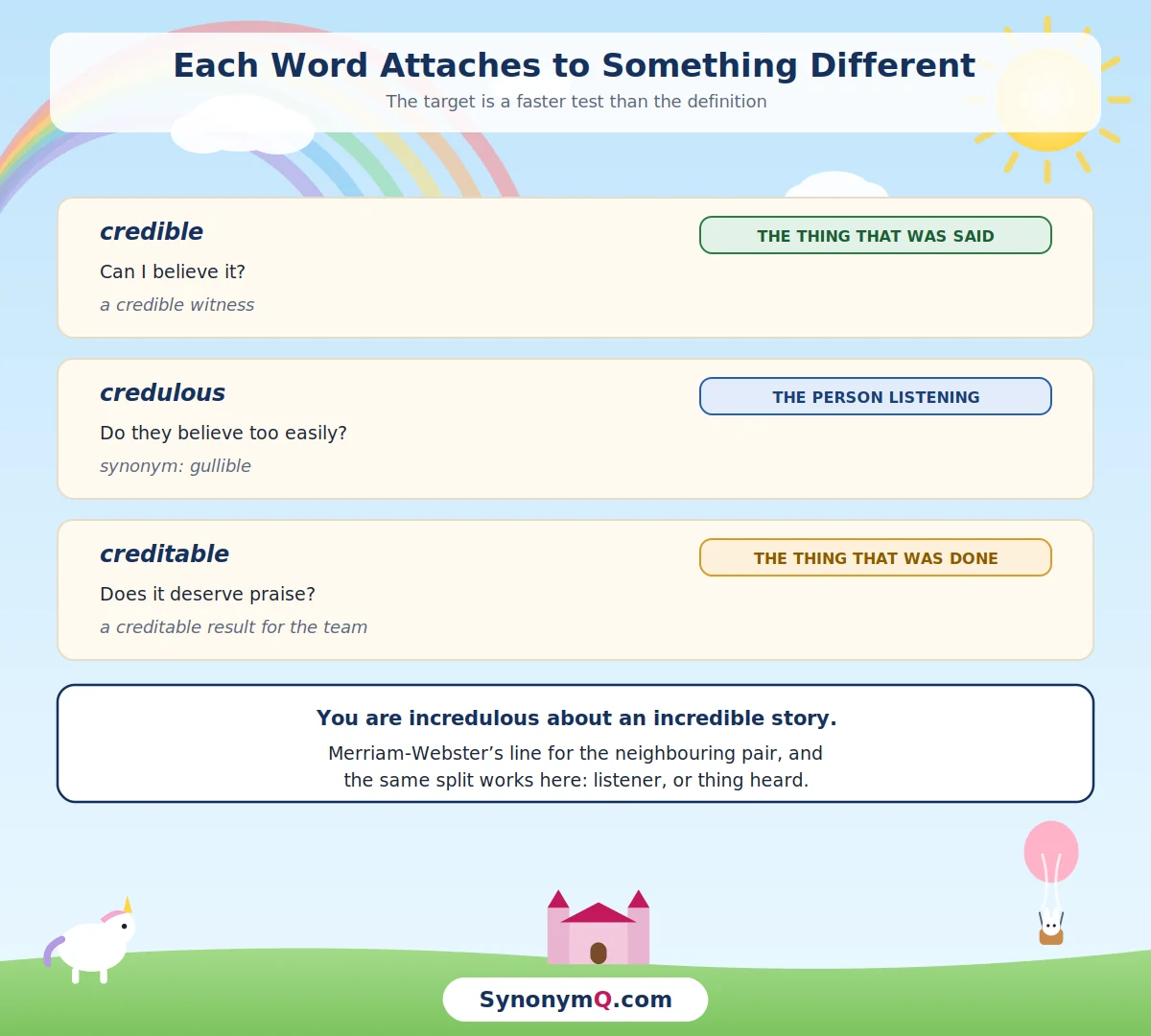
The definitions overlap enough to stay slippery. What separates them cleanly is not meaning but target: each word attaches to a different thing in the sentence.
| Word | Describes | The question it answers | Oxford’s example |
|---|---|---|---|
| credible | The thing that was said | Can I believe it? | a credible witness |
| credulous | The person listening | Do they believe too easily? | synonym: gullible |
| creditable | The thing that was done | Does it deserve praise? | a creditable result for the team |
Merriam-Webster makes the same move for the neighbouring pair, and the phrasing transfers directly: you are incredulous about an incredible story. One word is for the listener, the other for the thing heard.
Apply that split here and the sentences sort themselves. A report can be credible. A reader can be credulous. A performance can be creditable. Swap any of those and the sentence stops making sense rather than merely sounding wrong.
Where Creditable Actually Lives
Look at what Oxford chose to illustrate creditable with, because the pattern is unusually tight.
“It was a very creditable result for the team.” · “The Green Party won a creditable 16 per cent of the vote.” · “Although they struggled, they ended up coming a creditable second.” · “The chairman welcomed the company’s creditable performance in the previous year.”
A match result, an election result, a league position and a company’s annual figures. Every single example is a reported outcome that fell short of first place but still deserves respect.
That is the word’s natural home: results journalism, and British results journalism in particular. A creditable second is the idiom it was built for.
Which also explains the feeling most people have that they half know the word. You have read it. You have very likely never written it.
There is one loose end. Merriam-Webster does record a belief sense for creditable as its first entry, glossed “worthy of belief”, while Oxford records no such sense at all.
That disagreement is real, but it is not your problem. The sense is rare enough that using it invites the exact misreading you were trying to avoid, so credible vs creditable stays a clean split in practice.
For how two dictionaries can disagree like this without either being wrong, see prescriptive vs descriptive.
The Second Sense of Credible Nobody Mentions
Here is the genuine trap on this page, and it has nothing to do with creditable.
Credible has a second sense that both major dictionaries record, and it is not about belief. Oxford gives it as “able to be accepted because success seems feasible”, with the synonym viable. Merriam-Webster glosses it “good enough to be effective”.
| Sense | Meaning | Example |
|---|---|---|
| Believable | Can be accepted as true | a credible witness, a credible explanation |
| Viable | Strong enough to work | the only credible alternative to imprisonment, a credible deterrent |
So “a credible plan” does not mean a plan you believe. It means a plan that could actually succeed. In business and political writing that is almost always the sense intended, and readers take it that way without noticing the switch.
This matters because it is a live ambiguity, whereas credible versus creditable mostly is not. If a sentence could be read either way, replace the word with believable or workable and the ambiguity disappears.
So Do You Need Creditable at All?
For most writing, no. That is the honest answer, and it is worth more than another definition.
The test is whether you are reporting an outcome. If you are not, creditable is almost certainly the wrong reach, and a plainer word will read better.
| What you meant | Verdict | Use instead |
|---|---|---|
| Believable, trustworthy | Requires Rewrite | credible. This is the common error and the sentence is wrong, not just formal |
| A respectable result or performance | Direct Swap | creditable is correct here, and it is the one place it earns its keep |
| Praiseworthy, in ordinary prose | Swap With Adjustment | respectable, solid or commendable. Correct but formal, so drop the register |
| Morally good | Swap With Adjustment | admirable. Oxford records this sense, but it reads dated |
Row one is the row that matters. Writing a creditable source when you meant a credible one is not a register slip; it is a different claim. You have praised the source rather than believed it.
The same one-way pattern shows up whenever a rare word shadows a common one. It is the structure behind notable vs noteworthy and impressive vs impressed, where one form is doing nearly all the work in real sentences.
The Three-Way Test, in One Pass
Four questions, in order, and you will not need the definitions again.
- Is the thing you are describing a person? If it is a person who believes too easily, you want credulous. No other word on this page describes a person.
- Is it a result, score or performance? Then creditable is available and idiomatic. A creditable second.
- Is it something said, written or claimed? Then it is credible, and creditable would be an error rather than a formal alternative.
- Do you mean workable rather than believable? Credible still, but consider writing viable so nobody has to guess which sense you meant.
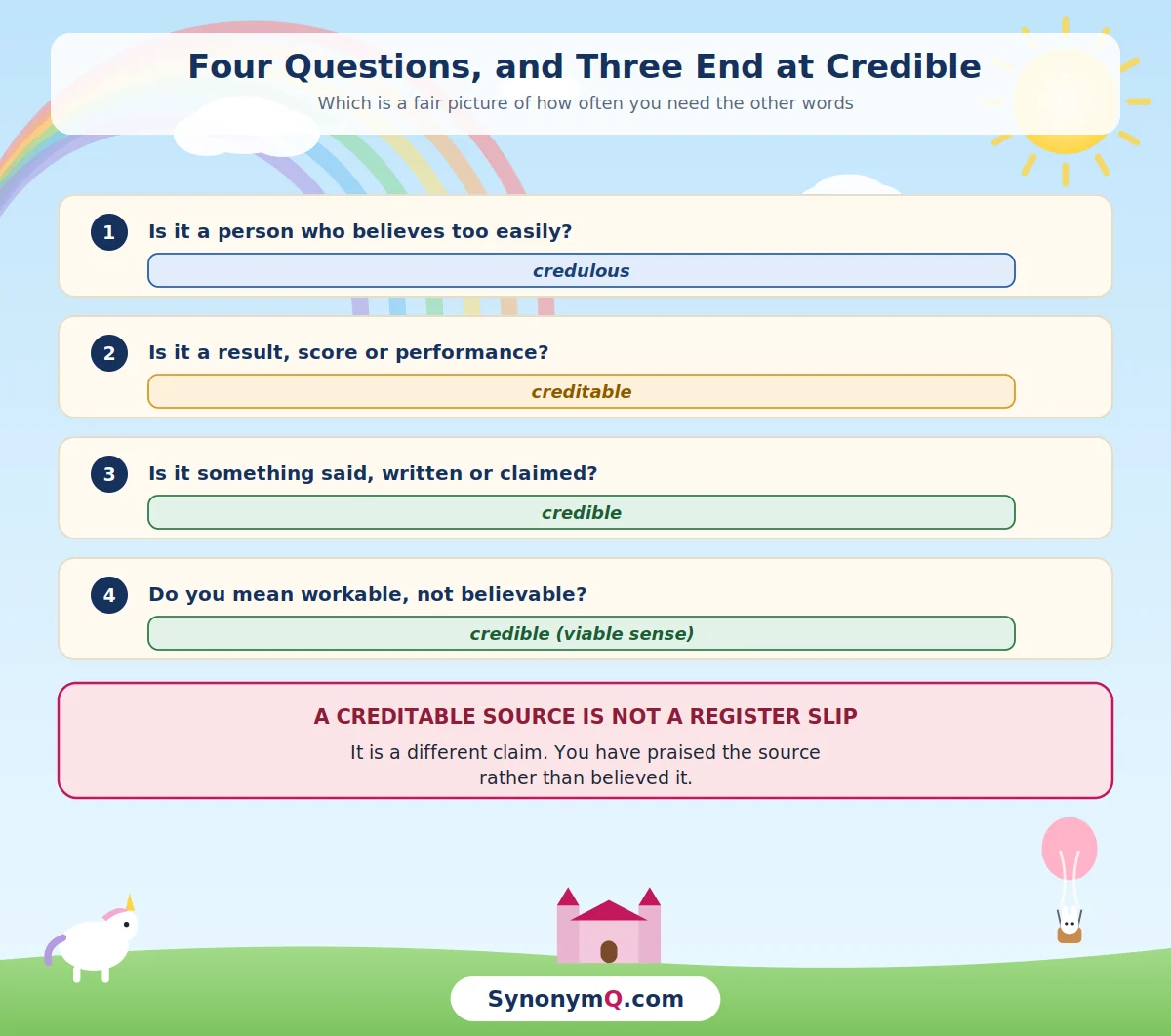
Notice that three of the four steps end at credible. That is not a flaw in the test but the distribution of the words themselves, and it is why credible vs creditable resolves the same way most of the time: write credible unless you are reporting a score.
If the two words still feel interchangeable, the useful comparison is not with each other but with a pair that genuinely splits down the middle, such as disinterested vs uninterested.
Frequently Asked Questions
What is the difference between credible and creditable?
Credible means believable and describes something said or claimed. Creditable means deserving praise and describes a result or performance. Oxford marks creditable formal and leaves it out of its core 5000 words.
What does creditable mean?
Oxford defines it as “of a quite good standard and deserving praise or approval”, with a second sense of “morally good”. Its examples are all reported outcomes: a team result, an election share, a company’s performance.
What is the difference between credible and credulous?
They describe different things. A story is credible if it can be believed; a person is credulous if they believe too readily. Merriam-Webster puts the parallel case plainly: you are incredulous about an incredible story.
Is incredible the opposite of credible?
Not in practice. Incredible now usually means excellent rather than unbelievable, so the pair has drifted apart. If you want the true opposite of credible, write implausible or not credible.
Which word is more common?
Credible, by a wide margin. It carries no register label and sits in the Oxford 5000 at C1, while creditable and credulous are both marked formal and fall outside that list.
How This Page Was Checked
Read from the sources attributed, on 29 September 2026:
- Oxford Learner’s Dictionaries, credible: both senses, the viable synonym, and the Oxford 5000 C1 classification.
- Oxford Learner’s Dictionaries, creditable: the formal label, both senses, and the four example sentences quoted in section three.
- Oxford Learner’s Dictionaries, credulous: the definition and the formal label.
- Merriam-Webster, creditable: the belief sense Oxford does not record, and the 1594 first use.
- Merriam-Webster, “Incredible vs Incredulous”: the listener-and-thing split quoted in section two.
Cambridge Dictionary returned an access error for creditable on the day this page was written, so no claim here rests on it.

Naveed Akhtar writes every guide on SynonymQ. He is an SEO content writer with ten years of article-writing experience, working on the question a thesaurus never answers: which of these words belongs in this sentence, for this reader. Every page cites the dictionary entries it draws on and the date they were read.