
40 Synonyms for Catalyst: Which One Should You Use?
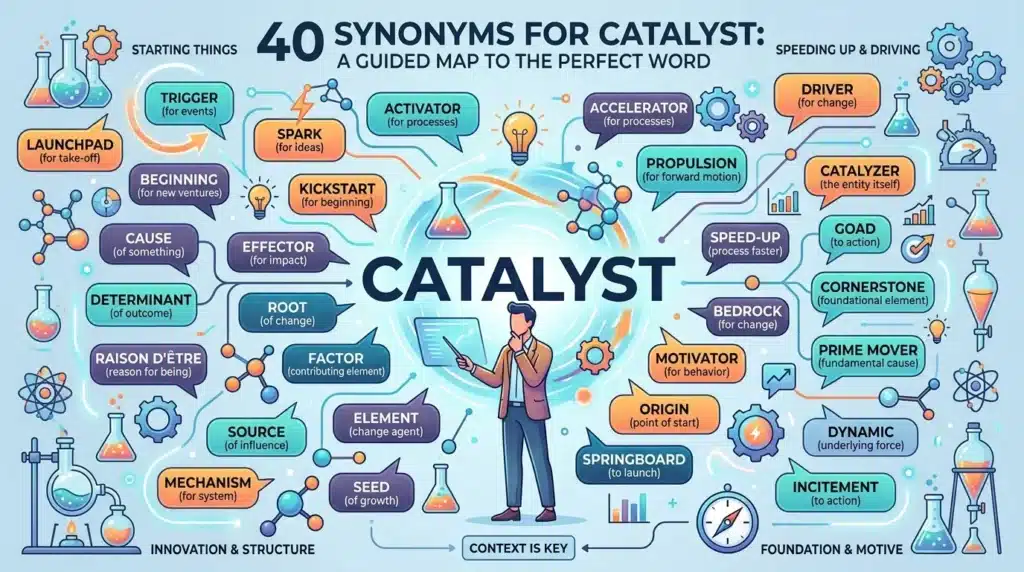
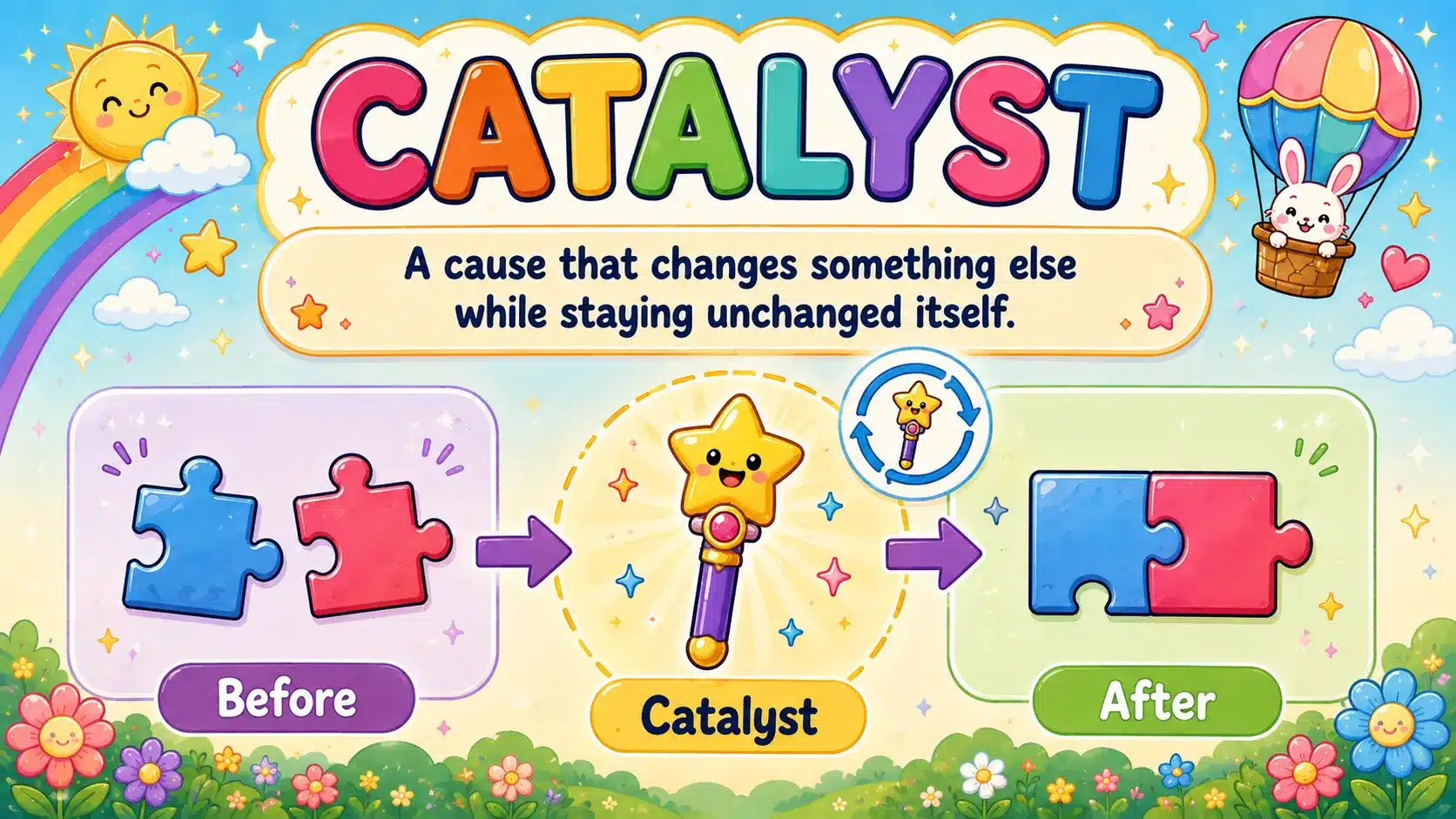
The best synonyms for catalyst are trigger, spark, impetus, stimulus, spur, driving force, turning point and agent of change. Catalyst means a person, thing or event that causes change without being changed itself. Pick the trigger words for beginnings, the driver words for momentum, and the person words for people.
Quick Reference: The 12 Strongest Synonyms for Catalyst
These twelve carry most of the work. The rest of this guide is about the gap between them.
| Synonym | Register | Intensity (1-5) | Best used for |
|---|---|---|---|
| Trigger | neutral | 4 | The single event that started it |
| Spark | neutral | 4 | A small cause with a large effect |
| Impetus | formal | 3 | Academic and policy writing |
| Stimulus | formal | 3 | Economics, science, research |
| Spur | neutral | 3 | Something that pushes action forward |
| Driving force | neutral | 4 | Sustained cause, not a one-off |
| Agent of change | neutral | 3 | A person or organization |
| Turning point | neutral | 4 | A moment after which nothing is the same |
| Tipping point | neutral | 4 | The moment a slow build goes fast |
| Instigator | neutral | 4 | The person who set it off, often critically |
| Springboard | neutral | 2 | Something you launch from |
| Shot in the arm | casual | 3 | Informal writing and speech |
Intensity is SynonymQ’s editorial judgment: 1 = mild, 5 = strongest. A guide, not a measurement.
What Catalyst Actually Means: Four Senses
Catalyst is a countable noun with one technical sense and three figurative ones. The synonym that fits depends entirely on which sense you are in.
| Sense | Plain meaning | Typical field |
|---|---|---|
| Chemical | A substance that speeds a reaction without being used up | Chemistry, biology |
| Event | The thing that set a change in motion | News, history, business |
| Person | Someone who makes change happen around them | Leadership, profiles |
| Story | The event that pushes the plot into motion | Fiction, screenwriting |
According to the Oxford Learner’s Dictionaries entry for catalyst, the two headline senses are the chemical one and “a person or thing that causes a change.”
Quick meaning selector
Use this before you pick a word. It saves the most common mistake on this page, which is borrowing a chemistry word for a human being.
- If you mean the thing that started it, go to trigger, spark, impetus
- If you mean the force that kept it going, go to driving force, engine, driver
- If you mean a person, go to agent of change, instigator, dynamo
- If you mean the decisive moment, go to turning point, tipping point, watershed
- If you mean an actual chemical, go to enzyme or biocatalyst, and read the false friends section first

All 40 Synonyms for Catalyst, Grouped by Meaning
English gives us about forty defensible alternatives for catalyst, not the several hundred a database will show you. The rest of this guide is about choosing between them well.
Words for the thing that starts a process
A trigger word names the beginning of a change rather than its momentum.
1. Trigger (neutral, noun) — the specific event that set something off — The leaked memo was the trigger for three weeks of protest.
2. Spark (neutral, noun) — a small cause with a disproportionately large effect — One rejected loan application was the spark for her whole business.
3. Impetus (formal, noun) — the force that gets a process moving or moving faster — The court ruling gave fresh impetus to the reform campaign.
4. Stimulus (formal, noun) — something applied deliberately to produce a response — Cheap credit acted as a stimulus for household spending.
5. Spur (neutral, noun) — something that prods a person or group into acting — Falling enrollment was the spur for the new scholarship program.
6. Impulse (formal, noun) — an initial push that starts movement — The exhibition gave a fresh impulse to public interest in the collection.
7. Incentive (neutral, noun) — a reward designed to cause a chosen behavior — The tax credit was the incentive that finally moved buyers.
8. Fillip (formal, noun) — a sudden small boost to something already underway — The royal visit gave the seaside town a welcome fillip.
9. Goad (formal, noun) — something irritating that provokes action — His dismissive review became the goad she needed to finish the book.
10. Precipitant (formal, noun) — the immediate cause that brings an event forward — The strike was the precipitant of the government’s collapse, not its underlying cause.
Words for the force that keeps change moving
A driver word names sustained pressure, not a one-off event.
11. Driver (neutral, noun) — an ongoing factor that produces an outcome — Remote work is the main driver of the office vacancy rate.
12. Driving force (neutral, noun) — the strongest sustained cause behind something — She was the driving force behind the merger for two years.
13. Engine (neutral, noun) — the part of a system that generates the movement — Exports remain the engine of the country’s recovery.
14. Prime mover (formal, noun) — the originating cause or the person most responsible — He was the prime mover in setting up the trust.
15. Springboard (neutral, noun) — something you push off from to reach the next stage — The internship was a springboard into publishing.
16. Launch pad (neutral, noun) — a starting position that makes the next step possible — The grant became a launch pad for the whole research group.
17. Wellspring (literary, noun) — a deep and continuing source — Her grandmother’s letters were the wellspring of the novel.
Words for a person who causes change
Person words carry judgment. Two of them are compliments, two are complaints, and the rest depend on your framing.
18. Agent of change (neutral, noun) — a person or body whose actions produce change — Teachers are the most underrated agents of change in any city.
19. Change agent (formal, noun) — the same idea in management and consulting language — Every department nominated one change agent for the rollout.
20. Instigator (neutral, noun) — the person who started it, often with a hint of blame — Police named him as the instigator of the sit-in.
21. Firebrand (literary, noun) — a passionate person who stirs others into action — The union sent a firebrand to speak, and the room turned.
22. Provocateur (formal, noun) — someone who deliberately causes reaction — The gallery hired a provocateur to program its opening season.
23. Spearhead (neutral, noun) — the person or group leading a push from the front — She was the spearhead of the campaign for paid leave.
24. Mover and shaker (casual, noun) — an influential person who makes things happen — The conference is full of movers and shakers from three industries.
25. Dynamo (casual, noun) — a person with relentless energy who drives progress — Our new coordinator is a dynamo, and the backlog is gone.
26. Spark plug (casual, noun) — the person who energizes a team, chiefly American — The point guard is the spark plug of that whole offense.
27. Ringleader (casual, noun) — the person who organized something, almost always critical — The school identified three ringleaders behind the walkout.
Words for the moment that turned things
These name a point in time rather than a cause, which makes them a swap only when your sentence is about timing.
28. Turning point (neutral, noun) — the moment after which the direction changed — Her illness was the turning point in how the family talked to each other.
29. Tipping point (neutral, noun) — the moment a slow build becomes rapid change — Ten percent adoption turned out to be the tipping point.
30. Watershed (formal, noun) — a dividing line between two eras — The ruling was a watershed for privacy law.
31. Flashpoint (neutral, noun) — the point at which tension becomes conflict — The eviction notice was the flashpoint for the whole dispute.
32. Inciting incident (formal, noun) — the story event that forces the plot to begin — The letter arriving on page four is the inciting incident.
Everyday and informal alternatives
Informal words are the right answer more often than writers expect, especially in email and social posts.
33. Shot in the arm (casual, noun) — a sudden encouraging boost — The grant was a real shot in the arm for the youth club.
34. Kickstart (casual, noun) — something that gets a stalled process going — The pilot scheme gave recruitment the kickstart it needed.
35. Jump start (casual, noun) — a quick external push to restart activity — A single viral post gave the shop a jump start.
36. Boost (neutral, noun) — an increase in strength, confidence or speed — Free shipping gave weekend orders a noticeable boost.
37. Nudge (casual, noun) — a gentle push toward a decision — A reminder email was all the nudge most donors needed.
38. Push (casual, noun) — pressure applied to make something happen — The deadline gave the team the push it needed.
Chemistry and biology terms
Strict chemistry has almost no true synonym for catalyst. These two are real; the words people usually reach for are in the false friends section below.
39. Enzyme (neutral, noun) — a protein that catalyzes a reaction in a living thing — Lactase is the enzyme that breaks down milk sugar.
40. Biocatalyst (formal, noun) — any biological molecule or cell used to catalyze a reaction — The plant uses an engineered biocatalyst instead of a metal one.
Save the ones you want with SynonymQ bookmarks, or search a different word in the SynonymQ synonym finder.

Register and Formality Table
Every synonym above sorts into exactly six registers. Match the register to the document, not to how impressive the word sounds.
| Register | Words in this group |
|---|---|
| Formal | impetus, stimulus, impulse, fillip, goad, precipitant, prime mover, change agent, provocateur, watershed, inciting incident, biocatalyst |
| Neutral | trigger, spark, spur, incentive, driver, driving force, engine, springboard, launch pad, agent of change, instigator, spearhead, turning point, tipping point, flashpoint, boost, enzyme |
| Casual | mover and shaker, dynamo, spark plug, ringleader, shot in the arm, kickstart, jump start, nudge, push |
| Slang | none in this set; catalyst has no established slang equivalent |
| Literary | firebrand, wellspring |
| Archaic | none in current use; catalyst itself is a modern coinage |
Register labels here are SynonymQ editorial guidance based on general modern usage, not corpus measurements. Where a published dictionary carries a label, this guide follows it.
Can You Swap It In? The Catalyst Substitution Test
Most thesaurus entries imply every listed word drops straight into your sentence. Most of them do not. Test sentence: The report was the catalyst for the policy change.
| Alternative | Substitution | What the swap does |
|---|---|---|
| trigger | Direct swap | Keeps the meaning, sharpens the timing |
| spark | Direct swap | Adds the idea of a small cause, big effect |
| impetus | Direct swap | Raises the formality, softens the suddenness |
| stimulus | Swap with adjustment | Prefers “stimulus to” or “stimulus for growth” |
| driving force | Swap with adjustment | Needs “behind,” not “for” |
| turning point | Swap with adjustment | Needs “in,” not “for,” and shifts to timing |
| agent of change | Requires rewrite | Applies to people and bodies, not documents |
| dynamo | Requires rewrite | People only; a report cannot be a dynamo |
| shot in the arm | Requires rewrite | Needs “gave the policy a shot in the arm” |
| enzyme | Never | Literal chemistry only |
Three patterns are worth memorizing. Catalyst takes for, driving force takes behind, and turning point takes in.
Which Word Should You Use?
Here is the short version, written as if you asked over someone’s shoulder.
- Writing a college essay or a research paper, use impetus or stimulus.
- Writing news or a case study, use trigger or turning point.
- Describing a person you admire, use driving force or agent of change.
- Describing a person you blame, use instigator or ringleader.
- Writing about a small cause with huge results, use spark.
- Writing about slow pressure that finally broke, use tipping point.
- Writing a friendly email or a social post, use shot in the arm or kickstart.
- Writing about a real chemical reaction, keep catalyst or name the enzyme.
Two rules cover the rest. If the cause happened once, choose a trigger word; if it kept applying pressure, choose a driver word.
Words That Are Not True Synonyms for Catalyst
These six show up in thesaurus lists and in student essays, and each one changes your meaning in a specific way.
Accelerant — In fire investigation an accelerant is a fuel that burns and is consumed. A catalyst is not consumed. Writing “the accelerant of reform” reads as arson to anyone with a forensics background.
Reagent — A reagent takes part in a reaction and is used up by it. That is the exact opposite of the defining property of a catalyst, so the two are not interchangeable in any chemistry sentence.
Promoter — In catalysis a promoter is an additive that makes a catalyst work better. It is a helper, not the catalyst itself, and swapping them will be marked wrong in a chemistry paper.
Harbinger — A harbinger announces that something is coming. It causes nothing. “The layoffs were a harbinger of recession” and “the layoffs were a catalyst for recession” are two different claims.
Linchpin — A linchpin is the part everything depends on. It holds a system together rather than starting a change, so a linchpin is about structure and a catalyst is about motion.
Trailblazer — A trailblazer goes first. Going first is not the same as causing others to move, and the two only overlap when the person did both.

Head-to-Head Comparisons
Catalyst vs Trigger
| Point | Catalyst | Trigger |
|---|---|---|
| Focus | The cause of change | The moment change began |
| Duration | Can keep acting | Instant and finished |
| Blame | Usually neutral | Often implies something bad |
Trigger is the sharper word for a single moment, and it carries a faint negative charge from its use in crisis reporting. Catalyst is the better word when the change is positive or when the cause kept working over time.
Catalyst vs Impetus
| Point | Catalyst | Impetus |
|---|---|---|
| Register | neutral | formal |
| Grammar | a catalyst for | impetus for, impetus to |
| Picture | Something that causes change | Force that speeds movement |
Impetus is the safer choice in academic and policy prose, where catalyst has become a slightly tired metaphor. Use catalyst when you want the reader to picture a cause that changed things without itself changing.
Catalyst vs Turning Point
| Point | Catalyst | Turning point |
|---|---|---|
| Names | A cause | A moment |
| Preposition | for | in |
| Answers | Why did it change? | When did it change? |
Swap these only if your sentence is really about timing. “The trial was the catalyst for reform” explains a cause; “the trial was the turning point in the reform effort” locates a date.
Catalyze vs Accelerate
| Point | Catalyze | Accelerate |
|---|---|---|
| Starts things | Yes | No |
| Speeds things | Yes | Yes |
| Needs a process already running | No | Yes |
You can catalyze something that had not started. You can only accelerate something already moving. If you need more speed words specifically, see the SynonymQ guide to synonyms for quickly.
Common Collocations With Catalyst
These are the pairings that sound native. Each one is written as a full sentence, because a collocation you cannot use in a sentence is not a collocation.
- act as a catalyst — The new funding acted as a catalyst for the whole department.
- serve as a catalyst — Her resignation served as a catalyst for a wider review.
- a catalyst for change — The union called the strike a catalyst for change.
- a catalyst for growth — Cheap broadband became a catalyst for growth in rural towns.
- prove to be a catalyst — The pilot proved to be a catalyst for the national rollout.
- become a catalyst — A single blog post became a catalyst for the recall.
- provide the catalyst — The anniversary provided the catalyst the museum needed.
- the catalyst behind — She was the catalyst behind the merger.
- a catalytic role — The mediator played a catalytic role in the settlement.
- catalytic converter — The thieves targeted the catalytic converter under the car.
Locked expressions: do not substitute
Replacing the headword inside these breaks the phrase.
| Locked expression | What happens if you swap |
|---|---|
| catalytic converter | Becomes meaningless; it is a fixed part name |
| act as a catalyst | “Act as a trigger” is fine, but “act as a spark plug” is not |
| catalyst for change | “Trigger for change” works; “enzyme for change” does not |
One grammar note that catches people out. You play a catalytic role, and you act as a catalyst, but you do not “play a catalyst.” If you want more verbs in that pattern, see synonyms for play.
Catalyze, Catalytic, Catalysis: The Word Family
Catalyst is the noun. The rest of the family is where most errors happen, because two forms are spelled differently on each side of the Atlantic.
| Form | Part of speech | Example |
|---|---|---|
| catalyst | noun | The vote was the catalyst. |
| catalysis | noun (process) | The process depends on acid catalysis. |
| catalyze / catalyse | verb | The grant catalyzed three new projects. |
| catalytic | adjective | The mediator had a catalytic effect. |
The Oxford Learner’s Dictionaries entry for catalyse labels catalyse as British English and catalyze as North American English. British academic publishers that follow Oxford spelling also print catalyze, so check your style guide rather than assuming.
Verb alternatives for catalyze
| Verb | Register | Best used for |
|---|---|---|
| trigger | neutral | A single starting event |
| spark | neutral | Small cause, large result |
| set off | casual | Everyday speech and email |
| kick-start | casual | Restarting something stalled |
| galvanize | formal | Shocking a group into action |
| precipitate | formal | Bringing a bad event forward |
| prompt | neutral | A mild, polite cause |
| instigate | formal | Deliberate starting, often negative |
| foment | formal | Stirring up unrest, always negative |
| hasten | formal | Making an expected event arrive sooner |
Grammar and ESL notes
Catalyst is countable, so it needs an article: a catalyst, the catalyst, two catalysts. Never write “she was catalyst for the change.”
The default preposition is for. “A catalyst for reform” is the standard pattern; “a catalyst of reform” appears in older and more formal writing but sounds heavier to most readers today.
There is no verb “to catalyst” and no adjective “catalystic.” The verb is catalyze or catalyse, and the adjective is catalytic.
How to Pronounce Catalyst and Its Trickier Alternatives
Catalyst itself is regular once you know the stress falls on the first syllable. Three of its alternatives are not.
| Word | IPA (BrE / NAmE) | Say it |
|---|---|---|
| catalyst | /ˈkætəlɪst/ · /ˈkætəlɪst/ | KAT-uh-list |
| catalyse / catalyze | /ˈkætəlaɪz/ · /ˈkætəlaɪz/ | KAT-uh-lyze |
| impetus | /ˈɪmpɪtəs/ · /ˈɪmpɪtəs/ | IM-pi-tuhs |
| fillip | /ˈfɪlɪp/ · /ˈfɪlɪp/ | FIL-ip |
| harbinger | /ˈhɑːbɪndʒə(r)/ · /ˈhɑːrbɪndʒər/ | HAR-bin-jer |
| linchpin | /ˈlɪntʃpɪn/ · /ˈlɪntʃpɪn/ | LINCH-pin |
Transcriptions are taken from the Oxford Learner’s Dictionaries entries for each word. Note that impetus is stressed on the first syllable, not the second.
One more pair worth separating. The verb precipitate ends /-eɪt/, as in /prɪˈsɪpɪteɪt/, while the adjective ends /-ət/, as in /prɪˈsɪpɪtət/.
Etymology and Origin of Catalyst
Catalyst is a young word built on an old one. Etymonline’s entry for catalyst dates the noun to 1900, formed in English from catalysis by analogy with analyst.
Catalysis is much older, dating to the 1650s, from the Latinized Greek katalysis, “dissolution, a dissolving,” from katalyein, “to dissolve.” That breaks down further into kata, “down” or “completely,” and lyein, “to loosen.”
The chemical sense arrived through the Swedish chemist Jöns Jakob Berzelius, who in 1836 applied catalysis to “change caused by an agent which itself remains unchanged.” The figurative sense of catalyst, the one this guide is mostly about, is dated to 1943.
That history explains the one thing writers most often get wrong. The defining feature is not speed but survival: a catalyst causes change and comes out unchanged.

Catalyst Synonyms by Writing Situation
Academic writing and essays
Use impetus, stimulus, impulse, precipitant, driver and watershed. Catalyst is acceptable in a humanities essay but flagged as a cliché by many style guides, so vary it.
Keep the metaphor consistent: if you call something a catalyst, do not also say it was “consumed” by the process. Check your draft length with the SynonymQ word counter before you submit.
Résumés, cover letters and professional email
Use driving force, agent of change, spearhead, prime mover and boost. Avoid instigator and ringleader, which read as blame even when you mean initiative.
“Served as the catalyst for a 30 percent reduction in onboarding time” works well because it is specific. For phrasing your track record, see synonyms for experience and synonyms for benefits.
Creative writing and fiction
Use spark, flashpoint, firebrand, wellspring, goad and inciting incident. Screenwriters use inciting incident as a technical term, so it signals craft knowledge in a workshop.
Catalyst itself is a scientific metaphor, which can feel cold inside close third-person narration. A spark or a goad usually sits better in a character’s own thoughts.
Everyday conversation and social media
Use kickstart, jump start, shot in the arm, nudge, push and spark plug. These sound like speech, which is exactly what a caption needs.
Reach for the register your reader uses, not the one that sounds most educated. When you need the next word fast, the SynonymQ synonym finder will give you the whole set in one search.
Before and After: Better Word Choices
Before: The new manager was a catalyst and improved everything about the team. After: The new manager was the driving force behind a 40 percent drop in ticket backlog. Why: Driving force fits a person who kept applying pressure, and the specific number does the work the vague verb was doing.
Before: Social media was the accelerant of the movement. After: Social media was the catalyst for the movement. Why: An accelerant is consumed as it burns. Social media was not consumed, so the original picture contradicts itself.
Before: Her promotion was a catalyst in her career. After: Her promotion was the turning point in her career. Why: The sentence is about timing, and catalyst takes for, not in. Turning point takes in and names the moment.
Before: The pilot program acted as a catalyst that catalyzed further catalytic change. After: The pilot program acted as a catalyst, and three departments copied it within a year. Why: Repeating the word family three times reads as padding. Say what actually changed instead.
When the original word is better
Sometimes catalyst is already the right choice, and swapping it makes the sentence worse. Keep it when the cause genuinely stayed unchanged, when your reader knows the science, or when the alternative is rarer than the word it replaces.
Fillip, precipitant and wellspring are all correct English and all uncommon. Dropping one into an ordinary business email will read as showing off rather than as precision. The same trap applies to any word list, which is why synonyms for fancy opens with the same warning.
Antonyms of Catalyst
An antonym for catalyst is anything that slows, blocks or prevents change. There is no single perfect opposite, so pick by field.
| Antonym | Field | Meaning |
|---|---|---|
| inhibitor | chemistry | A substance that slows a reaction |
| catalyst poison | chemistry | A substance that deactivates a catalyst |
| retardant | chemistry, materials | Something that slows a process |
| deterrent | general | Something that discourages action |
| damper | general | Something that reduces enthusiasm |
| brake | general | Something that slows momentum |
| obstacle | general | Something blocking progress |
| impediment | formal | A hindrance to movement or action |
| hindrance | formal | Something that gets in the way |
| bottleneck | business | The point where progress narrows |
| roadblock | business | Something that stops progress dead |
| disincentive | policy | A reason not to act |
| stabilizer | technical | Something that resists change |
| drag | general | A steady force against forward motion |
Words like stabilizer and retardant are near-opposites in a useful sense: they preserve a state rather than causing one. If your sentence is about keeping something safe rather than keeping it still, synonyms for protect is the closer list.
Search the full set in the SynonymQ antonym finder, or read Antonyms 101: How Opposite Words Sharpen Your Meaning for how to use opposites deliberately.

Catalyst in Spanish, French and Italian
The three Romance equivalents are close cognates, and all three carry the same chemical-plus-figurative split as English.
| Language | Word | Register | Notes |
|---|---|---|---|
| Spanish | catalizador | neutral | Masculine; feminine form catalizadora used for people |
| French | catalyseur | neutral | Masculine; catalyseur de takes the place of English “catalyst for” |
| Italian | catalizzatore | neutral | Masculine; catalizzatrice used for a female person |
Spanish: La reforma fue el catalizador del cambio.
French: Ce rapport a été le catalyseur du changement.
Italian: Quella decisione è stata il catalizzatore del cambiamento.
All three take a genitive linker rather than a direct translation of “for,” which is the single most common mistake English speakers make with these words.
How to Avoid Repeating Catalyst
Repetition is the reason most people arrive on a page like this. Here is a method that takes about four minutes on a finished draft.
- Search your draft for catalyst, catalyze and catalytic and count the hits.
- Keep the strongest one, usually the first or the one in your thesis sentence.
- For each remaining hit, decide whether the sentence is about a cause, a person, or a moment.
- Replace causes with trigger, impetus or driver; people with driving force or agent of change; moments with turning point.
- Read the paragraph aloud. If the replacement makes you pause, put the original back.
Step five matters more than the other four. For longer rewrites, the SynonymQ paraphrasing tool will restructure whole sentences, and How to Paraphrase Without Plagiarizing covers where the line sits.
If the person you are writing about deserves credit rather than analysis, the warmer vocabulary in synonyms for honor usually lands better than catalyst, which can sound clinical about a human being.

Frequently Asked Questions
What is a catalyst in easy words?
A catalyst is something that makes a change happen faster without being changed itself. In chemistry it is a substance that speeds up a reaction and comes out the same as it went in. In everyday English it is any person, event or thing that sets a change in motion.
What is the definition of the word catalyst?
Catalyst is a countable noun with two main definitions: a substance that increases the rate of a chemical reaction without being consumed, and a person or thing that causes change. Both senses share one idea, which is causing change while remaining unchanged.
What is a good synonym for catalyst?
Trigger is the best all-purpose synonym for catalyst, because it fits both a single event and a wide range of registers. For formal writing choose impetus or stimulus; for a person choose driving force or agent of change; for a decisive moment choose turning point.
What are 15 synonyms for catalyst?
Fifteen strong synonyms for catalyst are trigger, spark, impetus, stimulus, spur, impulse, incentive, driver, driving force, engine, prime mover, agent of change, instigator, turning point and tipping point. The full grouped set of forty is above, sorted by which sense you need.
What is an analogy or metaphor for a catalyst?
The match and the bonfire is the standard analogy: the match starts a fire far larger than itself and is not consumed by it. Other common metaphors are the pebble that starts an avalanche, the yeast in bread, and the person who opens a jammed door for everyone behind them.
What are 5 examples of catalysts?
Five well-known catalysts are enzymes in the human body, the platinum in a car’s catalytic converter, iron in ammonia production, chlorophyll’s role in photosynthesis, and acids used to speed up reactions in a laboratory. In figurative use, examples are usually events such as a court ruling or a resignation.
What does catalyze mean?
Catalyze means to cause or speed up a change, either chemically or figuratively. In chemistry it means to increase the rate of a reaction without being consumed; in general writing it means to set something in motion, as in “the report catalyzed a national debate.”
What is another word for catalytic?
Catalytic has no exact one-word synonym, but accelerating, activating, enabling and transformative cover most figurative uses. In technical writing, keep catalytic, because it names a specific mechanism that the general alternatives do not.
Is it catalyze or catalyse?
Both are correct. Oxford Learner’s Dictionaries labels catalyse as British English and catalyze as North American English, and many British academic publishers use the -ize form as house style. Pick one and use it consistently across the document.
Can a person be a catalyst?
Yes. Describing a person as a catalyst is standard English and usually a compliment, meaning they cause change around them. If you want to be warmer, driving force reads better; if you want to assign blame, instigator is the accurate word. The vocabulary in synonyms for empowered works well alongside it in leadership writing.
What is the opposite of a catalyst in chemistry?
An inhibitor is the direct chemical opposite, because it slows a reaction rather than speeding it. A catalyst poison is the stronger case: it deactivates a catalyst entirely. In everyday writing, deterrent, damper and obstacle are the usual opposites.
Pick the Word, Then Check the Sentence
Choosing among the synonyms for catalyst comes down to three questions: was the cause a single event or a sustained force, was it a person or a thing, and is your reader expecting chemistry or metaphor. Answer those and the list above narrows to two or three words.
Then read the sentence aloud with your replacement in it. If the preposition changed or the rhythm broke, you needed a rewrite rather than a swap. Try the next candidate in the SynonymQ synonym finder and keep going until one sounds like something you would actually say.

About the Author
Written by Naveed Akhtar, founder of SynonymQ, who writes about vocabulary and clear writing.
Published: 24 August 2026. Last updated: 24 August 2026.
Sources consulted: Oxford Learner’s Dictionaries entries for catalyst, catalyse, impetus, fillip, harbinger, linchpin and precipitate, for definitions, register labels and pronunciation; Etymonline’s entries for catalyst and catalysis, for word history.
Further reading: Merriam-Webster and the Cambridge Dictionary both carry full entries for catalyst if you want a second definition to compare.

Naveed Akhtar writes every guide on SynonymQ. He is an SEO content writer with ten years of article-writing experience, working on the question a thesaurus never answers: which of these words belongs in this sentence, for this reader. Every page cites the dictionary entries it draws on and the date they were read.