
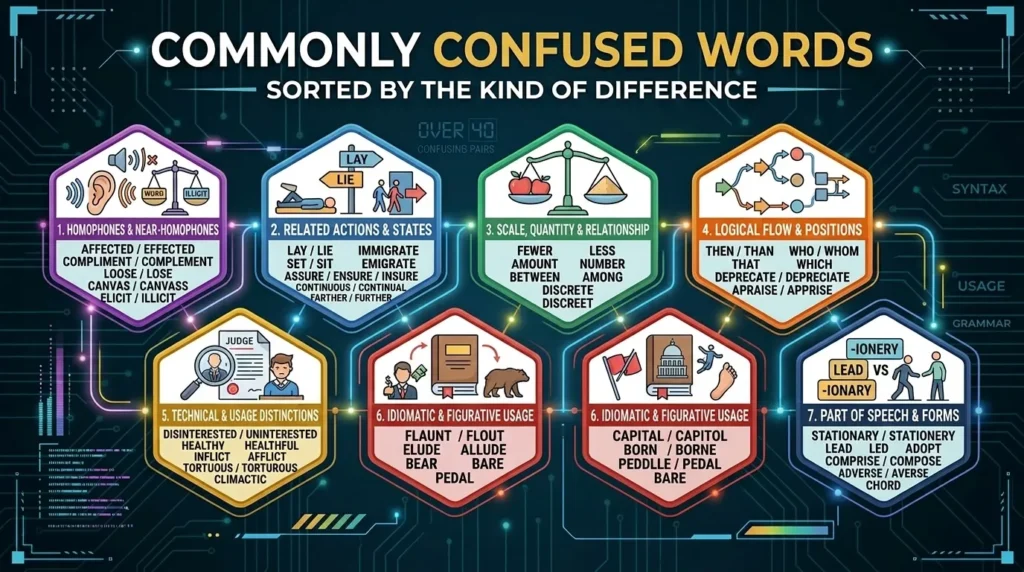
Commonly Confused Words: Sorted by the Kind of Difference
Lists of commonly confused words are almost always alphabetical, which tells you nothing about how to settle the pair in front of you. Sorting by the kind of difference is more useful, because each kind has its own test. There are four.
By Naveed Akhtar, an SEO content writer with 10 years of article-writing experience · Updated 18 September 2026 · About 7 minutes
Everyone Else Sorts Them Alphabetically
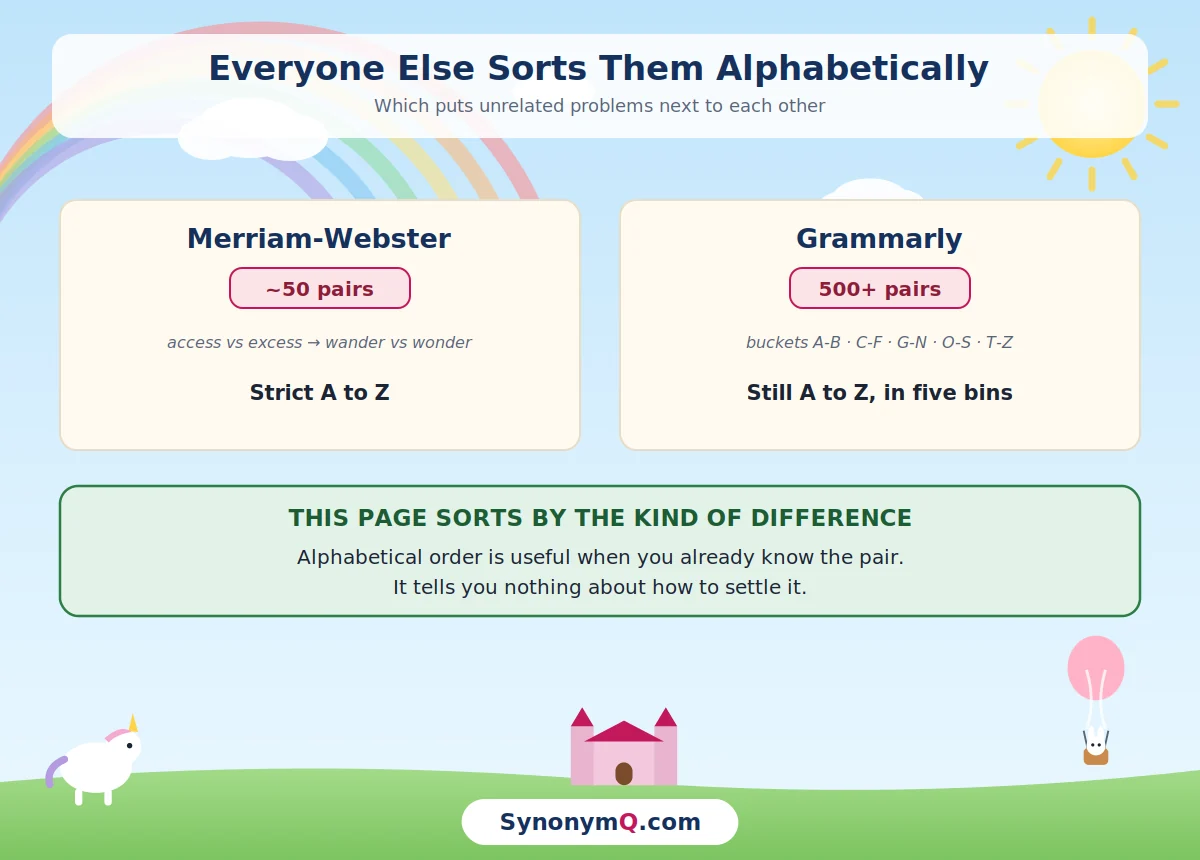
Merriam-Webster’s list runs about fifty pairs, from access vs excess through to wander vs wonder, in strict alphabetical order.
Grammarly’s is far larger, well over five hundred pairs, and it is also alphabetical. The letters are split into five buckets, A–B through T–Z, which is alphabetical order with signposts.
Both are good at what they do. If you already know your pair is affect vs effect, alphabetical order takes you straight to it, and that is the whole job.
The problem is what happens when you do not know the pair. Alphabetical order puts affect vs effect next to allusion vs illusion, and those two are confusing for completely unrelated reasons. One is a part-of-speech problem. The other is a sound-alike problem.Sorting by the reason instead means that once you have found your group, you already know which question to ask about your own sentence.
Commonly Confused Words Fall Into Four Groups
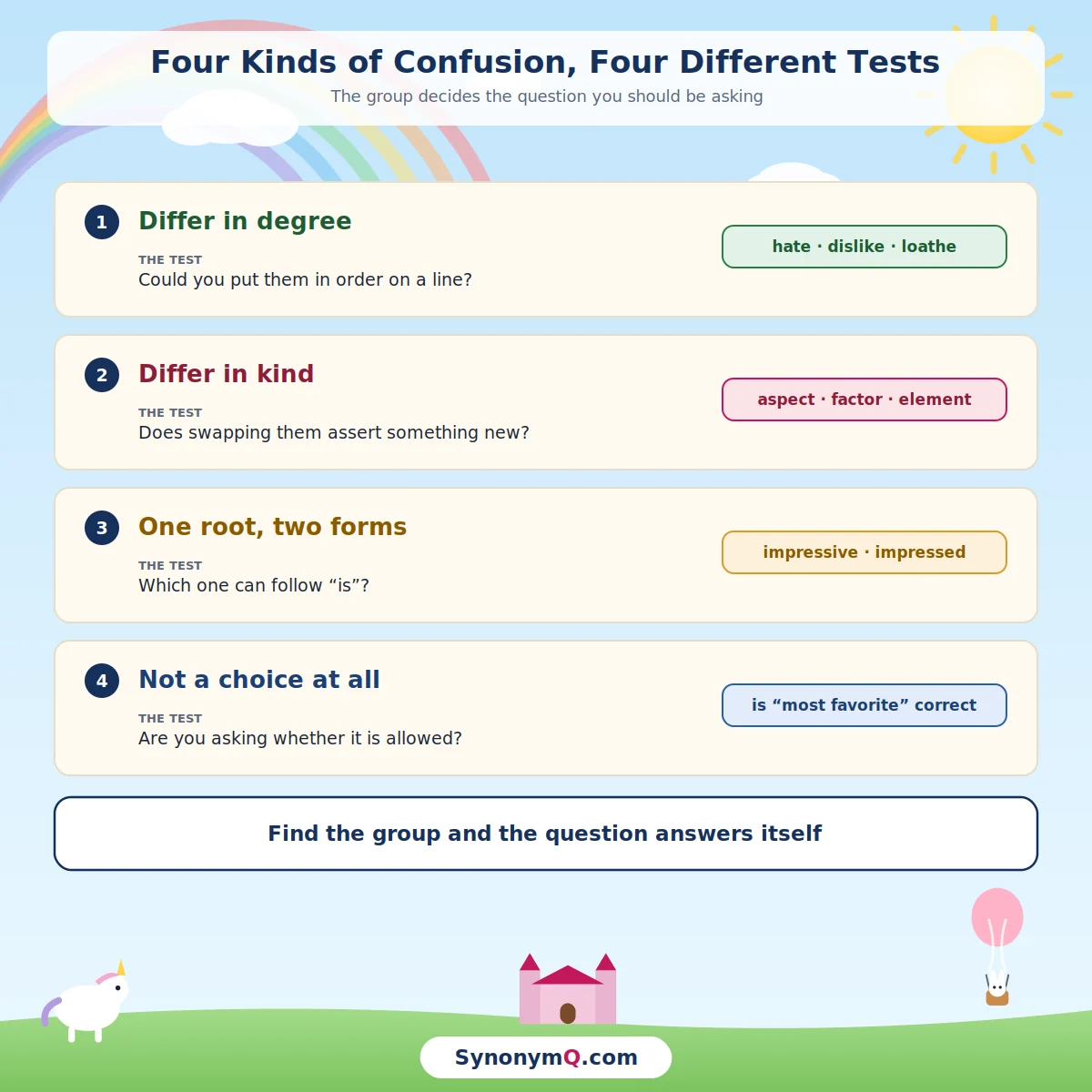
Every confusable pair on this site falls into one of four groups, and the group decides the test.
| Group | The test | What goes wrong if you pick badly |
|---|---|---|
| 1. Differ in degree | Could you put them in order on a line? | You overstate or understate |
| 2. Differ in kind | Does swapping them assert something new? | You say something untrue |
| 3. One root, two forms | Which one can follow is? | The sentence reads as an error |
| 4. Not a choice at all | Are you asking whether it is allowed? | You look for a synonym that does not exist |
Groups one and two are the pair most people merge, and the difference between them matters more than any individual word choice.
Group One: They Differ in Degree
Same territory, different intensity. These words sit on a line, and the only question is where your case belongs on it.
| The set | What the scale measures |
|---|---|
| hate vs dislike vs loathe | How strong the aversion is, and how much of it you are admitting to |
| grief vs sorrow vs sadness | Depth of feeling, and how formal the word is |
The giveaway is that you can argue about the order without anyone thinking you have misunderstood the words. Reasonable people disagree about whether loathe outranks hate, and that disagreement is about calibration.
The risk in this group is quiet. Picking too strong a word does not produce an error a reader can point at. It produces a sentence that sounds slightly hysterical, and the reader adjusts their view of you rather than of the subject.The fix is always the same: decide how strong your case actually is, then pick the word at that point on the scale. Never pick the strongest word available because it sounds more committed.
Group Two: They Differ in Kind
These are not stronger and weaker versions of one another. They make different claims, so choosing wrong does not overstate. It says something that is not true.
| The set | What separates them |
|---|---|
| aspect vs factor vs element | One claims a cause, one claims a part, one claims nothing at all |
| given vs provided | What each one attaches to, and what it commits the sentence to |
| appreciation vs gratitude | Whether you are valuing something or owing someone |
The test is a swap. Put the other word in and ask whether the sentence now claims something you would have to defend if challenged.
Claims a causeThree factors behind the delay. Claims the parts it is made ofThree elements of the delay.Those two sentences are not more and less emphatic. One says these things produced the delay; the other says they compose it. Only one of them can be right about a given delay.
This is the group where a thesaurus actively misleads. It lists all three words together because they occupy the same subject area, and a subject area is not a meaning.Group Three: One Root, Two Forms
Both words come from the same source and the ending does the work. A spell-checker never catches these, because both spellings are real words in good standing.
| The set | What the ending changes |
|---|---|
| impressive vs impressed | Whether you are describing the thing or describing yourself |
| systemic vs systematic | Whether you mean a method or an extent, and why the usual rule still leaves you hesitating |
Because the words share a root, meaning-based reasoning tends to go in circles. The grammar is what separates them, and grammar gives a yes-or-no answer.
Ask which form can follow is, which one takes an object, which one has a working adverb. One of those questions almost always settles it in a few seconds.
A warning about the rules of thumb. Most pairs in this group come with a memorable rule, and the rules are usually correct and usually insufficient. They tell you the common case and go quiet on the one you are actually stuck on.Group Four: When the Question Is Not Which Word
Sometimes the reader is not choosing between two options. They have written something and want to know whether it is acceptable, or whether a word carries a tone they did not intend.
| The page | The actual question |
|---|---|
| is “I’m humbled” correct | Whether a common phrase says what the speaker means |
| is “most favorite” correct | Whether a redundancy is an error or an accepted idiom |
| actually vs really | Two adverbs that differ in tone rather than in meaning |
A thesaurus cannot help here, because there is no substitution to make. The answer is either a usage note or a register label, and both live in dictionaries rather than in synonym lists.
Working Out Which Group You Are In
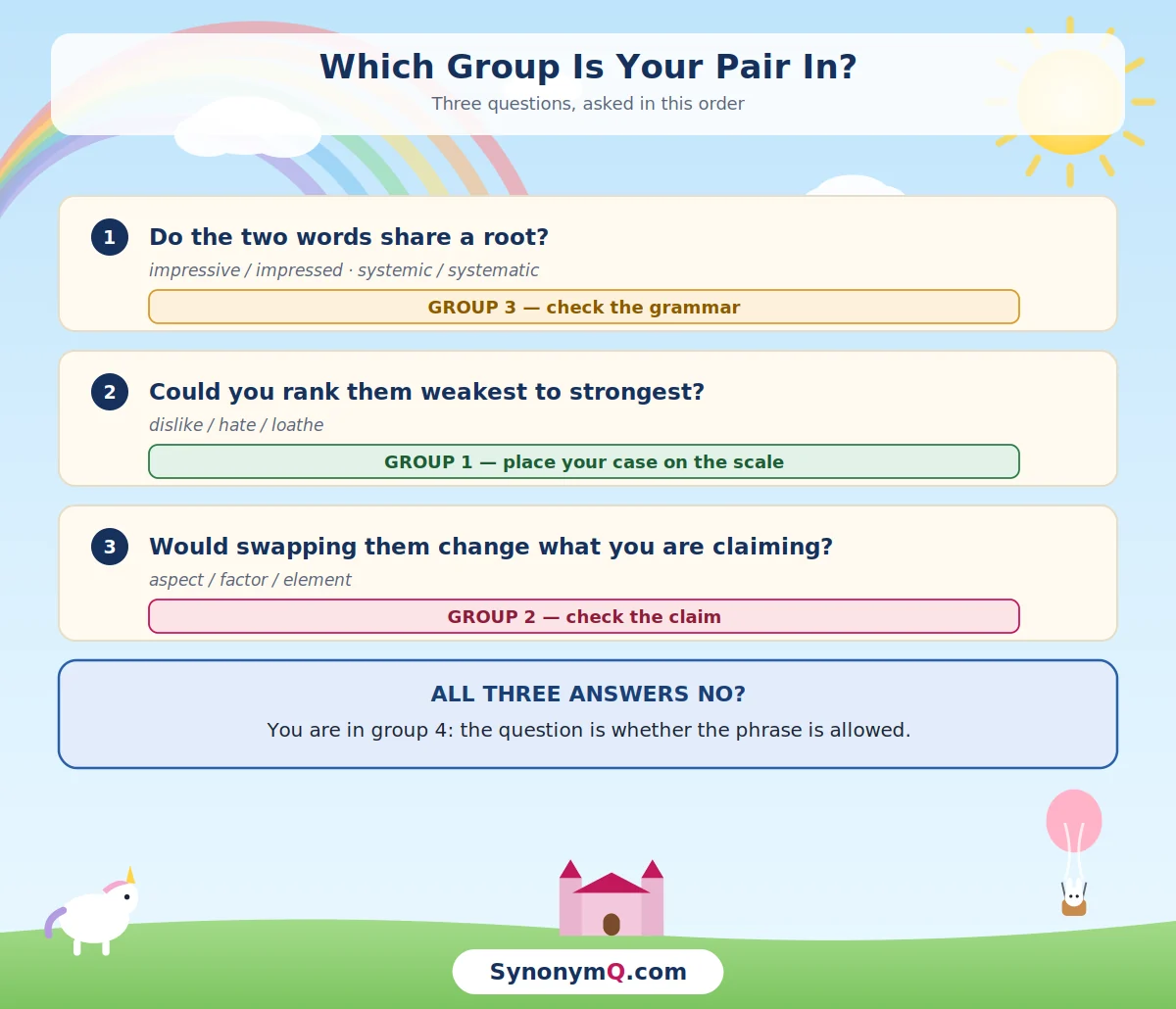
Three questions, and the order matters because the first one is the cheapest to answer.
| Ask | If yes | Then |
|---|---|---|
| 1. Do the two words share a root? | Group 3 | Check the grammar, not the meaning |
| 2. Could you rank them weakest to strongest? | Group 1 | Place your case on the scale |
| 3. Would swapping them change what you are claiming? | Group 2 | Check which claim is true |
| All three no | Group 4 | You are asking whether a phrase is allowed |
Question one first because it is visible. Impressive and impressed share a root on sight, and that alone routes you to a grammar test before you have thought about meaning at all.
Why the Group Matters More Than the Pair
Learning that affect is usually the verb helps with one pair. Learning that shared-root pairs are settled by grammar helps with every pair you meet afterwards.
That is the case for grouping. A list of five hundred pairs is a reference you consult. Four tests are something you can carry.
And it tells you when to stop looking. If your pair is in group four, no amount of searching for a synonym will help, because the question was never which word to use.Frequently Asked Questions
What are commonly confused words?
Word pairs and trios that writers mix up, either because they sound alike, share a root, sit close in meaning, or because one of them is not quite standard. The reason they are confused decides how you fix them.
Why not just list them alphabetically?
Alphabetical order works when you already know your pair. It does not help when you are stuck, because it puts unrelated problems side by side and offers no method.
Which group causes the most damage?
Group two, where the words differ in kind. An overstatement in group one sounds off; a wrong choice in group two asserts something untrue, and a careful reader will hold you to it.
Is a thesaurus useful for these?
For group one, sometimes. For groups two and four it can mislead, because it lists words by subject area rather than by what each one claims or permits.
How many pairs does this page cover?
Ten, each with a full article behind it. This is an index of the questions worked through here, not a complete list of English confusables. Merriam-Webster and Grammarly both maintain those.
How This Page Was Checked
Read on 18 September 2026:
- The organisation and approximate size of the two largest lists on this subject — Merriam-Webster (about 50 pairs, strict alphabetical) and Grammarly (500+ pairs, five alphabetical buckets).
The four-group taxonomy is this site’s own. It is not a scheme any dictionary or style guide publishes. It is a way of organising the questions worked through here, and it is offered as useful rather than as authoritative.
Each entry links to a full article. The one-line descriptions say what kind of difference is at stake, never what the answer is, because the answer usually rests on a distinction the dictionaries record and a single line cannot carry it.
Newer pages join this index as they are published. The full article list has everything, and the synonym reference covers the general case.
Written by Naveed Akhtar, an SEO content writer with 10 years of article-writing experience.
Target topic: sorting confusable word pairs by the kind of difference rather than alphabetically

Naveed Akhtar writes every guide on SynonymQ. He is an SEO content writer with ten years of article-writing experience, working on the question a thesaurus never answers: which of these words belongs in this sentence, for this reader. Every page cites the dictionary entries it draws on and the date they were read.